How do you calculate CAC for a staffing agency?

Learn how to calculate customer acquisition cost for a staffing agency in 2026, including the core formula, labor allocation, channel CAC, and tracking rules.

Customer acquisition cost (CAC) for a staffing agency equals the sales and marketing costs assigned to a period divided by the new client accounts acquired from that spend. In 2026, calculate both spend-only CAC and fully loaded CAC so recruiter, BDR, and owner prospecting time does not disappear from the result.
TL;DR
- Staffing agency CAC equals acquisition costs divided by new client accounts acquired.
- Fully loaded CAC includes recruiter, BDR, and owner prospecting time; spend-only CAC does not.
- Track channel CAC separately for cold email, LinkedIn, paid media, referrals, and events.
- In 2026, compare CAC with client gross profit, not placements, leads, replies, or booked calls.
How do you calculate CAC for a staffing agency?
Use this formula:
Staffing agency CAC = total client-acquisition costs ÷ new client accounts acquired
The costs and client count must cover the same acquisition window. If you are deciding whether to add headcount or software, this BDR versus lead generation software comparison shows which costs belong on each side of the decision.
| CAC measure | Costs included | Client event counted | Best for |
|---|---|---|---|
| Spend-only CAC | Advertising, prospecting tools, contact data, contractors and events | First revenue-producing placement or assignment | Comparing direct channel spend |
| Fully loaded CAC | Spend-only costs plus allocated sales labor | First revenue-producing placement or assignment | Measuring the real acquisition cost |
| Channel CAC | Costs assigned to one acquisition channel | Clients attributed to that channel | Comparing cold email, LinkedIn, paid media and referrals |
Follow these steps for a repeatable 2026 calculation:
- Set the acquisition period. Use a consistent reporting window. A 1-month view helps with operating control, a rolling 3-month view reduces short-term swings, and a 12-month view supports planning.
- Total acquisition costs. Include only expenses tied to winning new client accounts. Keep recruiting delivery costs out of CAC.
- Count acquired clients. Count a client when it produces the revenue event your agency selected. Do not count prospects, booked calls, signed agreements without revenue, job orders or placements for existing accounts.
- Divide costs by clients. Apply the same rule every period so the trend remains comparable.
- Segment the result. Calculate CAC by channel, niche, salesperson and client type when your records support that split.
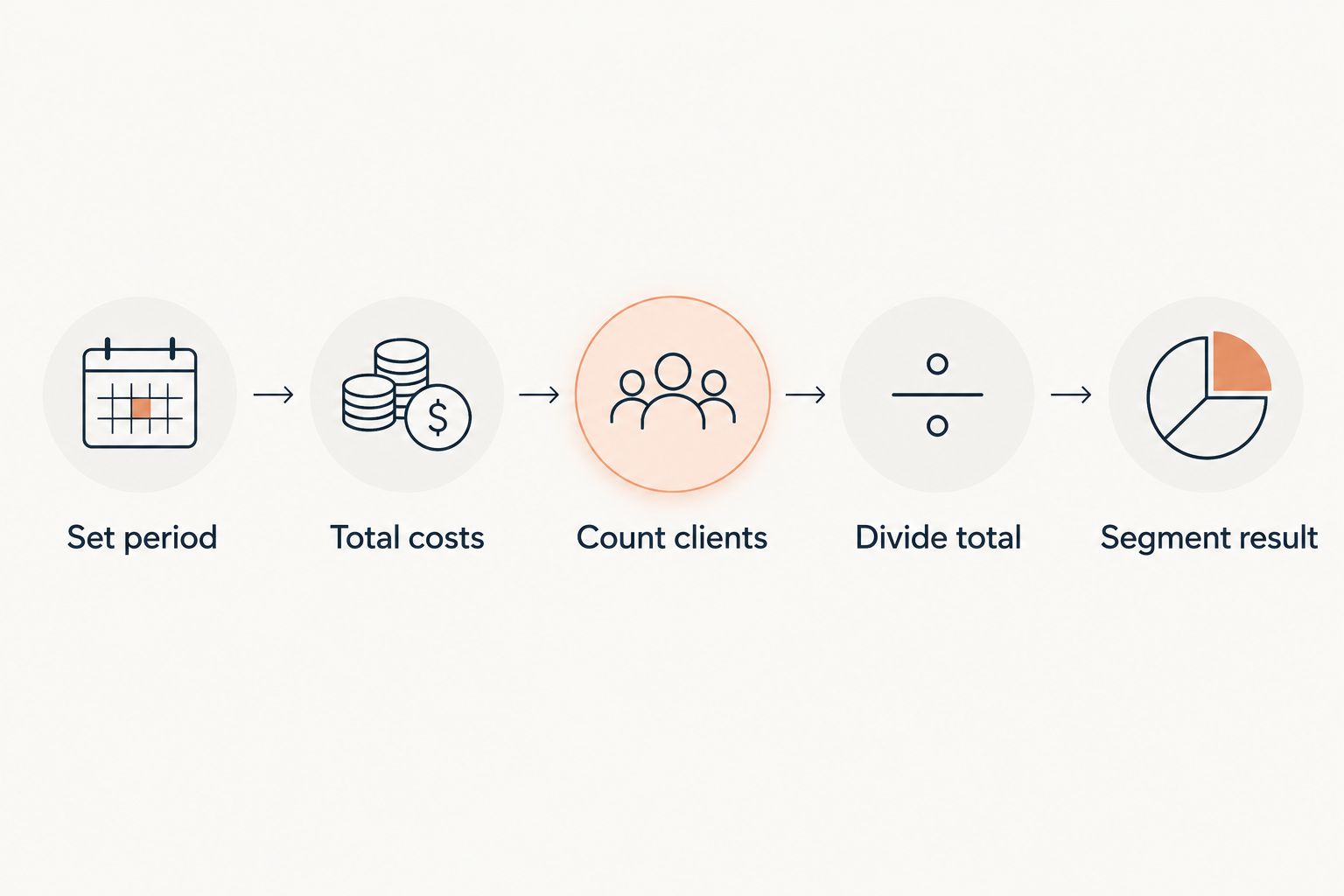
A useful CAC calculation keeps costs, client events, and attribution inside the same reporting rule.
The client event matters. A signed agreement that never produces revenue is not equivalent to an acquired paying client. Choose either the first revenue-producing placement, assignment or invoice according to your operating model, document the rule, and keep it fixed throughout 2026.
Why this matters
CAC shows whether your staffing business-development motion creates clients at a sustainable cost. It also exposes channels that generate activity without generating accounts.
Replies and booked calls are leading indicators. They are not acquired clients. If a campaign books meetings but produces no revenue-generating account, its client CAC cannot be calculated as if those meetings were wins.
The useful staffing agency CAC is the cost of acquiring a revenue-producing client, not the cost of generating sales activity.
Spend-only CAC: direct acquisition costs
Spend-only CAC includes the expenses you can assign directly to client acquisition in 2026. Typical categories are:
- Paid search, social advertising and sponsorships
- Prospecting and outreach software
- Contact-data subscriptions
- Freelance appointment setting or campaign support
- Events used for new-business development
- Content or landing-page production created for acquisition
Do not include payroll in this version. That makes spend-only CAC useful for comparing direct expenses, but it does not show the full economic cost of winning an account.
Use the same accounting treatment every period. Moving a tool between sales overhead and acquisition spend can change CAC even when business performance stays identical.
Fully loaded CAC: direct costs plus labor
Fully loaded CAC adds the cost of the time spent prospecting, qualifying, following up and closing new clients. Include time from BDRs, full-desk recruiters, solo billers, agency owners and any other person working on new-business acquisition.
Calculate the labor component with this mechanism:
Allocated acquisition labor = hourly employment cost × hours spent acquiring new clients
Then add allocated labor to spend-only acquisition costs before dividing by acquired clients. Use your own payroll, commission and working-hour records. Do not rely on a generic staffing benchmark because state, role, compensation model and operating structure change the result.
Separate client acquisition from candidate sourcing and delivery. A full-desk recruiter may perform both in the same day, but only time spent winning new accounts belongs in CAC. Time spent filling an existing client's roles belongs in delivery economics.
Fully loaded CAC is the better 2026 measure for deciding whether manual research is consuming too much recruiter or BDR capacity.
Channel CAC: cost by acquisition source
Channel CAC applies the formula to one source at a time:
Channel CAC = costs assigned to the channel ÷ clients acquired through the channel
Track cold email, LinkedIn, paid media, referrals, events and inbound content separately. Use a documented attribution rule when a prospect touches more than one channel. First-touch and last-touch attribution answer different questions, so do not switch between them when comparing periods.
Channel CAC can also reveal a measurement problem. If costs are recorded but acquired clients have no source, the agency cannot tell which channel produced the account. Fix source tracking before using the result to reallocate budget.
Why staffing agency CAC varies
Staffing agencies can use the same formula and get very different results because their acquisition motions differ. Six factors drive that variation:
- Operating model. A solo biller allocates owner time, while an agency with a dedicated BDR records separate sales labor.
- Client definition. Counting a signed agreement instead of a revenue-producing account lowers the reported figure without improving revenue.
- Sales cycle. Costs incurred in one period may produce a client in a later period, creating a timing mismatch.
- Channel mix. Referral, outbound, event and paid campaigns carry different combinations of cash spend and labor.
- Targeting quality. Time spent contacting people who do not own the hiring decision increases acquisition labor without adding clients.
- Niche and territory. The available account list, buyer role and outreach process change by vertical and market.
For a longer sales cycle, add a cohort view. Group prospects by the period when acquisition work began, then assign resulting clients back to that cohort. This prevents one 2026 reporting period from carrying the cost while another receives all the wins.
How do you lower CAC for a staffing agency?
Lower CAC by removing wasted prospecting work or improving the share of qualified opportunities that become revenue-producing clients. Cutting tools without measuring labor can make fully loaded CAC worse if recruiters must replace automated research with manual work.
Start with four checks:
- Remove channels that produce activity but no acquired clients.
- Narrow the ICP by vertical, company profile, hiring pattern and decision-maker role.
- Route recruiter and BDR time toward accounts showing a current business-development signal.
- Review follow-up coverage before increasing list volume.
As a staffing business-development tool, StaffingLeads watches hiring, funding, past-client and network signals, identifies decision-makers with verified email addresses, and runs email and LinkedIn sequences. That can reduce the manual research inside fully loaded CAC, but it does not guarantee that an account will convert.
StaffingLeads is best for staffing agency owners, solo billers and business-development teams that want to time outreach around hiring, funding, past-client and network signals.
The limitation is equally clear. StaffingLeads is not an ATS or CRM, and it has no integrations with Bullhorn, Salesforce or HubSpot. Agencies that need candidate workflow management, pipeline administration or those integrations need a different system for that work.
| StaffingLeads fit | Practical effect |
|---|---|
| Staffing-specific account signals | Helps prioritize when a company enters outreach |
| Decision-maker identification | Reduces manual contact research |
| Email and LinkedIn sequences | Keeps outreach execution in one staffing business-development workflow |
| Not an ATS or CRM | Does not manage candidate delivery or replace account records |
Audit your acquisition workflow
See how staffing-specific signals and decision-maker research fit into client prospecting.
What costs belong in staffing agency CAC?
Staffing agency CAC includes direct acquisition spend and, for a fully loaded calculation, allocated sales labor. Candidate sourcing, recruiter delivery work, payroll funding and service costs for existing clients do not belong in client-acquisition cost.
Keep shared expenses documented. If a tool supports both client acquisition and delivery, assign only the portion used for acquisition under a consistent allocation rule.
What is a good CAC for a staffing agency?
A good CAC leaves sufficient client gross profit after acquisition and service-delivery costs under your agency's operating model. Calculate that relationship from your own placement revenue, contract gross profit, client retention and acquisition costs rather than using a universal benchmark.
Compare like with like. Permanent placement, contract staffing and retained search can produce different client economics even inside the same agency.
How often should a staffing agency calculate CAC?
Calculate an operating CAC every month in 2026, then review rolling 3-month and 12-month trends. The rolling views stop a single client win or delayed close from controlling the decision.
Use the same reporting cadence for spend-only, fully loaded and channel CAC. A mismatch between periods makes the comparison unreliable.
FAQ
How do you calculate customer acquisition cost for a staffing agency?
Divide total client-acquisition costs by the number of new revenue-producing client accounts acquired from those costs. Calculate spend-only, fully loaded and channel CAC separately when the records support each view.
What should a staffing agency include in fully loaded CAC?
Include direct acquisition spend plus allocated recruiter, BDR, owner and sales-management time spent winning new accounts. Exclude candidate sourcing and delivery work for existing clients.
Should signed staffing agreements count as acquired clients?
Count the client event that your agency has defined and documented, but a revenue-producing event gives a clearer economic measure than a signature alone. Apply the same definition throughout 2026.
Is cost per lead the same as CAC?
No. Cost per lead divides spend by leads generated, while CAC divides acquisition costs by new clients acquired. Leads, replies and booked calls do not become CAC wins until they meet your documented client event.
How do you calculate CAC for a solo recruiter?
Add direct prospecting expenses to the value of the solo recruiter's time spent winning clients, then divide by acquired client accounts. Keep candidate-delivery hours outside the calculation.
Can StaffingLeads reduce staffing agency CAC?
StaffingLeads can reduce manual research within fully loaded CAC by identifying companies showing hiring, funding, past-client or network signals and finding decision-maker contacts. Conversion still depends on targeting, outreach, follow-up and the agency's offer.
How do you compare CAC across outreach channels?
Calculate channel CAC with costs and clients attributed under one consistent rule. Compare cold email, LinkedIn, paid media, referrals and events without mixing first-touch and last-touch attribution.
Why did staffing agency CAC increase?
CAC increases when acquisition costs rise, fewer new clients convert, labor allocation expands or costs and wins fall into different periods. Check each input before cutting a channel.
One last thing
Do not improve reported CAC by loosening the client definition. Counting signed agreements, job orders or booked calls as acquired clients makes the number look better without proving that acquisition produced revenue.
For 2026, write the client event, cost categories, labor-allocation rule and attribution model beside the calculation. That short record makes every later comparison usable.
Related guides
Let your agent start the conversations.
StaffingLeads watches hiring, funding, past-client and network signals, finds the decision-maker behind each one, and sends personalised email and LinkedIn outreach in your voice. You pick up the replies.
Start your 14-day free trial →Keep reading
Free, no signup