Full Desk Recruitment in 2026: The Workflow That Works

Full desk recruitment means one recruiter owns both sides of the desk. Here's the 2026 workflow for sourcing clients and candidates without dropping either.
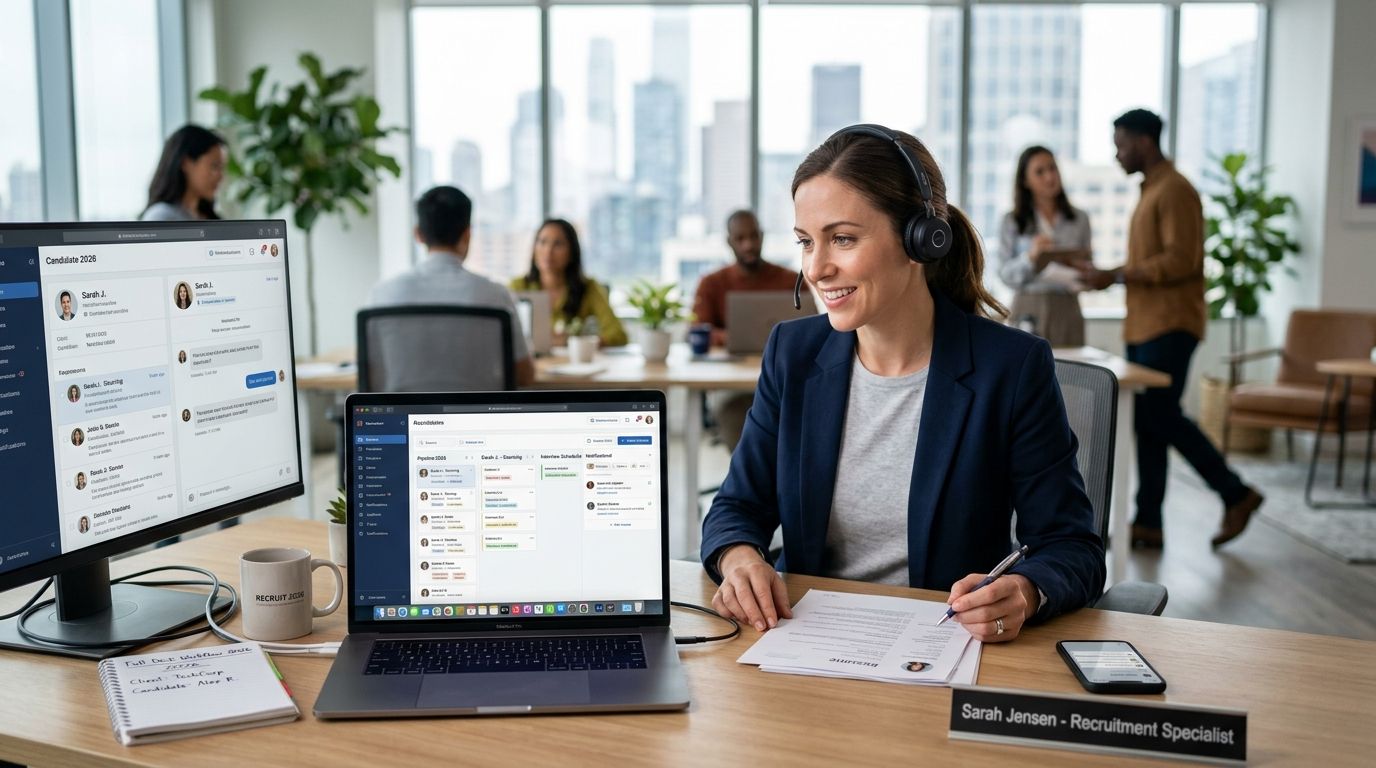
Full desk recruitment means one recruiter owns the entire placement, from finding the client to closing the candidate. No handoff, no split commission, no waiting on a BD team to bring in the req. In 2026, most agencies still run this model wrong, and the workflow below shows where it breaks and how to fix it.
TL;DR
- Full desk recruitment means one recruiter handles both business development and candidate placement end to end.
- The workflow breaks at business development first, not candidate sourcing — most full desk recruiters run out of prospecting hours before they run out of candidates.
- Hiring, funding, and past-client signals tell you which companies to call before a competitor does.
- StaffingLeads finds the hiring-manager contact and runs the outreach sequence; it is not an ATS or CRM replacement.
- Split desks trade recruiter bandwidth for specialization — full desk trades specialization for control over the whole placement.
Why This Matters
A full desk recruiter controls both ends of the fee: the client relationship and the candidate relationship. That control means faster decisions and no internal handoff friction, but it also means the recruiter is the single point of failure for both halves of the desk.
Agencies that run StaffingLeads alongside a full desk model usually do it for one reason: the business-development side of the desk is the part that stalls first. A recruiter can source candidates from LinkedIn, referrals, and their own database all day. Finding the next client — and the right person to call at that client — takes a different kind of hour, and most full desk recruiters don't have enough of them.
What Full Desk Recruitment Actually Means
Full desk recruitment is the opposite of a split desk. On a split desk, one person (the biller or account manager) owns client business development, and a second person (the delivery recruiter) owns candidate sourcing and submittals. On a full desk, one recruiter does both jobs for every requisition they carry.
The model shows up most in three places in 2026:
- Solo billers and small agencies where there isn't headcount to split roles.
- Niche and boutique desks where deep candidate knowledge and deep client knowledge live in the same person.
- Contingency and retained search shops where the recruiter's relationship with the client is the differentiator, not a shared account team.
The tradeoff is bandwidth. A full desk recruiter who spends the week sourcing candidates and never touches new business development is one lost account away from an empty pipeline.
The Full Desk Workflow, Step by Step
1. Build the target list from hiring and funding signals
Job boards show you who posted a req last week. They don't show you who just closed a funding round and is about to triple headcount, or who's hiring in a department that historically signals three more reqs are coming. Full desk recruiters who work from job boards alone are working the same list as every other agency calling that company.
2. Find the decision-maker, not the HR inbox
A generic HR inbox email gets ignored or forwarded into a queue. The hiring manager — the person who owns the open req and feels the pain of the unfilled seat — is who a full desk recruiter needs on the phone or in an inbox. Identifying that specific contact, with a verified email, is the step most agencies skip because it's slow to do manually.
3. Run outreach in parallel with req work, not after it
Business development can't wait until candidate pipelines are full. A full desk recruiter should have an email and LinkedIn sequence running to prospective clients every week, regardless of how busy current reqs are. Tools built for staffing lead generation experts exist specifically because this step gets dropped first when reqs pile up.
4. Source and qualify candidates while the client conversation is still warm
Once a client conversation opens, the recruiter needs to move into sourcing immediately. A req that sits for two weeks while the recruiter is still doing outreach elsewhere loses momentum, and the client starts calling other agencies.
5. Submit, negotiate, close
This is the part every recruiter already knows. The full desk difference is that the same person who built the client relationship is also negotiating the offer, which usually means fewer surprises at the finish line because there's no handoff loss between BD and delivery.
6. Mine past clients and your network for the next req
The fastest req to fill is one from a client you already placed with. Full desk recruiters who track past-client and network signals — a former client changing companies, a past hiring manager getting promoted somewhere new — turn one placement into the next one without starting a cold search over.
Where the Full Desk Workflow Breaks
Three failure points show up over and over in 2026 agency workflows:
- Business development stalls under req load. The recruiter has three open reqs and zero hours left for new prospecting.
- Outreach hits generic contacts. Emails to a company's main HR line get a fraction of the response a direct hiring-manager email gets.
- Candidates go cold during the sales cycle. A recruiter juggling both sides loses candidates to competing offers while still negotiating the client relationship.
Each of these is a bandwidth problem, not a skill problem. The recruiter knows how to do the work — there just isn't enough of the week left to do all of it well.
Tools That Support a Full Desk Recruiter, Not Replace One
StaffingLeads is built for the business-development half of a full desk workflow specifically. It watches hiring signals, funding events, past-client movement, and network activity, then identifies the hiring-manager contact with a verified email and runs the email and LinkedIn sequence to open the conversation.
It is not an ATS or a CRM. It doesn't manage your candidate pipeline, and it doesn't replace recruiting software for staffing firms that you already run for delivery. A full desk recruiter still needs somewhere to track candidates and submittals — StaffingLeads sits upstream of that, on the client-finding side of the desk.
The honest limitation: a tool that surfaces signals and finds contacts still requires a recruiter to make the call, run the negotiation, and close the placement. Nothing automates the parts of full desk recruitment that actually require a recruiter.
See the signals behind your next client
Check hiring, funding, and past-client signals for your target accounts.
FAQ
What is full desk recruitment?
Full desk recruitment is a staffing model where one recruiter handles both business development (finding and closing clients) and candidate sourcing and placement for every requisition they carry, with no handoff to a separate BD or delivery team.
Full desk vs split desk recruiting — which is better?
Neither is universally better. Full desk gives a single recruiter full control and accountability but limits how many reqs they can carry; split desk lets recruiters specialize in either BD or delivery but adds a handoff step between the two roles.
How many open reqs can one full desk recruiter carry?
It depends on req complexity, vertical, and how much of the week goes to business development versus sourcing. Agencies should track their own recruiter's time split by role and vertical rather than apply a single benchmark.
What's the biggest bottleneck in a full desk workflow?
Business development, not candidate sourcing. Most full desk recruiters run out of prospecting hours before they run out of candidates, because open reqs pull their attention away from finding the next client.
Do full desk recruiters need a CRM or ATS?
Yes, for tracking candidates, submittals, and client records. A CRM or ATS handles delivery and pipeline tracking; it does not replace the work of finding new clients and identifying the right hiring-manager contact.
How do full desk recruiters find companies that are hiring?
Job boards show reqs that are already posted and already being worked by competing agencies. Hiring signals, funding events, and past-client movement surface companies earlier, often before a req goes public.
Is full desk recruiting still viable in 2026?
Yes, particularly for solo billers, boutique desks, and niche agencies where the same person's client knowledge and candidate knowledge are the differentiator. It requires disciplined time allocation between BD and delivery to stay viable at scale.
Is it cheaper to hire a BDR or use lead generation software on a full desk model?
The right comparison depends on your agency's headcount, vertical, and current pipeline volume. Run the cost and time comparison specific to your desk rather than relying on a general answer.
One Last Thing
The full desk recruiters who last past their first few years in 2026 aren't the ones who work the hardest — they're the ones who protect a fixed block of business-development time every week, no matter how many reqs are open. Treat outreach like a standing meeting you can't cancel, not a task you get to when the desk is quiet. The desk is never quiet.
Related Guides
Let your agent start the conversations.
StaffingLeads watches hiring, funding, past-client and network signals, finds the decision-maker behind each one, and sends personalised email and LinkedIn outreach in your voice. You pick up the replies.
Start your 14-day free trial →Keep reading
Free, no signup