Cognism alternative for staffing agencies

Need a Cognism alternative for staffing agencies? Choose signal-led targeting and outreach, or keep Cognism for contact research. Compare workflows before switching.

Cognism is a B2B contact-data and prospecting platform suited to finding people at target companies. Contact research alone does not answer the staffing question: which employer has a reason to speak with you now? In 2026, StaffingLeads is the better Cognism alternative for staffing agencies that need hiring signals and email/LinkedIn outreach; stay with Cognism when contact research is your main requirement.
TL;DR
- StaffingLeads is a Cognism alternative for staffing agencies that need signal-led lead generation and staffing business development.
- Cognism fits teams whose primary requirement is B2B contact research rather than a staffing-specific outreach workflow.
- Compare account relevance, decision-maker accuracy, and outreach ownership before changing tools.
- Keep your ATS or CRM: a business-development tool does not replace either system.
Why this matters
A staffing prospect is not just a company with an email address. You need an employer that fits your niche, a person who can influence an agency engagement, and a credible reason to contact that person.
Those are separate problems. A contact-data platform addresses research; a staffing business-development workflow connects employer signals with decision-makers and outreach. Your choice depends on which part currently stops you from booking relevant conversations.
For your 2026 buying decision, name that bottleneck before comparing feature lists. If recruiters already find relevant employers but struggle to identify contacts, evaluate contact data. If they have contacts but lack a reason to approach them, evaluate targeting and timing.
Cognism versus a staffing-focused alternative at a glance
| Tool | Best for | Standout capability | Difference from Cognism | Main limitation for this decision |
|---|---|---|---|---|
| Cognism | B2B contact research across target companies | Company and contact prospecting | The contact-research option you are benchmarking | You still need to establish the staffing opportunity and decide how to approach it |
| StaffingLeads | Staffing agencies seeking signal-led business development | Hiring, funding, past-client, and network signals connected to decision-maker identification and email/LinkedIn sequences | Focuses on staffing-specific targeting and the reason to reach out | Not an ATS or CRM; no integrations with Bullhorn, Salesforce, or HubSpot |
Best for contact research: Cognism. Best for staffing-specific targeting and outreach: the staffing-focused alternative. Neither choice removes your responsibility to qualify an employer's need for agency support.
Do not treat a funding announcement or an open vacancy as a buying commitment. Each is a reason to investigate. Your qualification conversation establishes whether the employer needs external recruiting help, has an unresolved hiring problem, and fits your delivery capability.
StaffingLeads: best for signal-led staffing business development
StaffingLeads watches hiring, funding, past-client, and network signals, identifies decision-makers with verified email addresses, and runs email and LinkedIn sequences. Its role is staffing business development, not candidate management or recruitment operations.
That distinction matters for a solo biller or full-desk recruiter. The question is not simply whether you can obtain another contact; it is whether you can connect a relevant employer event with the right person and an appropriate message.
Where the staffing-focused approach shines
- Staffing-specific targeting: Hiring activity gives you a starting point for assessing employer demand against your ICP.
- More than new logos: Past-client and network signals bring relationship context into prospecting.
- Decision-maker identification: Verified email supports reaching the selected contact rather than stopping at company research.
- Connected outreach: Email and LinkedIn sequences support the next step after identifying a prospect.
These capabilities fit a workflow where recruiters need both account selection and follow-through. A signal supplies the context; your message explains why your niche, candidate access, or delivery approach is relevant. The signal itself is not the pitch.
Where the staffing-focused approach falls short
- It is not an ATS: Keep candidate tracking, submissions, and recruitment delivery in a system designed for those jobs.
- It is not a CRM: Do not expect it to replace your client relationship record or opportunity-management process.
- No integrations with Bullhorn, Salesforce, or HubSpot: Define how your team will record activity and update those systems separately.
- It does not establish buying intent: A verified email and a hiring signal do not confirm that an employer wants agency support.
The lack of those integrations is a concrete operating constraint. Before choosing the tool, assign responsibility for recording qualified conversations, updating existing-client records, and checking whether someone else already owns the account.
Head-to-head: what changes in your workflow
| Dimension | Staffing-focused alternative | Cognism |
|---|---|---|
| Core selection question | Which employer signal creates a reason to approach this account? | Which companies and contacts match the research criteria? |
| Staffing context | Hiring, funding, past-client, and network signals | Your team must establish the staffing relevance of the researched contact |
| Outreach role | Runs email and LinkedIn sequences | Evaluate how contact research fits your existing outreach process |
| System boundary | Business development only; no Bullhorn, Salesforce, or HubSpot integrations | Assess the current product against your team's contact-research requirements |
Best for: Staffing owners and recruiters whose bottleneck is choosing relevant accounts and acting on a timely reason to contact them.
Verdict: Choose the staffing-focused workflow when targeting and outreach are the jobs you need to solve. Keep recruitment delivery and client-record ownership separate.
Cognism: best for teams that need contact research
Cognism remains a sensible choice when your business-development team already knows which employers to target and needs a dedicated B2B prospecting platform. It serves a different starting question: finding relevant companies and people, rather than building a staffing-specific reason for contact.
That is a strength when account strategy already exists. An agency with an established niche, a researched account list, and a working outreach process does not need to replace that process merely to adopt a staffing-focused tool.
Where Cognism shines
- Contact-research focus: Evaluate it when finding people at target companies is the central job.
- General B2B prospecting: It fits research requirements that are not limited to staffing business development.
- A distinct role in your process: Your team can assess its value as a research platform without expecting it to run recruitment operations.
Where Cognism falls short for this use case
- Contact relevance is not opportunity qualification: Your recruiter must still determine whether an employer needs agency support.
- A contact does not supply the message: You need a defensible reason to approach the person.
- General research is not a staffing strategy: Your ICP, vertical expertise, and account-selection rules still need an owner.
These are boundaries of the contact-research task, not evidence that Cognism is a bad product. If your team already handles those responsibilities well, they are not reasons to switch.
Best for: Agencies with a working account-selection and outreach process that primarily need contact research.
Verdict: Stay with Cognism when it solves your actual research bottleneck. Do not replace a useful tool to obtain capabilities your team will not use.
Why staffing agencies consider switching from Cognism
The case for switching is a change in the job you need done. Evaluate an alternative when you need a workflow that connects staffing-relevant signals, decision-maker identification, and outreach rather than treating each as a separate task.
Three specific requirements justify that evaluation:
- You need a reason to contact the account: Your team wants hiring or funding context before writing the approach.
- You need relationship context: Past clients and network signals belong in account selection, not just new-company research.
- You need outreach execution: Identifying a contact is not enough if email and LinkedIn follow-up still lack an owner.
There is no need to assume a pricing change, service failure, or data-quality problem to make this decision. Compare the workflow you require with the workflow you already have.
For a 2026 business case, measure the cost of acquiring a qualified client, not just the volume of contacts collected. Use the staffing agency CAC calculation guide to structure your own calculation, and separate software expense from recruiter effort.
Run a workflow check before replacing Cognism
Use 10 target accounts over a 30-day review period as a defined evaluation scope, not a promised performance benchmark. Include employers from your actual niche and accounts your team can realistically serve.
Evaluate 2 outreach channels: email and LinkedIn. Keep the account-selection rules consistent so you are assessing the workflow rather than comparing unrelated audiences.
- Account fit: Confirm that each employer matches your geography, vertical, and service model.
- Hiring context: Record the reason for approaching the employer. Distinguish an observed signal from a confirmed agency requirement.
- Decision-maker: Check whether the selected person influences the hiring need or supplier decision. A title alone is not enough.
- Outreach: Review whether the message connects your staffing offer to the account's situation.
- Outcome: Record qualified conversations and agreed next steps, not just contacts found or messages sent.
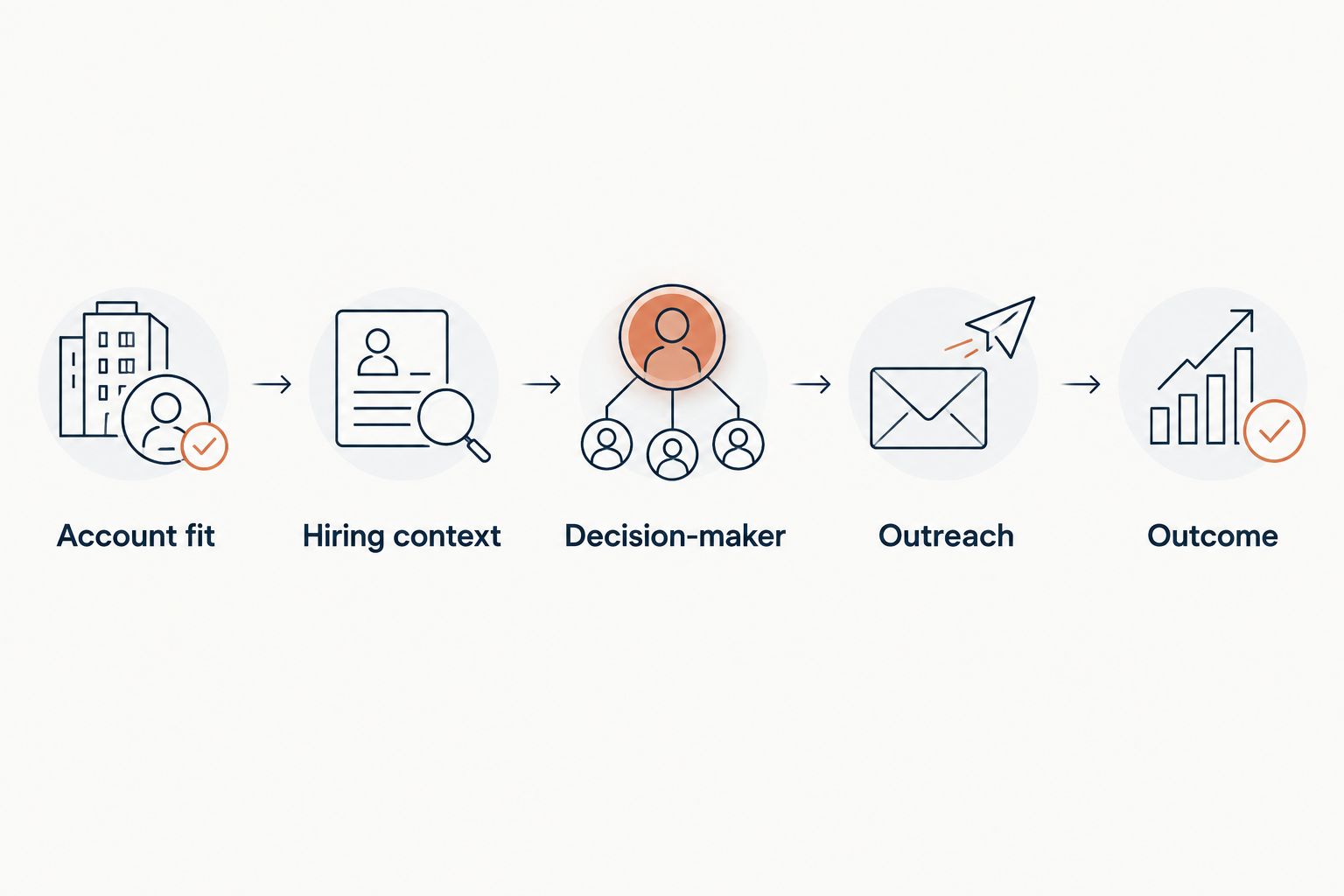
Evaluate the path to a qualified conversation, not just the contact record.
For your 2026 review, give each account a clear owner. Record why a prospect was rejected as well as why it advanced; irrelevant accounts reveal targeting problems that a contact count hides.
Also check the handoff. If you use Bullhorn, Salesforce, or HubSpot, decide how activity and qualified opportunities will be recorded without assuming an integration. A useful prospecting workflow still needs a reliable client record.
When staying with Cognism is the right call
Stay with Cognism if your team already selects relevant employers, researches hiring context, owns follow-up, and mainly needs contact discovery. Replacing the research platform will not fix a vague ICP or an outreach message with no staffing-specific reason to reply.
Stay, too, when you cannot assign ownership to the new workflow. Someone must review targeting, approve messaging, qualify responses, and maintain the client record. Automation does not remove those responsibilities.
Change tools only when the alternative solves a defined workflow gap. That is a stronger decision rule than choosing whichever product has the longer feature list.
FAQ
What's a good Cognism alternative for staffing agencies in 2026?
StaffingLeads fits staffing agencies that need hiring, funding, past-client, and network signals connected to decision-maker identification and email/LinkedIn outreach. Choose based on that workflow requirement, not an assumption that every contact-data platform needs replacing.
Is a staffing-focused tool better than Cognism?
A staffing-focused tool is the better fit when staffing-specific targeting and outreach are your main requirements. Cognism remains a sensible choice when your team mainly needs B2B contact research.
Can this alternative replace our ATS or CRM?
No. The staffing-focused alternative described here is a business-development tool, not an ATS or CRM, so keep recruitment delivery and client-record management in their designated systems.
Does it integrate with Bullhorn, Salesforce, or HubSpot?
No. It has no integrations with Bullhorn, Salesforce, or HubSpot, so define a separate process for recording activity and qualified opportunities.
Does a hiring signal mean an employer wants agency help?
No. A hiring signal provides context for investigation; your recruiter must confirm the employer's need, decision process, and willingness to use external recruiting support.
What should we check before switching from Cognism?
Check account fit, hiring context, decision-maker relevance, outreach ownership, and qualified outcomes. Also confirm how your team will maintain its client records without assuming an integration.
When should a staffing agency keep Cognism?
Keep Cognism when contact research is the main requirement and your account-selection and outreach processes already work. Switching tools is not a substitute for fixing targeting or assigning follow-up ownership.
One last thing
Before your 2026 purchase decision, ask each recruiter to finish this sentence for a target account: This employer should speak with us because...
If the answer is only that the company has vacancies, the account still needs qualification. A specific hiring problem, relevant relationship, or clear delivery fit gives you something useful to discuss; an email address merely gives you somewhere to send it.
Related guides
Let your agent start the conversations.
StaffingLeads watches hiring, funding, past-client and network signals, finds the decision-maker behind each one, and sends personalised email and LinkedIn outreach in your voice. You pick up the replies.
Start your 14-day free trial →Keep reading
Free, no signup