I-9 and E-Verify for staffing agencies

I-9 and E-Verify for staffing agencies serve different roles. Set clear ownership, choose an examination process, and handle mismatches without making assumptions.

Staffing agencies’ I-9 and E-Verify compliance is the process of documenting employment eligibility and, where applicable, checking government records so employees can start assignments under the correct verification process. Form I-9 and E-Verify serve different purposes; your agency must also distinguish employees on its payroll from candidates hired directly by clients.
TL;DR
- I-9 and E-Verify for staffing agencies require separate workflows: employment eligibility documentation and, where applicable, electronic verification.
- Assign responsibility by employment relationship, not by who sourced the candidate or controls the worksite.
- Use current USCIS and E-Verify instructions; confirm state requirements and client obligations with counsel.
- Staffingleads supports staffing business development, not I-9 completion, E-Verify cases, or compliance recordkeeping.
Why employment verification matters for staffing agencies
A recruiter finds the worker. A client supervises the assignment. Your agency runs payroll. That division creates room for a dangerous assumption: someone else completed the employment verification.
Determine who employs the worker before deciding who owns the verification process. A direct-hire placement and an agency-employed temporary assignment do not create the same responsibilities. Review those distinctions alongside co-employment risk for staffing agencies.
For your 2026 operating procedure, use current guidance from U.S. Citizenship and Immigration Services, which administers Form I-9, and E-Verify’s employer guidance. State participation requirements, federal contracting obligations, and client terms need separate review. Requirements vary by state and change; confirm the current rules for your operating model with your own counsel.
This guide provides an operating framework, not legal advice. Do not treat a checklist, client request, or software setting as a substitute for the applicable rule.
Build a verification process that survives assignment changes
Identify the employer before onboarding
Start with a written responsibility map. A spreadsheet is sufficient: record the worker, employing entity, assignment, work location, and person responsible for verification. Do not infer the employer from the company logo on a job posting.
For a direct-hire placement, the hiring client generally handles its employee onboarding. For an agency-employed assignment, your agency generally owns its employer obligations. Employer-of-record arrangements and other structures require a closer review of the actual relationship.
Set an internal control of 1 named process owner per hire, with a backup. This is an operating recommendation, not a statutory staffing requirement. Ownership must remain clear when a full-desk recruiter hands a placement to payroll or operations.
- Record the employing legal entity, not just the trading name.
- Distinguish direct hire from agency employment.
- Record the worker’s actual work location.
- Assign an owner and backup for verification.
- Ask counsel to resolve ambiguous employment arrangements.
Separate Form I-9 from E-Verify
Write 2 separate workflows: one for Form I-9 and one for E-Verify when participation applies. These are process controls, not interchangeable compliance options. E-Verify does not replace Form I-9.
Form I-9 documents identity and employment authorization through the required completion and examination process. E-Verify uses information from the completed form to check relevant government records. Participation obligations depend on the applicable federal, state, and contractual circumstances.
For a 2026 review, check the current USCIS form instructions and E-Verify employer materials rather than reusing an old onboarding checklist. Confirm the applicable completion and case-creation deadlines with counsel and build reminders around those verified rules.
- Map Form I-9 completion separately from case creation.
- Confirm which employing entities participate in E-Verify.
- Check requirements by state and operating model.
- Review federal contractor obligations where relevant.
- Keep the source and review date beside each procedural rule.
Assign document examination to a trained owner
Begin with a written examination procedure and the current USCIS acceptable-document guidance. Train the responsible employee or authorized representative before handing over a worker’s documents. Delegating the task does not automatically remove the employer’s responsibility for errors.
Employees choose which acceptable documents to present under the applicable rules. Do not demand a particular document because of a worker’s citizenship, national origin, accent, or perceived immigration status. The Department of Justice’s Immigrant and Employee Rights Section addresses immigration-related employment discrimination.
Keep business development separate from this process. Staffingleads is best for staffing business-development teams that want signal-based prospecting and outreach, not employment-verification administration. Staffingleads identifies decision-makers with verified email addresses and runs email and LinkedIn sequences; it does not complete Form I-9 or manage E-Verify cases.
- Give document examiners current USCIS instructions.
- Let employees choose among acceptable document options.
- Establish an escalation route for uncertain documents.
- Restrict access to identity and authorization records.
- Keep prospecting systems outside the verification workflow.
Define the remote-hire examination route
A video call alone is not a universal substitute for the required document examination. USCIS describes physical examination procedures and a DHS-authorized alternative procedure for qualifying employers. Confirm eligibility and procedural conditions before choosing the remote route.
For your 2026 remote-hire checklist, decide the examination method before the start date. If you use an authorized representative, provide instructions, an escalation contact, and a quality review. Do not leave a remote worker to invent the process.
Use the same decision structure across branches. A client’s preferred onboarding portal does not establish that your agency qualifies for a particular examination method.
- Confirm whether physical examination or an authorized alternative applies.
- Verify current eligibility conditions for the chosen procedure.
- Name the examiner or authorized representative.
- Document required examination and recordkeeping steps.
- Review completed records for omissions before closing onboarding.
The process should move in a clear sequence: Employer responsibility, Form I-9, Document examination, E-Verify applicability, and Record review. E-Verify applicability is a decision point, not permission to skip the preceding documentation.
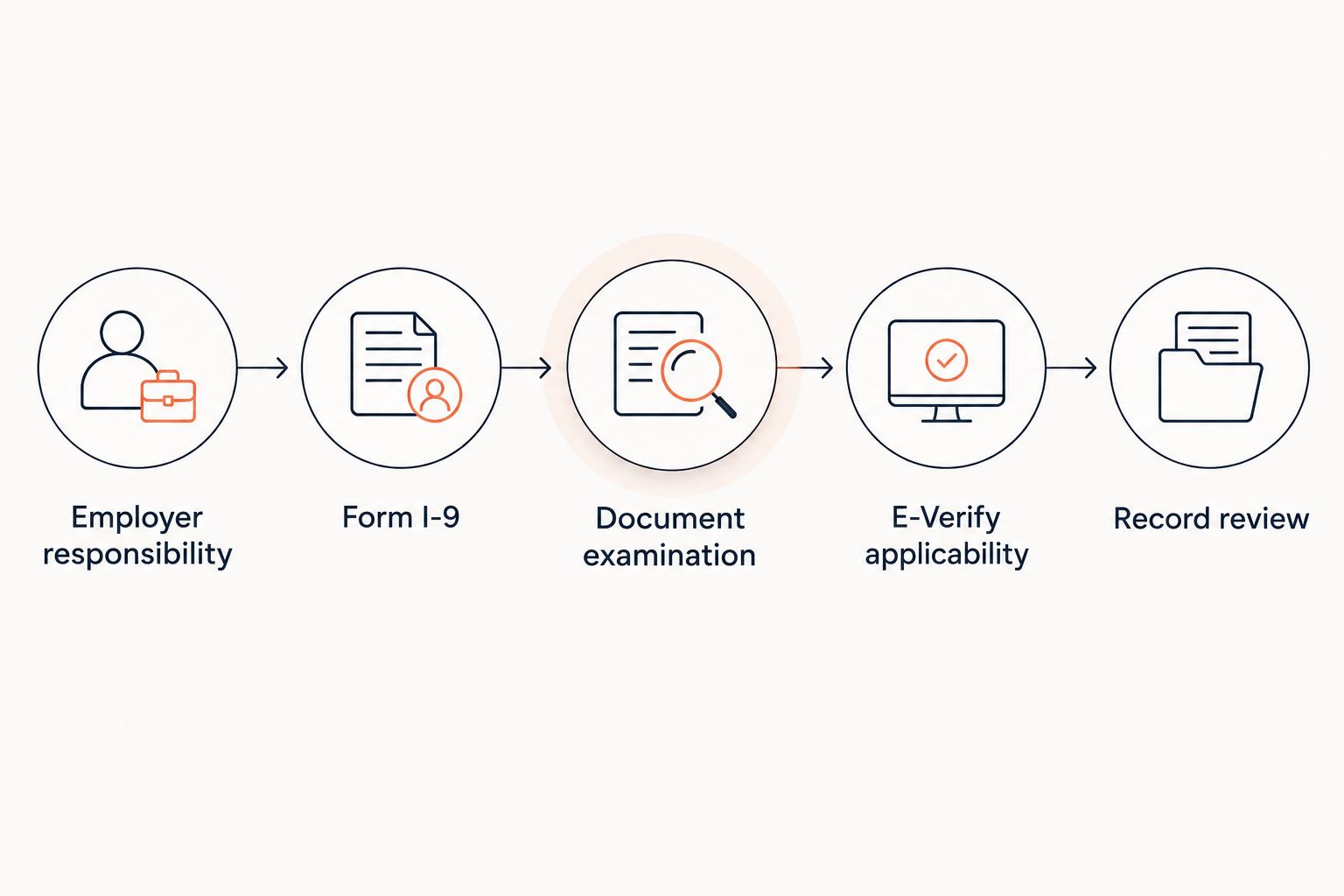
Determine employer responsibility before choosing the verification procedure.
Handle mismatches without making assumptions
An E-Verify mismatch does not establish that a worker lacks employment authorization. Follow the current E-Verify notice, employee-choice, referral, and case-resolution instructions. Do not turn an initial system result into your own eligibility verdict.
Build a private communication process for the affected employee. Train recruiters and client-facing staff not to suspend, terminate, delay training, or take other prohibited adverse action because of an unresolved mismatch while the employee is following the applicable resolution process.
Separate genuine questions from assumptions about the worker. Escalate uncertain cases to the trained process owner and counsel, not to a sales manager under pressure to protect an assignment.
- Deliver required notices through the prescribed process.
- Explain available next steps without coaching the employee’s decision.
- Follow current referral and resolution instructions.
- Restrict case information to authorized personnel.
- Document the final case outcome and required follow-up.
Review records before reassignment and retention decisions
An assignment change is not automatically a new employment event. Before creating another Form I-9 or E-Verify case, review the employment relationship and current USCIS and E-Verify rules on continuing employment, rehires, and reverification.
For your 2026 internal review, use 3 checks per file: completeness, applicable follow-up, and retention status. This is a suggested review structure, not a legal audit standard. Record who checked the file and how corrections were made.
Retention obligations depend on the relevant employment dates and current rules. Have counsel confirm your schedule, then apply it consistently. Preserve original entries and a correction trail; never backdate a form to make a late action look timely.
- Check required fields and signatures for completeness.
- Review whether reverification or rehire procedures apply.
- Keep corrections attributable and dated.
- Calculate retention from the applicable employment records.
- Suspend destruction when a preservation obligation applies.
Compare your administration options
Choose an administration method based on who will maintain the process, not on whether the interface looks simple. Neither paper nor software transfers the employer’s underlying responsibilities. E-Verify is a separate verification layer where applicable, not an alternative storage format.
| Option | Best for | Strength | Key limitation |
|---|---|---|---|
| Controlled paper process | Agencies able to maintain secure physical files and manual tracking | Makes the review trail directly inspectable | Requires manual reminders, access controls, and retention management |
| Electronic I-9 system | Agencies needing structured workflows across locations | Can support reminders, controlled access, and review records | Must satisfy applicable electronic-record requirements; features require verification |
| Authorized representative | Agencies arranging examination away from their own office | Provides a route for delegated examination duties | Requires clear instructions and quality control; delegation does not erase employer responsibility |
| E-Verify | Participating employers and employers required to participate | Checks submitted employment information against relevant government records | Does not replace Form I-9 or authorize discriminatory screening |
Ask an electronic-system provider to demonstrate correction history, access restrictions, record retrieval, and export. Confirm the actual functions rather than assuming an ATS includes compliant I-9 administration.
Staffingleads belongs outside this comparison: its staffing business-development function supports prospecting and outreach, not employee verification. Keep that boundary explicit when buying software or assigning internal ownership.
Common mistakes staffing agencies make
- Treating every placement as agency employment. Direct-hire placements and agency-payroll assignments need different responsibility maps. Establish the relationship before opening an onboarding task.
- Following a client request without checking its scope. A contract clause does not settle every legal question about participation, document access, or worker treatment. Have counsel review what your agency can promise.
- Creating duplicate records for every assignment. Review continuing employment, rehire, and reverification rules first. A new worksite does not by itself answer those questions.
- Demanding a preferred identity document. Standardize examiner training around acceptable-document rules, not recruiter preference. Escalate uncertainty without imposing extra requirements on particular workers.
- Confusing sales automation with compliance administration. StaffingLeads is not an ATS or CRM and does not manage employment verification. Keep worker documents out of business-development sequences.
FAQ
Do staffing agencies need both Form I-9 and E-Verify?
Form I-9 and E-Verify are separate requirements, and E-Verify participation depends on the agency’s circumstances. Confirm current federal, state, and contractual obligations with counsel; E-Verify does not replace Form I-9.
Who completes the I-9 when a staffing agency places a worker?
Responsibility follows the employment relationship, not simply who sourced the candidate. Distinguish agency-employed workers from direct hires and confirm the allocation for employer-of-record or other arrangements with counsel.
Can a staffing agency use a video call to examine I-9 documents?
A video call alone is not a universal substitute for document examination. USCIS describes a DHS-authorized alternative procedure for qualifying employers; confirm current eligibility and procedural requirements before using it.
Does every new client assignment require another I-9?
A new assignment does not automatically require another Form I-9. Review the current rules for continuing employment, rehires, and reverification against the worker’s actual employment history.
Does an E-Verify mismatch mean the worker cannot work?
An initial E-Verify mismatch does not establish that a worker lacks employment authorization. Follow the current notice and resolution process and do not take prohibited adverse action while the employee follows that process.
Can recruiters ask workers to bring a specific identity document?
Employees choose from the acceptable document options under the applicable Form I-9 rules. Train recruiters not to request particular documents based on citizenship, national origin, or perceived immigration status.
What should a staffing agency check before changing its verification process in 2026?
Check current USCIS instructions, E-Verify employer guidance, and applicable state requirements before changing the process. Ask counsel to confirm deadlines, examination procedures, retention rules, and contractual obligations for your operating model.
One last thing
Test the handoff, not just the form. Ask a recruiter, an onboarding coordinator, and payroll who owns an unresolved verification issue when a worker changes assignments. If their answers differ, fix ownership before adding another system.
Related guides
Let your agent start the conversations.
StaffingLeads watches hiring, funding, past-client and network signals, finds the decision-maker behind each one, and sends personalised email and LinkedIn outreach in your voice. You pick up the replies.
Start your 14-day free trial →Keep reading
Free, no signup