Co-employment risk for staffing agencies

Manage co-employment risk for staffing agencies with clear client duties, worker reporting, payroll checks, and counsel-led reviews. Contracts alone aren't enough.

Staffing agencies’ co-employment risk is exposure to employment obligations shared with a client, with the aim of managing it being to protect workers and prevent disputes over responsibility. For temporary and contract placements, your agency can handle payroll while the client directs daily work; the applicable legal test—not the contract label—determines each party’s obligations.
TL;DR
- Co-employment risk for staffing agencies depends on actual working arrangements and the applicable law, not contract labels alone.
- Separate worker classification from joint-employer analysis; resolving one does not resolve the other.
- StaffingLeads supports staffing business development, not employment compliance, payroll, or assignment supervision.
- Document client responsibilities, worker reporting routes, time approvals, and changes to each assignment.
Why co-employment risk matters for staffing agencies
You cannot manage an assignment safely if responsibility stops at the agency-client boundary. A worker can receive instructions from a client supervisor, submit hours through an agency process, and raise a complaint with either organization. Each handoff needs an owner.
Co-employment is a business description, not a single legal test. Joint-employer questions arise under laws including the Fair Labor Standards Act, federal employment discrimination statutes, and workplace safety requirements. Different laws examine different facts. A conclusion under one law does not settle every other obligation.
For your 2026 operating review, distinguish temporary staffing from direct-hire recruiting. An agency that employs workers assigned to client sites has different responsibilities from a recruiter introducing candidates for employment directly by the client. Have counsel assess your actual model, states, and assignments.
Staffingleads serves the business-development side of that operation. Staffingleads is best for staffing teams seeking signal-based prospect targeting and outreach, not co-employment compliance. Booking a call and approving an assignment are separate decisions.
How to manage co-employment risk in 2026
Start with a shared responsibility record for each client relationship. It should describe what happens in practice, who receives exceptions, and which changes require review before work continues. Use your existing documents and records first; software does not replace the legal assessment.
The process below connects sales qualification to assignment oversight. It is an operating framework, not a substitute for advice from your own counsel. Requirements vary by state and change; confirm the current rules governing each placement.
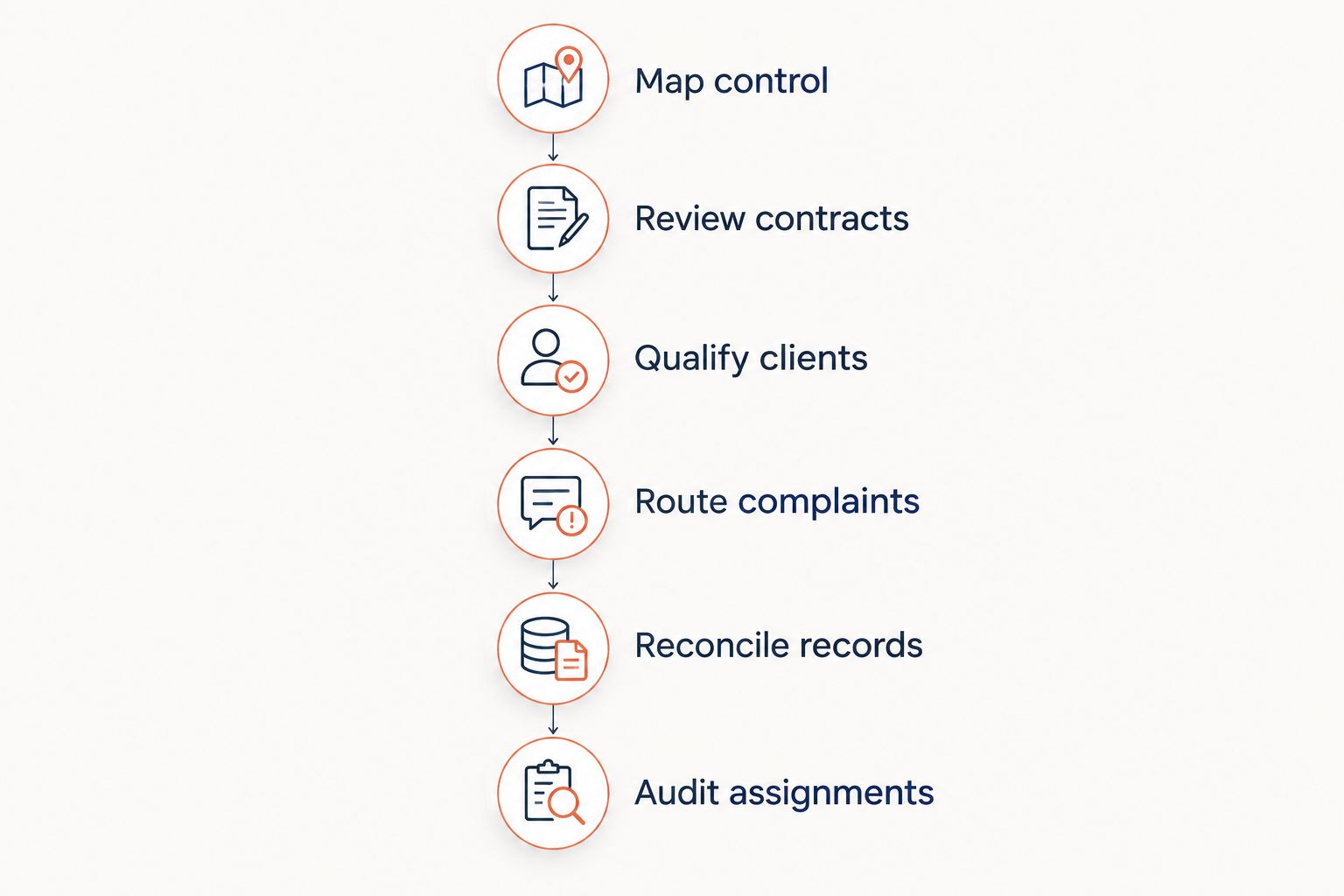
Client qualification and assignment oversight belong in the same operating process.
Map control
Write down who makes employment decisions and who directs the worker onsite. Start with an interview involving your account manager and the client supervisor. Compare their answers with the assignment documents; disagreement is a problem to resolve, not a detail to leave for later.
Under the Fair Labor Standards Act, the U.S. Department of Labor addresses wage-and-hour obligations, including joint-employment questions. Do not assume that running payroll makes your agency solely responsible for every issue. Ask counsel which test applies to your arrangement and jurisdiction.
Your responsibility record should cover more than hiring. Changes to schedules, tasks, supervision, and removal requests can matter to the assessment.
- Record who hires, assigns, supervises, and requests removal.
- Identify who sets schedules and approves worked hours.
- Describe who supplies training, equipment, and workplace instructions.
- Record who receives complaints and authorizes corrective action.
Review contracts
Read the client agreement beside the actual workflow. A clause assigning time approval to the client does little operational work if nobody receives disputed timesheets. Turn each responsibility into a named contact and a documented process.
A contract allocates responsibilities between businesses; it does not erase duties imposed by law. Have counsel review indemnity, insurance, reporting, record access, and cooperation provisions against the work being performed. Do not treat an indemnity clause as proof that the agency has no exposure.
Use the 2026 contract review to identify gaps between sales promises and delivery. If the client expects your agency to handle a task, confirm that your team can actually perform it before accepting the assignment.
- Match contract duties to the assignment’s real operating model.
- Name contacts for time disputes, safety concerns, and worker complaints.
- Document how both parties exchange relevant records.
- Require review when duties, work locations, or supervision change.
Qualify clients
Before accepting a job order, ask how the client will supervise assigned workers. A hiring signal identifies a prospecting opportunity; it does not establish that a workplace is suitable for a placement. Your sales handoff needs to preserve that distinction.
Begin manually with a client qualification form and a conversation with the person responsible for the work. Ask about actual duties, location, training, supervision, and complaint handling. Resolve unanswered questions before treating the order as ready for recruiting.
Staffingleads staffing business development uses hiring, funding, past-client, and network signals to identify decision-makers with verified email addresses and run email and LinkedIn sequences. That is the faster path for prospect targeting and outreach—not client safety approval. Staffingleads is not an ATS or CRM and has no integrations with Bullhorn, Salesforce, or HubSpot.
- Describe the work rather than relying on a job title.
- Identify the onsite supervisor and an escalation contact.
- Ask who provides task-specific orientation and safety training.
- Separate prospecting approval from assignment approval.
Route complaints
Give workers a clear route to report concerns to your agency, including concerns about client personnel. A reporting process fails if it sends a worker only to the supervisor involved in the complaint. Explain how the agency receives, records, and escalates the report.
Federal employment discrimination issues can involve the Equal Employment Opportunity Commission and statutes such as Title VII of the Civil Rights Act. Coverage and responsibility require legal assessment; state laws can add separate obligations. Confirm the current requirements with your own counsel.
For workplace safety, OSHA’s Temporary Worker Initiative addresses staffing agency and host-employer responsibilities. Training arrangements should reflect the assignment’s hazards. Do not assume that a general orientation covers every task a client assigns.
- Provide a reporting contact outside the client’s supervisory chain.
- Record the concern, assignment, people involved, and action taken.
- Establish who coordinates investigations and protective measures.
- Escalate safety concerns and retaliation concerns for appropriate review.
Reconcile records
Check that time records reflect work performed, not merely hours the client approved for billing. A billing disagreement and a wage obligation are different questions. Route disputes through a defined payroll review rather than leaving the worker between the agency and client.
For your 2026 review, ask counsel and your payroll adviser to assess the applicable federal and state wage rules. Include the states where workers perform their duties, not only the state where your agency is based. State requirements change and need current confirmation.
Worker classification is a separate issue. The W2 vs 1099 vs corp-to-corp staffing workers guide addresses that distinction; selecting a classification does not, by itself, settle a joint-employer question.
- Compare submitted hours, payroll records, and disputed time entries.
- Record assignment duties and changes relevant to payroll review.
- Define who investigates missing or inconsistent records.
- Preserve correction records and the reason for each adjustment.
Audit assignments
Review the assignment after work begins, not only when the agreement is signed. The job described during sales can differ from the job performed onsite. Ask the worker and client supervisor about duties, training, schedules, and reporting routes, then compare their accounts.
Use a manual assignment log before adding another system. A shared record is useful only if someone owns the follow-up. Assign a responsible person for each unresolved issue and retain the outcome.
Your 2026 review should also address workers’ compensation through the relevant state agency and your advisers. Confirm how coverage, job classification, and claims handling apply to the actual assignment. Do not infer those answers from a client’s industry label alone.
- Compare current duties with the original job order.
- Check whether locations, supervisors, or work activities changed.
- Confirm that workers know how to report concerns.
- Document corrective actions and unresolved questions.
Compare ways to manage the work
Choose support according to the gap you need to close. Legal interpretation, operational recordkeeping, and prospecting are different jobs. Buying a tool for one does not complete the others.
| Option | Best for | Strength | Key limitation |
|---|---|---|---|
| Manual responsibility records | Owners establishing a repeatable assignment process | Captures duties, contacts, exceptions, and follow-up in a format your team controls | Requires disciplined updates and does not determine legal obligations |
| Employment counsel | Agencies assessing state-specific duties and disputed working arrangements | Evaluates the facts under the applicable laws and reviews contractual allocation | Advice still needs an operating process and accurate assignment facts |
| Payroll and assignment records | Teams reconciling hours, payments, and placement details | Provides the records needed to investigate operational discrepancies | Recordkeeping alone does not resolve supervision, safety, or discrimination questions |
| Staffingleads staffing business development | Recruiters finding decision-makers through hiring and relationship signals | Supports staffing-specific prospect targeting and email/LinkedIn outreach | Does not manage employment compliance, payroll, or client-site supervision |
Keep a functioning manual process if your problem is unclear ownership rather than prospect volume. Counsel needs reliable facts, and your delivery team needs clear instructions. More outreach cannot repair an unresolved responsibility gap.
Common mistakes staffing agencies make
Treating the client agreement as legal immunity
An agreement can allocate duties and establish cooperation between the parties. It cannot guarantee that a regulator or court will accept your preferred employer label. Review the facts alongside the contract.
Confusing classification with co-employment
Whether a worker is properly treated as an employee or independent contractor is not the same question as whether multiple entities have employer obligations. Keep both analyses visible. Do not close one checklist because the other has been completed.
Letting sales approve operational exceptions
A full-desk recruiter can own the relationship without being the final authority on safety, payroll, or legal questions. Establish where sales approval ends and specialist review begins. Preserve unresolved issues in the handoff.
Treating removal as the end of a complaint
Ending an assignment does not answer what happened or whether further action is required. Retain the report, the reason for the decision, and the review outcome. Have counsel assess complaints involving discrimination, retaliation, or other protected activity.
FAQ
What is co-employment risk for staffing agencies?
Co-employment risk for staffing agencies is exposure to employment obligations involving both the agency and its client. The applicable legal test and actual working arrangement determine responsibility; a contract label alone does not settle it.
Is co-employment the same as joint employment?
Co-employment is a broad business term; joint employment is a legal determination under a particular law. Different statutes use different tests, so your counsel should assess each relevant obligation separately.
Can a staffing contract eliminate co-employment risk?
A staffing contract cannot eliminate statutory employment obligations. It can allocate responsibilities between the businesses, establish cooperation, and address contractual remedies, but the actual arrangement still requires legal review.
Who is responsible for temporary worker safety?
Staffing agencies and host employers have safety responsibilities that need to be assessed against the assignment. OSHA's Temporary Worker Initiative addresses this relationship; confirm training, hazard reporting, and current federal or state-plan requirements with qualified advisers.
Does using 1099 workers avoid joint-employer issues?
A 1099 designation does not resolve worker classification or joint-employer questions. Have counsel assess the actual relationship under the applicable federal and state laws rather than relying on the tax form or contract wording.
What should a solo biller document before a placement?
A solo biller should document actual duties, work location, supervision, time approval, training arrangements, and reporting contacts. Record unresolved questions and route them for review before approving the assignment.
Does StaffingLeads manage co-employment compliance?
StaffingLeads does not manage co-employment compliance. It supports staffing business development through hiring, funding, past-client, and network signals, decision-maker identification, and email and LinkedIn outreach; it is not an ATS or CRM.
One last thing
Ask the client what happens when the assignment changes. That question tests whether the responsibility process works beyond the original job order. A worker moved to another task or location needs more than an unchanged contract in a folder.
Make that question part of your 2026 client review. Record who authorizes changes, who checks the new duties, and who informs the worker. An assignment record should describe the work being performed, not just the work originally sold.
Related guides
Let your agent start the conversations.
StaffingLeads watches hiring, funding, past-client and network signals, finds the decision-maker behind each one, and sends personalised email and LinkedIn outreach in your voice. You pick up the replies.
Start your 14-day free trial →Keep reading
Free, no signup