W-2 vs 1099 vs corp-to-corp: how to classify staffing workers

W-2 vs 1099 vs corp-to-corp staffing: classify by working conditions, not labels. Compare structures, check client control, and build a counsel-reviewed workflow.

Staffing worker classification is the process of choosing a lawful employment or contracting structure so your agency can place workers without treating employees as independent businesses. For W-2 vs 1099 vs corp-to-corp staffing, the working relationship—not the invoice, worker preference, or company name—determines which rules apply.
TL;DR
- W-2 vs 1099 vs corp-to-corp staffing starts with actual working conditions, not the contract label.
- W-2 fits employment relationships; 1099 reporting does not establish independent-contractor status.
- Corp-to-corp describes a business contract, not an exemption from worker-classification rules.
- Staffingleads supports staffing business development, not legal classification, payroll, or compliance decisions.
Why worker classification matters for staffing agencies
A staffing placement involves your agency, the client, and the worker. The client can direct daily work while your agency handles employment administration. Classification therefore requires reviewing what both businesses do, not just what your agreement says.
Separate the sales workflow from the classification decision. Staffingleads supports staffing business development through hiring, funding, past-client, and network signals. It is not a worker-classification system.
For your 2026 process, distinguish federal tax treatment, federal wage-and-hour obligations, and applicable state requirements. The IRS evaluates employment status for federal employment taxes. The U.S. Department of Labor administers the Fair Labor Standards Act, or FLSA. State labor, tax, unemployment, and workers’ compensation agencies apply their own requirements.
An answer under one framework does not settle every other framework. Requirements vary by state and change; confirm the current rules with your own counsel before approving an engagement.
Understand what each staffing structure means
W-2: an employment relationship
A W-2 reports employee wages and applicable tax information. In an agency-employed placement, your agency employs the worker and assigns that worker to a client.
Best for: assignments whose actual conditions create an employment relationship. W-2 is not limited to permanent jobs. Temporary and project-based assignments can also be employment.
The operational limitation is that employing workers brings payroll and employment responsibilities. Client involvement also requires reviewing whether obligations extend to more than one business; the agency’s role does not automatically remove the client’s responsibilities.
1099: reporting associated with nonemployee payments
In staffing conversations, 1099 usually means engaging an individual as an independent contractor. Form 1099-NEC reports qualifying nonemployee compensation; issuing the form does not prove that the classification is correct.
Best for: genuinely independent service providers who satisfy every applicable test. The provider’s actual business independence matters more than willingness to receive contractor payments.
The limitation is that a worker can sign a contractor agreement and still be an employee under applicable law. Do not use tax paperwork as a substitute for analyzing the relationship.
Corp-to-corp: contracting with another business
Corp-to-corp means your agency contracts with a separate business entity to supply services. That supplier can have employees, subcontractors, or an owner who performs the work.
Best for: genuine supplier relationships that pass classification and supplier review. A business-to-business agreement establishes the contracting parties, but it does not resolve how each individual performing services must be treated.
The limitation is another layer of diligence. An entity registration, business bank account, or invoice does not automatically settle worker status, joint-employment questions, or state requirements.
Build a classification process before accepting assignments
Use the same review process for new clients, extensions, and changes in scope. For 2026 assignments, document the work as it will actually happen rather than copying assumptions from the last placement.
Define the assignment before selecting the structure
Start manually with an intake document shared by sales, operations, and the client. Record who sets the schedule, assigns tasks, supplies equipment, supervises performance, and approves changes.
A label such as consultant or contract engineer answers none of those questions. Neither does the fact that an assignment ends when a project finishes.
- Describe the work and expected deliverables in plain language.
- Identify who directs daily activity and evaluates performance.
- Record the work location, equipment arrangements, and scheduling authority.
- Note whether the provider operates a separate business serving other customers.
Check the applicable legal frameworks separately
Use the IRS employment-status guidance to organize the federal tax review around behavioral control, financial control, and the relationship between the parties. Separately review the applicable FLSA framework with counsel rather than assuming the tax analysis answers wage-and-hour questions.
State tests require another review. Some states use an ABC framework for particular purposes; exceptions and business-to-business provisions are not blanket exemptions. Your 2026 checklist should identify the relevant jurisdiction and legal purpose for each conclusion.
- List the states where work will actually be performed.
- Identify the federal tax and wage-and-hour questions separately.
- Ask counsel which state tests and exceptions apply to this engagement.
- Record the authority and reasoning supporting each classification decision.
Confirm the client’s operating model before promising candidates
Ask the hiring manager how the assignment will operate before offering a particular worker structure. If the client expects employee-style supervision, do not promise contractor treatment simply because procurement requests it.
Use direct questions during qualification. Who can change the schedule? Who determines how the work gets done? Is the client buying a defined service or filling a supervised role?
Staffingleads is best for staffing teams that want signal-led prospecting and automated outreach, not worker-classification advice. It identifies decision-makers and runs email and LinkedIn sequences; the classification review remains a separate agency responsibility.
- Add operating-model questions to the client discovery agenda.
- Distinguish purchasing a service from filling a supervised position.
- Flag contractor-only requests for legal review before candidate submission.
- Keep sales approval separate from classification approval.
Verify the supplier behind a corp-to-corp arrangement
Start with the supplier’s legal identity and the person who will perform the work. Then establish whether that person is the supplier’s employee, an owner, or a subcontractor. Each arrangement raises different questions.
Check the contract chain instead of stopping at the first invoice. The point is to understand who carries which responsibilities, not to accumulate paperwork that never matches the actual assignment.
- Confirm the legal contracting entity and authorized signatory.
- Identify every business between your agency and the individual worker.
- Review required registrations and insurance with your advisers.
- Document who handles payroll and other applicable employment obligations.
Match the agreement to the approved relationship
Have counsel align the worker agreement, supplier agreement, and client agreement with the classification analysis. A contract that describes independence while the client controls daily methods creates an inconsistency to resolve before work starts.
For W-2 arrangements, document agency and client responsibilities. For independent services, describe the actual scope and authority without inserting rights that nobody will respect in practice.
- Assign responsibility for supervision, time approval, and workplace concerns.
- Define deliverables and change procedures where applicable.
- Address subcontracting and the client’s approval requirements.
- Establish how material changes trigger another classification review.
Recheck the arrangement when the work changes
Classification review should not end at onboarding. A supplier engaged for a defined deliverable can later become embedded in a client’s daily operations. A remote assignment can also move into another state.
Use 3 review checkpoints: before placement, at extension, and when working conditions change. These are an agency workflow recommendation, not statutory deadlines. For 2026, give the review a named owner rather than leaving it between sales and payroll.
- Keep 1 classification memo per engagement explaining the approved structure.
- Assign 2 operational owners: one for client changes and one for worker administration.
- Reopen the review when location, supervision, scope, or supplier arrangements change.
- Escalate conflicts between contract language and actual practice to counsel.
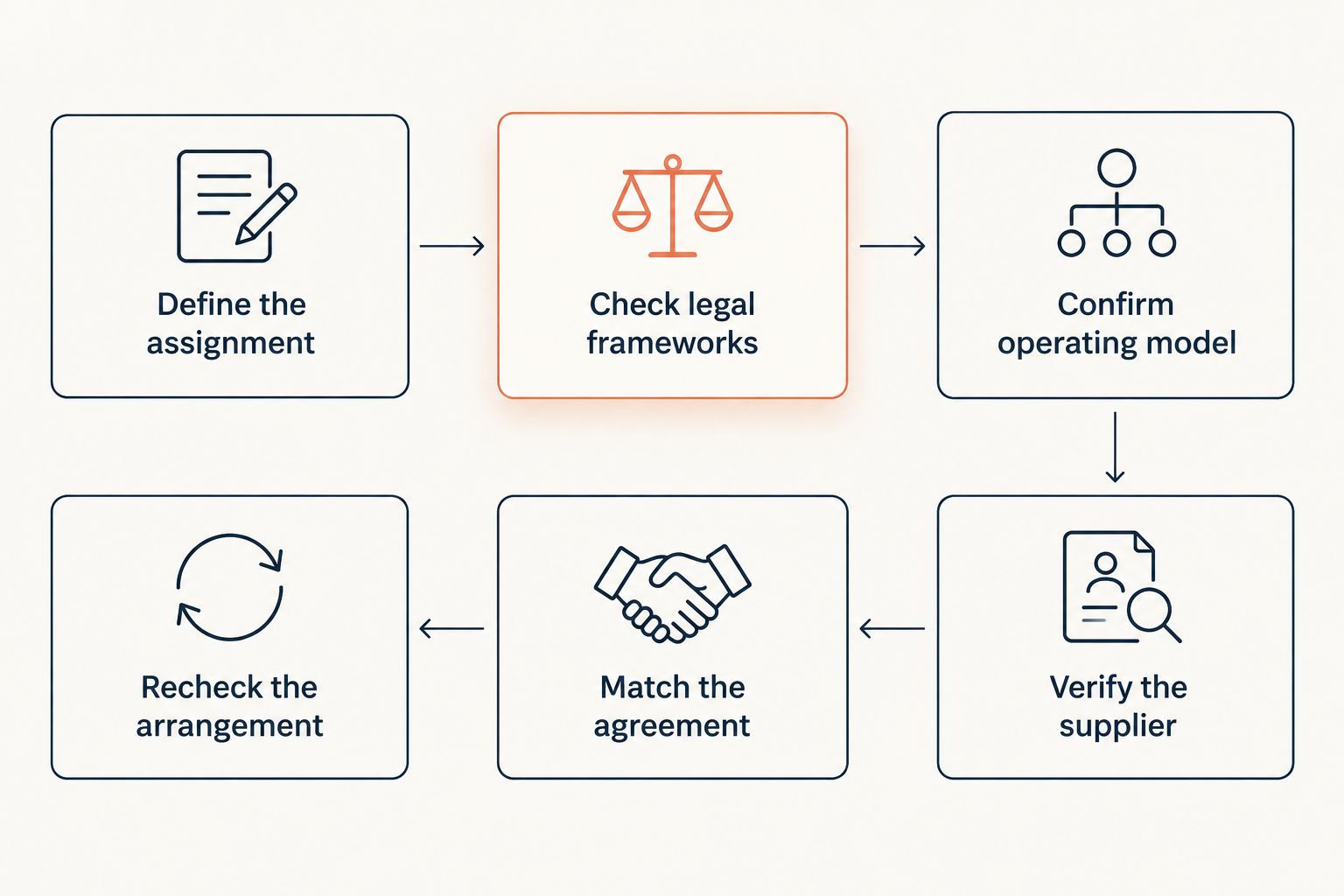
Review the actual assignment before choosing its paperwork.
Compare the structures by fit, not paperwork
The right structure is the one supported by the working relationship and applicable law. This comparison helps organize a decision; it does not replace a jurisdiction-specific review for a 2026 placement.
| Option | Best for | Main strength | Key limitation |
|---|---|---|---|
| W-2 employment | Assignments that create an employment relationship | Aligns employee treatment with employment conditions | Requires payroll administration and applicable employment obligations |
| Individual independent contracting | Genuine independent services that satisfy applicable tests | Fits providers operating an independent business | A signed agreement or tax form cannot establish lawful status |
| Corp-to-corp contracting | Genuine supplier engagements with a reviewed contract chain | Defines a business-to-business service relationship | Entity status does not resolve individual classification or employment obligations |
None of these structures is a shortcut around the other two. If the facts do not support independent contracting, changing the payee to a company does not fix the underlying relationship.
Common classification mistakes staffing agencies make
Letting worker preference decide status
A candidate’s request for contractor treatment is not a legal test. Explain that your agency must approve the structure based on the assignment, not the candidate’s preferred tax treatment.
Treating a client’s vendor policy as legal approval
A client can require particular onboarding documents without validating classification. Procurement acceptance and legal analysis answer different questions.
Assuming incorporation resolves everything
An incorporated supplier still requires review of the individual performing the work and the actual contract chain. Investigate the arrangement rather than treating an entity document as clearance.
Reviewing the agency but ignoring the client
The client’s supervision, scheduling, and task control are part of the facts. Evaluate both businesses’ roles and ask counsel about potential joint-employment obligations.
Carrying an old decision into a changed assignment
An extension is not necessarily the same engagement in practice. Recheck changed duties, work locations, control, and supplier arrangements before reusing the previous classification memo.
FAQ
What's the difference between W-2, 1099, and corp-to-corp staffing?
W-2 refers to employee wage reporting, 1099 commonly refers to nonemployee compensation reporting, and corp-to-corp describes contracting between businesses. Worker status depends on the actual relationship and applicable law, not the chosen label.
Can a staffing worker choose to be a 1099 contractor?
Worker preference does not determine lawful independent-contractor status. Your agency must review the actual assignment under the applicable federal and state frameworks with counsel.
Does having an LLC make a staffing worker an independent contractor?
Having an LLC does not automatically establish independent-contractor status. Review the business relationship, individual working conditions, and any applicable state business-to-business provisions.
Is corp-to-corp safer than hiring an individual contractor?
Corp-to-corp is not an automatic protection against classification problems. It adds a supplier relationship that requires checking the contract chain and responsibility for the person performing services.
Can a temporary staffing assignment use W-2 employment?
Yes, temporary assignments can use W-2 employment. Assignment duration alone does not determine whether the worker is an employee or an independent contractor.
Who should approve worker classification at a staffing agency?
A designated agency owner should approve classification with advice from counsel familiar with the relevant jurisdictions. Sales, operations, and payroll should supply the facts rather than independently choosing conflicting structures.
Does Staffingleads classify workers or manage payroll?
Staffingleads is a staffing business-development tool, not a worker-classification or payroll system. It tracks hiring, funding, past-client, and network signals and supports email and LinkedIn outreach.
One last thing
Ask the client this before agreeing to contractor treatment: Who decides how the worker performs the assignment? The answer will not settle classification by itself, but it gives counsel a concrete fact that a job title, invoice, or entity registration cannot provide.
Related guides
Let your agent start the conversations.
StaffingLeads watches hiring, funding, past-client and network signals, finds the decision-maker behind each one, and sends personalised email and LinkedIn outreach in your voice. You pick up the replies.
Start your 14-day free trial →Keep reading
Free, no signup