How to build a desk P&L for a staffing agency

Build a staffing desk P&L in 2026 with real contribution margin per recruiter, not agency-wide guesswork. The step-by-step method full-desk recruiters use.

Full-desk recruiters and solo billers build a staffing desk P&L to find out what one desk actually earns after commission, sourcing cost, and overhead — not what the agency's overall bank balance implies. A desk-level P&L matters more for full-desk operators than split-desk teams because the same person owns both the cost of finding candidates and the cost of closing clients, so those costs have to live on one line, not two.
TL;DR
- A staffing desk P&L isolates revenue, commission, sourcing cost, and overhead for one recruiter or desk, not the whole agency.
- Full-desk recruiters must count their own BD and sourcing time as a cost line — solo billers skip this most often.
- Contribution margin, not bill rate, is the number that tells you whether a desk is actually profitable in 2026.
- Spreadsheets handle desk P&L fine up to a few recruiters; QuickBooks class tracking scales it past that.
- Reconciling desk margin against cost of acquiring each client catches desks that look busy but aren't profitable.
Why staffing desk P&L matters for full-desk recruiters
A full-desk recruiter runs sourcing, BD, and closing on one line of business. That means the cost side of a desk's P&L looks different from a split-desk model, where sourcing and client-side BD sit with separate people and separate cost centers.
When one person owns both sides, it's easy to treat your own sourcing hours as free labor and only count hard costs — job board spend, a LinkedIn Recruiter seat, maybe a tool subscription. That understates true cost per placement and makes a desk look more profitable than it is. A desk P&L forces you to price your own time the same way you'd price a second recruiter's.
Solo billers have the opposite problem: they often never separate desk numbers from agency numbers at all, because there's only one desk. Building the P&L anyway gives you a baseline — so the day you hire recruiter number two, you already know what good looks like for one desk.
Build your desk P&L in seven steps
Line out your desk's billed revenue
Start with margin dollars, not the headline bill rate. Revenue on a desk P&L is what you keep, not what the client pays.
- Use gross margin dollars (bill rate minus pay rate, or placement fee minus any pass-through), never bill rate alone
- Separate contract revenue recognized this month from perm placement fees invoiced this month
- Flag fee timing: a perm placement signed in week one but invoiced in week three belongs in the invoice month
- Back out guarantee-period reversals and replacement placements as negative revenue, not as a cost
Separate direct desk costs from agency overhead
Every dollar tied to running this specific desk goes here — rent, insurance, and the owner's salary do not.
- Recruiter base pay or draw against commission
- Job board and sourcing tool spend allocated to this desk
- LinkedIn Recruiter or Sales Navigator seat cost, split across desks if shared
- Your own BD and sourcing hours, valued at what you'd pay someone else to do that work
- Candidate-side costs: background checks, assessments, onboarding paperwork tied to this desk's placements
Build the commission and payroll burden line
Commission structure drives most of the variance between a desk that looks profitable on paper and one that actually is. Start with your own recruiter commission structure and verify the payroll tax burden percentage with your payroll provider rather than assuming a flat rate.
- List commission as a percentage of margin dollars, not of bill rate
- Add employer-side payroll tax burden on top of base and commission, confirmed with your payroll provider for the current year
- If splits exist between sourcer and closer, allocate commission by the agreed split, not 50/50 by default
- Flag any draw against future commission as a liability, not a sunk cost, until it's earned out
Track cost per placement
Cost per lead tells you what outreach costs. Cost per placement tells you what revenue costs — and it's the number that actually predicts desk profitability.
- Total desk cost for the period divided by placements closed in that period
- Separate cost per contract placement from cost per perm placement — they rarely match
- Track days from first verified decision-maker contact to signed job order, by vertical
- Note which placements came from warm signals (past client, hiring trigger, referral) versus cold outreach, since cost per placement differs sharply between the two
Calculate contribution margin per desk
This is the number that answers the only question that matters: does this desk make money.
Contribution margin = revenue recognized minus commission and payroll burden minus direct sourcing cost minus allocated overhead. A desk with strong placement volume and thin margin dollars can still lose money once sourcing time and commission burden are counted honestly.
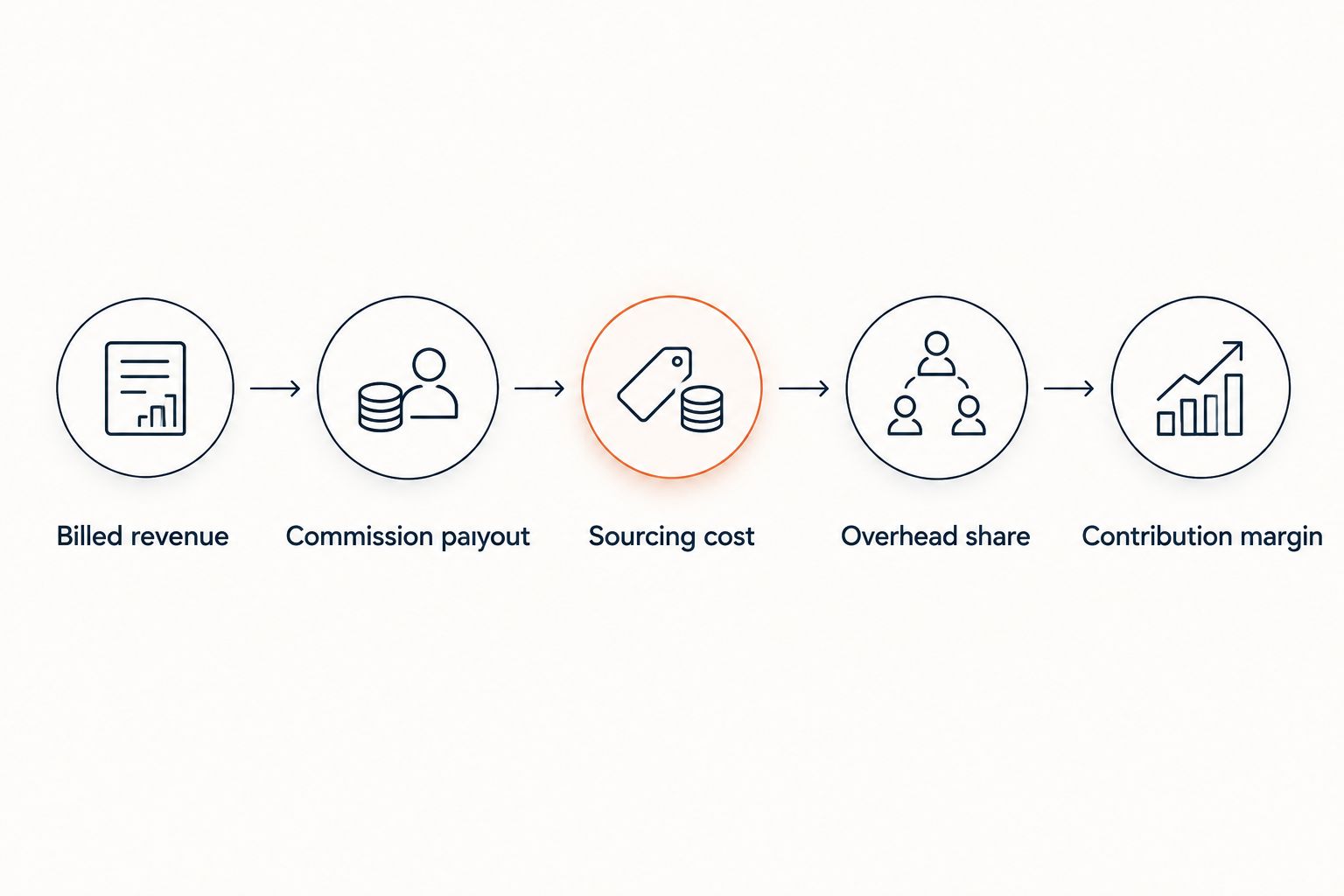
Contribution margin is what's left after every cost the desk actually caused.
Reconcile desk margin against cost of acquiring each client
A desk can show solid contribution margin and still be bleeding money if it costs too much to land each new client in the first place. Calculating CAC for a staffing agency at the desk level, not just the company level, tells you whether this desk's growth is actually affordable.
- Divide total BD and outreach cost for the period by new clients landed, not by placements
- Compare CAC against first-year margin dollars from that client, not lifetime projections
- Flag desks where CAC is rising while placement volume stays flat — that's a signal cost, not a volume problem
- Separate CAC for warm-signal outreach (hiring triggers, funding events, past clients) from cold outreach, since the two rarely cost the same
Review the desk P&L on a cadence that matches desk maturity
- New desks (first 90 days): review weekly — small sample sizes swing contribution margin fast
- Established desks: review monthly, reconciled against the prior month's commission payouts
- Flag any month where contribution margin drops two periods in a row before it becomes a quarter-long problem
- Re-run the full model any time commission structure, payroll burden, or tool spend changes
Cut the cost side of your desk P&L
See which hiring and funding signals are worth chasing before you spend BD hours on them.
Comparison: how to actually build and track it
| Option | Best for | Setup effort | Key limitation |
|---|---|---|---|
| Spreadsheet template (Sheets/Excel) | Solo billers and desks under 3 recruiters | Low, a few hours to build once | Manual updates; easy to let it go stale |
| ATS or CRM reporting module | Agencies already paying for ATS reporting | Medium, depends on how placements are tagged by desk | Often reports bill rate, not margin dollars, without configuration |
| QuickBooks class tracking | Agencies with 3+ desks and a bookkeeper | Medium-high, requires setting up classes per desk | Doesn't natively separate BD/sourcing time as a cost |
| Back-of-envelope / notebook | Nobody past month one | Lowest | No audit trail; no way to spot a two-month margin slide |
Verdict: a spreadsheet is the right starting point for any desk in 2026, build the formula once, and move to class tracking only once you're running more desks than you can eyeball in a sitting.
Common mistakes full-desk recruiters make
- Booking bill rate as revenue. Bill rate includes pay rate and burden that were never yours to keep, margin dollars are the only honest revenue line.
- Treating your own BD time as free. Solo billers are the most common offenders; unpriced sourcing hours hide a desk's true cost per placement.
- Lumping split-desk commission into one expense line. When sourcing and closing are split between two people, allocate commission by the agreed split, not evenly, or the P&L misattributes who's actually profitable.
- Ignoring worker classification cost differences. Contractor burden differs materially between W2, 1099, and corp-to-corp placements, and mixing them into one average cost-per-placement number hides which placement type is actually worth pursuing.
- Reviewing quarterly instead of monthly. A desk that's losing money for two straight months looks fine on a quarterly view until the hole is too deep to climb out of.
FAQ
What is a staffing desk P&L?
A staffing desk P&L is a profit-and-loss statement built around one desk, recruiter, or vertical rather than the whole agency. It shows revenue recognized, commission and payroll burden, direct sourcing cost, and the contribution margin that's left for that specific desk.
How do you calculate contribution margin for a recruiting desk?
Subtract commission and payroll burden, direct sourcing cost, and an allocated share of overhead from the margin dollars that desk recognized in the period. The result is contribution margin, the number that tells you whether the desk is actually profitable, not just busy.
What costs go into a staffing desk P&L?
Recruiter base pay or draw, commission payout, employer payroll tax burden, job board and sourcing tool spend, and the recruiter's own BD and sourcing time valued at a comparable rate. Agency-wide overhead like rent or the owner's salary is allocated separately, not booked directly to a single desk.
Is a staffing desk P&L different from a company-wide P&L?
Yes. A company-wide P&L nets everything together, which can hide a losing desk behind a profitable one. A desk-level P&L isolates each recruiter or vertical so you can see which desks are actually funding growth and which are being subsidized.
How often should recruiters review desk-level P&L?
Weekly for the first 90 days of a new desk, since small sample sizes swing contribution margin fast, then monthly once the desk is established. Re-run the full model any time commission structure or payroll burden changes.
Should BD and sourcing time count as a cost on a desk P&L?
Yes, even for solo billers. Valuing your own sourcing hours at what you'd pay someone else to do that work is the single biggest correction most recruiters need to make to get an honest contribution margin number.
Do split-desk and full-desk models calculate P&L differently?
The revenue and overhead lines are the same, but commission allocation differs. Split-desk models divide commission between sourcer and closer by an agreed split; full-desk recruiters carry the full commission line themselves since they own both sides.
How does CAC fit into a desk P&L?
Cost of acquiring each client sits alongside contribution margin, not inside it. A desk can show healthy contribution margin per placement and still be unaffordable to grow if CAC per new client is rising faster than first-year margin dollars from that client.
One last thing
The desk P&L mistake that costs the most isn't a wrong formula, it's reviewing it too late. A desk bleeding margin for two consecutive months in 2026 rarely self-corrects; by the time a quarterly review catches it, the commission structure, the tool spend, and the BD hours sunk into that desk are already gone. Build the spreadsheet once, check it monthly at minimum, and treat two down months in a row as the trigger to re-run every line, not just the revenue one.
Related guides
Let your agent start the conversations.
StaffingLeads watches hiring, funding, past-client and network signals, finds the decision-maker behind each one, and sends personalised email and LinkedIn outreach in your voice. You pick up the replies.
Start your 14-day free trial →Keep reading
Free, no signup