360 vs split desk: which recruiting model to run

360 vs split desk recruiting model: choose full-desk ownership or specialist teams. Compare handoffs, accountability, costs, and the right setup for your agency.

Choose a 360 recruiting desk if you want one recruiter to own client acquisition and candidate delivery; choose a split desk if you have enough work to give business development and recruiting distinct owners. The deciding factor in the 360 vs split desk recruiting model is whether shared ownership removes a bottleneck or creates a handoff you cannot manage.
TL;DR
- The 360 vs split desk recruiting model decision turns on ownership versus specialization, not agency size alone.
- Choose a 360 desk for full-desk recruitment with direct control of client relationships and candidate delivery.
- Choose a split desk when staffing business development and recruiting each need dedicated attention.
- Staffingleads supports client prospecting in either model; it does not replace an ATS or CRM.
Why this matters
Your desk model determines who finds the client, qualifies the vacancy, searches for candidates, and handles feedback. A weak setup lets urgent delivery work displace prospecting—or lets sales promise work the recruiting team cannot deliver.
For your 2026 operating plan, start with the work that stalls. Do not reorganize because another agency uses a different structure. If you need the ownership model explained first, the full-desk recruitment guide covers the end-to-end role.
A 360 desk suits recruiters who need direct ownership of both client development and candidate delivery. A split desk suits teams that need those functions protected from competing demands.
At a glance
Here, “split desk” means separating client-facing sales or account ownership from candidate delivery. It does not mean a split-fee agreement between independent recruiting firms.
| Dimension | 360 desk | Split desk |
|---|---|---|
| Best for | Solo billers and full-desk recruiters who want end-to-end ownership | Teams with distinct sales and delivery workloads |
| Client ownership | One recruiter owns the client relationship and delivery | Client owner coordinates with a delivery recruiter |
| Specialization | Recruiter works across sales and recruiting | Separate owners concentrate on each function |
| Handoffs | Fewer internal transfers between sales and delivery | Requires an explicit vacancy brief and feedback process |
| Prospecting continuity | Competes with the same recruiter's delivery workload | Has a dedicated owner when responsibilities are enforced |
| Accountability | Direct ownership, but sales and delivery still need separate measures | Separate role measures plus shared placement outcomes |
| Cost model | Combined-role compensation and capacity planning | Separate-role compensation and capacity planning |
| Standout feature | Relationship continuity | Functional focus |
Neither model fixes a weak ICP, poorly qualified job orders, or unclear client expectations. Those problems need their own correction.
A 360 desk wins on direct client ownership
A 360 recruiter handles both sides of the placement: winning the client and delivering candidates. The same person hears the hiring manager's requirements, tests them against the candidate market, and explains the tradeoffs.
That continuity matters when a vacancy changes during the search. You do not need an internal relay to explain why candidates reject the compensation, location, or interview process.
Best for: a solo biller or niche recruiter whose client relationships and candidate knowledge reinforce each other. The advantage is direct context, not a guarantee of better placements.
The limitation is dependence on that individual. If the recruiter is unavailable, another person needs enough recorded context to continue the search. Full-desk ownership is not permission to keep the account history in your head.
Stay with a 360 model when clients value a single accountable contact and the recruiter can sustain both acquisition and delivery. Splitting that relationship without solving a workload problem adds coordination rather than capacity.
A split desk wins on functional focus
A split desk separates business development from candidate sourcing and delivery. The client-facing owner concentrates on target accounts, decision-makers, vacancy qualification, and account development. The delivery owner concentrates on candidate identification, assessment, submission, and follow-through.
That separation lets you hire for different strengths. A capable candidate recruiter does not have to become your main salesperson, and a strong business developer does not have to run every candidate search.
Best for: an agency with recurring sales and delivery work that each justify dedicated ownership. Before changing your 2026 structure, identify the workload each role will own—not just the job title you want to hire.
The limitation is uneven capacity. Sales can generate searches delivery cannot absorb. Delivery can also sit underused when sales has too little qualified work. A split desk needs a shared view of demand and capacity, not separate teams celebrating separate activity totals.
A 360 desk wins on fewer internal handoffs
With a 360 desk, the person who qualifies the job order also runs delivery. There is no sales-to-recruiting transfer inside that desk.
A split desk needs a transfer that preserves the client's actual requirements. Passing over a job description is not enough. The delivery recruiter needs the reason for the hire, decision process, candidate requirements, and constraints that determine whether the search is workable.
Use a handoff with these named stages:
- Client brief: Record the business need, required experience, work arrangement, and interview process.
- Delivery acceptance: Confirm that the recruiting owner understands the brief and can take the search.
- Candidate feedback: Return client feedback to the delivery owner and resolve changes together.
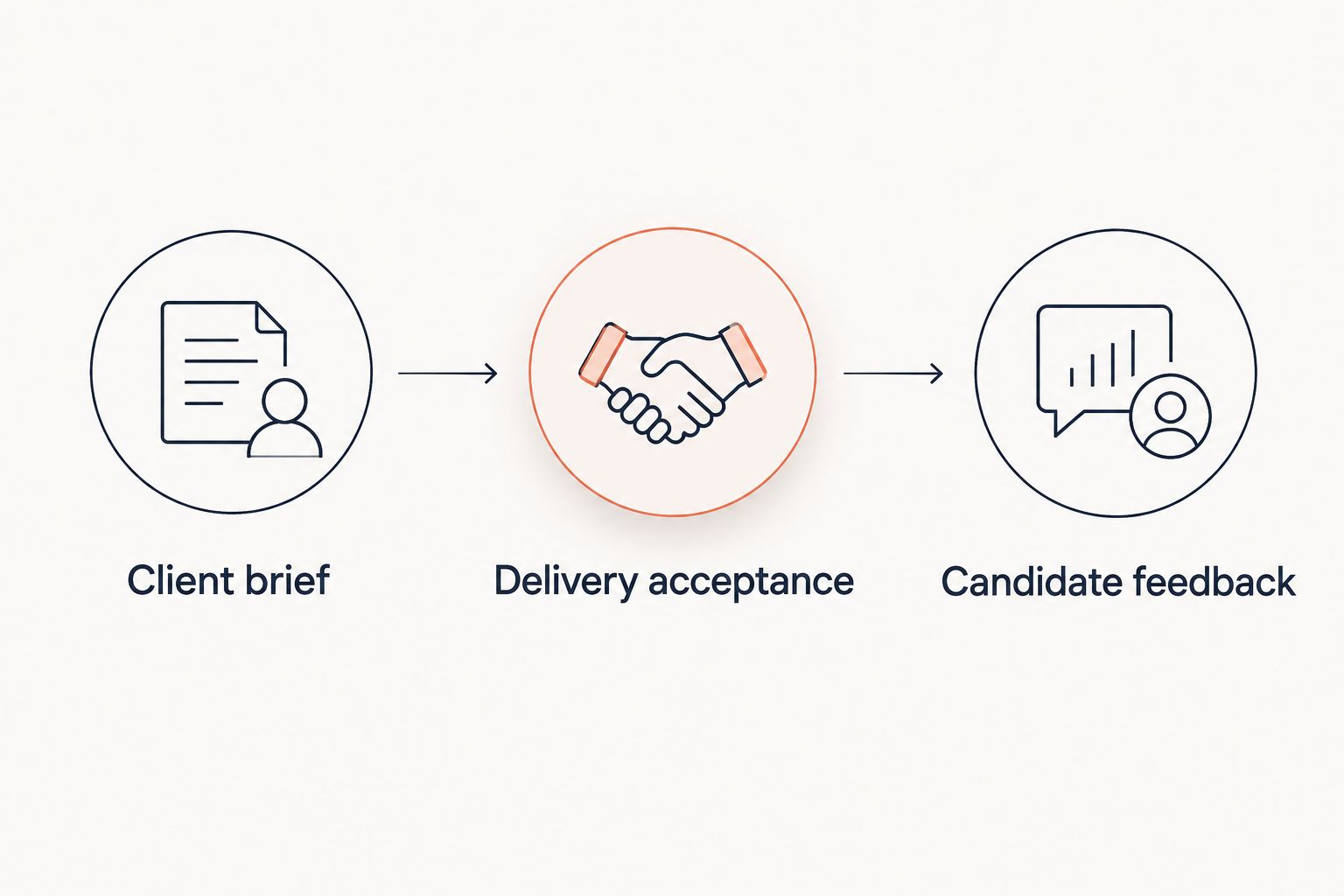
A split desk needs an accepted brief, not just a forwarded job description.
The 360 model removes this internal transfer, but it does not remove documentation. Candidate conversations, client feedback, and changing requirements still need a record.
A split desk wins on protected prospecting ownership
On a 360 desk, client prospecting and candidate delivery compete for the same person's attention. An urgent shortlist or interview issue can push new-business work aside.
A split desk assigns that work to a distinct owner. That is its structural advantage: delivery activity does not automatically consume the business developer's schedule. The advantage disappears if you routinely move the salesperson into delivery whenever a search becomes urgent.
Staffingleads supports staffing business development by watching hiring, funding, past-client, and network signals, identifying decision-makers with verified emails, and running email and LinkedIn sequences. Those functions support either desk model; they do not determine which structure you should run.
For a full-desk recruiter, the purpose is to keep client development active alongside delivery. For a split team, the purpose is to give the business-development owner staffing-specific targeting and outreach. Neither arrangement removes the need to qualify demand before accepting a search.
Both models need separate sales and delivery accountability
A 360 desk has 1 role owner covering 2 functions: client acquisition and candidate delivery. Measure those functions separately even when one person performs both.
Otherwise, placements can hide a weakening new-business pipeline. Equally, frequent sales conversations can hide searches that never progress.
A split desk makes role ownership more visible, but creates a different risk: sales and delivery blame each other for a stalled placement. Define who owns vacancy qualification, candidate feedback, and escalation before the search begins.
For your 2026 review, examine:
- Client acquisition: qualified opportunities and accepted job orders.
- Candidate delivery: search progress, submissions, interviews, and placements.
- Shared outcomes: repeat business, search quality, and reasons work stalls.
Neither model wins on accountability by default. The winner is the structure in which responsibilities are explicit and both functions receive attention.
Both models need viable job orders, not more activity
A full-desk recruiter can pursue too many weak searches. A split team can do the same, with sales passing vacancies to delivery before confirming that the client will engage.
Use the same acceptance questions in either structure:
- Does the vacancy fit your vertical, geography, and candidate access?
- Are you speaking to someone who can influence the hiring decision?
- Has the client explained what would make a candidate acceptable?
- Is the interview process clear enough to manage?
- Who will resolve feedback or changes to the brief?
A hiring signal is a reason to investigate an account, not proof that the company wants an agency. Funding is not a signed job order. Past-client activity is not automatic permission to reopen a search.
Staffingleads is a staffing business-development tool, not an ATS or CRM. It has no integrations with Bullhorn, Salesforce, or HubSpot. Keep your client and candidate records in the systems you use for that work; do not treat outreach automation as placement management.
Cost: compare role economics, not software pricing
The 360 and split desk models are operating structures, not software subscriptions. Their cost difference comes from how you compensate people, allocate capacity, and coordinate work.
A 360 model combines sales and delivery responsibilities in one role. A split model allocates those responsibilities across separate roles. Neither structure has an inherent cost advantage without your actual payroll, workload, and placement records.
Build your 2026 comparison from the same inputs:
- Compensation and employer costs for the roles involved.
- Prospecting and delivery software costs, allocated consistently.
- Time spent qualifying work, recruiting candidates, and coordinating handoffs.
- Completed placements and client acquisition outcomes over the same reporting period.
For acquisition efficiency, use the staffing agency CAC guide to define which costs belong in your calculation. Keep acquisition costs separate from delivery costs so a reorganization does not merely move spending between categories.
Commission design also needs to match ownership. Do not leave the client owner and delivery recruiter negotiating credit after a placement. Define attribution before they start working together.
Final verdict: choose the structure that solves your bottleneck
Choose a 360 desk if you are a relationship-led solo biller
Winner: 360 desk. Choose it when you can win clients and deliver candidates, want direct control of the relationship, and do not have enough distinct workload to justify separate owners.
Stay with the model when it works. If prospecting is the weak point, first protect a prospecting routine and improve targeting. Adding a handoff does not automatically fix inconsistent business development.
Choose a split desk if you lead a specialist delivery team
Winner: split desk. Choose it when sales and delivery each need sustained attention, your recruiters are strongest on candidate work, and you can enforce an accepted brief between functions.
Stay with a split desk when it already produces clear ownership. Do not move everyone to full-desk roles because you dislike a handoff that needs better management.
| Dimension | Winner |
|---|---|
| Direct client ownership | 360 desk |
| Functional specialization | Split desk |
| Fewer internal handoffs | 360 desk |
| Protected prospecting ownership | Split desk |
| Accountability | Tie—requires explicit measures |
| Job-order qualification | Tie—requires acceptance criteria |
| Cost | No universal winner—calculate your role economics |
FAQ
What is the difference between 360 and split desk recruiting?
A 360 recruiter owns client acquisition and candidate delivery; a split desk assigns those functions to separate owners. The main tradeoff is relationship continuity versus functional specialization.
Is a 360 desk better for a solo recruiter?
A 360 desk fits a solo recruiter who handles both winning clients and delivering candidates. Its limitation is competing workload: urgent searches can displace new-business activity.
When should a staffing agency switch to a split desk?
Switch when sales and delivery each need dedicated ownership and you can manage the handoff between them. Define the workload and vacancy acceptance process before creating separate roles.
Does split desk recruiting mean splitting fees with another agency?
Not in this comparison: split desk recruiting means separating client-facing sales from candidate delivery inside your operating structure. A split-fee arrangement between recruiting firms is a different decision.
Which recruiting desk model costs less?
Neither model has an inherent cost advantage. Compare compensation, employer costs, software, coordination work, and placement outcomes using your own records over the same period.
Can Staffingleads support both recruiting models?
Yes. Staffingleads supports staffing business development through hiring, funding, past-client, and network signals, decision-maker identification with verified emails, and email and LinkedIn sequences. It is not an ATS or CRM and has no integrations with Bullhorn, Salesforce, or HubSpot.
One last thing
Before changing your desk structure in 2026, trace a completed placement from the first client conversation to the final outcome. Mark where work waited, where context was lost, and where nobody owned the next action.
If the delay came from an unclear brief, fix the brief before changing the org chart. If it came from one recruiter repeatedly choosing between prospecting and delivery, evaluate dedicated ownership. Solve the actual blockage.
Related guides
Let your agent start the conversations.
StaffingLeads watches hiring, funding, past-client and network signals, finds the decision-maker behind each one, and sends personalised email and LinkedIn outreach in your voice. You pick up the replies.
Start your 14-day free trial →Keep reading
Free, no signup