Lead generation for construction staffing: complete 2026 guide

Lead generation for construction staffing agencies in 2026 starts with hiring, funding, and project signals. Find decision-makers and run focused outreach.

Construction staffing lead generation is the process of finding contractors with active labor demand, identifying the person responsible for workforce decisions, and starting relevant outreach with the aim of winning staffing clients. Lead generation for construction staffing agencies works differently in 2026 because demand follows projects, permits, contract awards, funding, and regional trade needs rather than a predictable corporate hiring calendar.
TL;DR
- Lead generation for construction staffing agencies works when project and hiring signals determine who receives outreach in 2026.
- LinkedIn Jobs is useful for visible demand, but permit and contract signals can reveal needs before a vacancy appears.
- Target project managers, superintendents, operations leaders, and other decision-makers instead of defaulting every message to HR.
- Verify contact data, segment by trade and personalize outreach around the signal that put each contractor on your list.
Why lead generation matters for construction staffing agencies
Construction staffing agencies sell against immediate labor problems. A contractor may need electricians for one project, equipment operators for another and a superintendent for a new location. A broad list of construction companies does not show which employer has a live need or which trade matters now.
The stronger 2026 approach starts with a reason to contact each account. That reason might be a new vacancy, project award, permit, funding announcement, past client relationship or contact move. These signals help a full-desk recruiter prioritize accounts instead of spending the day moving through an undifferentiated directory.
Channel mix still matters. Referrals, cold email, LinkedIn, local associations and content can all create conversations, as outlined in these staffing agency marketing ideas. The difference is that construction staffing business development needs tighter filtering by geography, trade, project type and hiring authority.
Construction employers also screen for role-specific qualifications. OSHA 10-Hour and OSHA 30-Hour cards are established training credentials, but they are not interchangeable requirements for every role or jobsite. Confirm the current requirement with the employer and verify each candidate's credentials rather than making a blanket promise in outreach.
Build a construction staffing lead-generation workflow
A usable workflow takes an account from signal to qualified conversation. Keep the steps visible so recruiters know why an account was selected, who owns the decision and what the next action is.
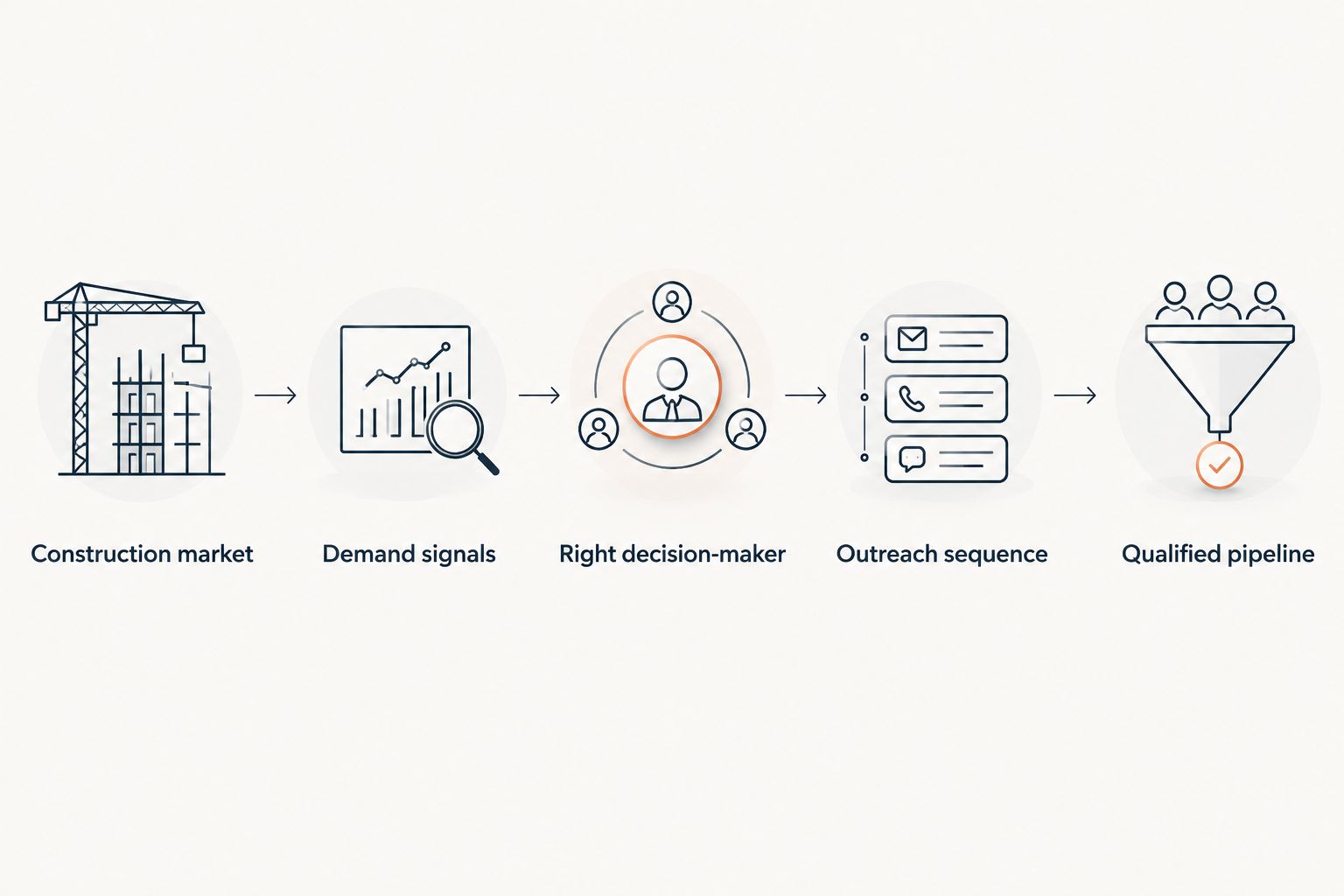
A contractor becomes a qualified lead only after the signal, contact and staffing need are confirmed.
Map your construction market
Define the market before collecting company names. Construction is too broad to treat as one prospecting category. Commercial general contractors, civil contractors, specialty subcontractors, homebuilders and industrial firms hire different roles through different decision-makers.
A narrow ICP also makes outreach easier to write. You can discuss the relevant trade and project environment instead of claiming that your agency fills every construction role. Start manually with public contractor directories, association member lists, project announcements and your existing placement records.
- Choose the construction segments your recruiters already understand.
- Define the cities, states or service radius you can cover.
- List the trades and management roles you can credibly recruit.
- Separate general contractors from specialty subcontractors.
- Exclude accounts that fall outside your delivery model.
Read demand signals before building lists
A company belongs on the active list because something changed. Job postings show visible demand, while permits, project awards and funding announcements provide additional context about where labor may be needed. Past-client activity and contact moves can also reopen a relationship without treating the account as entirely cold.
Do the first pass with sources available in your market. Review contractor career pages, public planning records, local business reporting, association updates and government contract notices. Record the original source beside the account so the recruiter can verify it before mentioning it.
- Save the company, location and source of the signal.
- Record the trade or role connected to the signal.
- Note the project type when the source names it.
- Confirm that the information still appears current in 2026.
- Remove accounts with no clear fit or actionable reason to call.
Find the right decision-maker
The right contact depends on how the contractor manages labor. A project manager or superintendent may control an urgent site need, while an operations leader or owner may manage vendor approval across projects. HR can still matter, but sending every message there ignores how construction work is organized.
Search the company site and LinkedIn manually first. Match each contact's responsibilities to the observed signal, then verify the email before outreach. StaffingLeads speeds up this part of construction staffing lead generation by connecting hiring, funding, past-client and network signals with decision-maker contact data and a verified email.
- Match project-level needs to project or field leadership.
- Match company-wide hiring to operations or executive leadership.
- Confirm the contact still works at the target company.
- Verify the business email before adding it to a sequence.
- Keep uncertain contacts out of automated campaigns.
Write outreach around the trigger
The first message should explain why this contractor is receiving it. Refer to the verified hiring or company signal, connect it to a role you understand and ask a direct question about the current staffing need. Do not pretend to know project details that the source did not provide.
StaffingLeads can run email and LinkedIn sequences after the account and contact are selected. It does not replace the judgment required to choose the right trigger or write a credible construction-specific message. A smaller sequence built around one trade and one signal is easier to review than a general campaign sent to every contractor in a region.
- Open with the verified reason for contacting the company.
- Name the relevant trade, role or project category.
- Ask who owns the current staffing requirement.
- Keep each follow-up tied to the same business context.
- Stop outreach when the contact opts out or the need is closed.
Protect deliverability and compliance
Verification removes invalid addresses, but it does not make a campaign compliant by itself. The CAN-SPAM Act governs commercial email, and the Federal Trade Commission is responsible for enforcement. Use accurate sender information, non-deceptive subject lines, a working opt-out method and the disclosures required for your campaign.
Requirements vary by jurisdiction and change. Review the current rules with your own counsel before scaling a sequence, especially when contact data comes from outside sources. The guide to whether staffing agencies can run cold outreach within CAN-SPAM rules explains the compliance questions to take into that review.
- Verify each address before the first email.
- Use a sending identity that accurately names the sender.
- Avoid subject lines that disguise the commercial purpose.
- Process opt-out requests and maintain suppression records.
- Confirm current federal and state requirements with counsel.
Measure the qualified pipeline
Activity is not the same as pipeline. Count an account as qualified only after confirming a relevant staffing need, a suitable decision-maker and a realistic next step. This keeps a large contact list from hiding weak business development performance.
Review results by source in 2026. Compare hiring signals, past-client reactivation, referrals, LinkedIn and manual project research using the same qualification standard. StaffingLeads supports the signal and outreach stages, but signed clients and placements still need to be tracked in the agency's chosen systems because StaffingLeads is not an ATS or CRM.
- Record the source that created each conversation.
- Separate replies from qualified staffing opportunities.
- Track meetings that reach a confirmed hiring authority.
- Track proposals and signed clients by original source.
- Calculate acquisition cost using your actual time and spending.
Find active staffing prospects
Use hiring and company signals to focus outreach on contractors with a reason to talk.
Compare lead-generation options
Construction staffing teams do not need the same prospecting setup. The right choice depends on recruiter capacity, market coverage and whether the team needs company data, timely signals or both.
| Option | Best for | Strength | Key limitation |
|---|---|---|---|
| Manual research | Solo billers with a narrow local market | Gives the recruiter direct control over account selection and message context | Research takes time and depends on a repeatable daily process |
| Referrals and past clients | Agencies with an established placement history | Starts with an existing relationship or shared context | Pipeline becomes inconsistent when reactivation depends on memory |
| LinkedIn Sales Navigator | Teams that need broad company and title filtering | Strong for manually finding companies and likely contacts | Does not replace staffing-specific hiring, funding, past-client and network signals |
| General B2B contact database | Agencies prospecting across several industries | Provides broader contact coverage across functions and company types | Requires manual work to identify timely construction staffing demand |
| StaffingLeads | Staffing teams prioritizing signal-based outreach | Connects staffing-specific signals, verified contacts, email and LinkedIn sequences | It is not an ATS or CRM and has no Bullhorn, Salesforce or HubSpot integrations |
StaffingLeads is best for construction staffing agencies that already know their niche and need staffing-specific signals plus verified decision-maker outreach; it is not an ATS or CRM.
Stay with manual research when the agency targets a small territory and the owner can inspect every account. Choose LinkedIn Sales Navigator when flexible company and title search matters more than staffing-specific timing. Use a larger B2B database when contact coverage across many industries is the main requirement.
Common mistakes construction staffing agencies make
Building one list for every construction trade
A concrete subcontractor and a commercial electrical contractor do not share the same labor needs. Separate campaigns by contractor type, trade and geography so the message reflects a real delivery capability.
Treating a job posting as the whole signal
The posting identifies demand, but it does not automatically identify the decision-maker, project context or vendor process. Verify those details before promising candidates or referencing a project.
Contacting only HR
HR can participate in vendor management, but construction staffing demand often starts with operations or field leadership. Map the need to the person responsible instead of relying on one department across every account.
Automating before verifying the list
Automation multiplies list errors. Verify the company, contact, email and trigger before placing the prospect into an email or LinkedIn sequence.
Measuring replies instead of qualified opportunities
A reply can be an opt-out, referral or rejection. The useful measure is whether the conversation confirms a relevant staffing need and reaches someone who can advance the vendor decision.
FAQ
What is lead generation for construction staffing agencies?
Lead generation for construction staffing agencies is the process of identifying contractors with labor demand and reaching the person responsible for staffing decisions. Effective programs connect project, hiring, funding, past-client or network signals to verified decision-maker outreach.
What is the best lead source for a construction staffing agency in 2026?
The best source is the one that consistently produces qualified conversations in your market. Hiring signals, project announcements, referrals, past clients and contact moves should be tracked separately so you can compare actual client outcomes.
Who should construction staffing recruiters contact?
Contact the person whose responsibilities match the labor need. That can include a project manager, superintendent, operations leader, owner or HR contact, depending on the contractor and vendor process.
Is LinkedIn enough for construction staffing lead generation?
LinkedIn is useful for company research, title filtering and direct outreach, but it does not cover every project or hiring signal. Pair it with contractor websites, public project sources, referrals and past-client records.
Does StaffingLeads replace a staffing CRM or ATS?
No, StaffingLeads does not replace a CRM or ATS. It supports staffing business development through signals, verified decision-maker contacts, email sequences and LinkedIn outreach, with no Bullhorn, Salesforce or HubSpot integrations.
How should a construction staffing agency measure lead quality?
Measure whether the account has a relevant staffing need, whether the contact can influence the vendor decision and whether the conversation produces a defined next step. Keep replies separate from qualified opportunities.
Can construction staffing agencies send cold email?
Construction staffing agencies can use commercial email when their campaigns meet applicable requirements. Confirm the current CAN-SPAM, state and data-use rules with your own counsel before launching or expanding outreach.
Which construction hiring signals should recruiters track in 2026?
Track relevant vacancies, project awards, permits, funding announcements, past-client activity and contact moves. Verify the source and connect the signal to a trade your agency can actually supply.
One last thing
Do not let automation erase the reason an account entered your pipeline. Preserve the original signal beside the company and contact record, then make that context available to the recruiter who handles the conversation. In 2026, the useful list is not the longest list; it is the list where every account has a verified reason for outreach and a named owner for the next action.
Related guides
Let your agent start the conversations.
StaffingLeads watches hiring, funding, past-client and network signals, finds the decision-maker behind each one, and sends personalised email and LinkedIn outreach in your voice. You pick up the replies.
Start your 14-day free trial →Keep reading
Free, no signup