Staffing Agency Marketing Ideas Beyond Cold Outreach

Staffing agency marketing ideas for 2026: build referrals, niche content, reviews, events and signal-based prospecting that creates warmer sales calls.

Staffing agency marketing is the system of building demand beyond cold outreach with the aim of creating warmer conversations and a steadier client pipeline. The strongest staffing agency marketing ideas in 2026 combine past-client relationships, niche content, proof, partnerships, and timely hiring signals.
TL;DR
- The best staffing agency marketing ideas combine referrals, niche content, client proof, partnerships, and trigger-based prospecting.
- Google Search Console is best for finding existing search visibility before you create more content.
- Past clients and placed candidates give recruiters warmer introductions than an unqualified prospect list.
- Hiring, funding, past-client, and network signals show when an account deserves immediate attention in 2026.
Why this matters for staffing agencies
Full-desk recruiters have two jobs competing for the same calendar: fill current roles and create the next client opportunity. A desk that depends entirely on outbound prospecting loses momentum whenever delivery work takes over. The full-desk recruitment model makes that tension especially clear because the same recruiter owns both candidate delivery and business development.
Marketing creates assets that keep working between prospecting blocks. A referral request can open a warm introduction. A niche guide can answer a hiring manager's question before the first sales call. A case study can remove doubt when the buyer compares agencies.
Cold outreach still belongs in the mix. The mistake is asking it to create awareness, trust, timing, and conversion by itself. In 2026, each message needs a reason for reaching out and proof that your desk understands the buyer's hiring problem.
Build a marketing system beyond cold outreach
Reactivate past clients first
Your past-client list is the fastest place to find accounts that already understand your work. Start manually with your ATS, CRM, placement records, or a spreadsheet. Separate active relationships from dormant accounts, then identify the hiring managers who changed employers or started hiring again.
Do not open with a generic check-in. Reference the prior relationship, ask about the current hiring plan, and make the next step easy. A short account review is stronger than a broad service pitch.
- Export past clients and hiring-manager contacts into one working list
- Mark the last placement, last conversation, and current employer
- Review dormant accounts for new job postings every 30 days
- Ask former client contacts about current hiring priorities
- Prioritize accounts where the relationship and demand signal overlap
Create a repeatable referral loop
Referrals should follow a defined event, not depend on remembering to ask. Good trigger points include a successful placement, positive client feedback, a candidate reaching a milestone, or a hiring manager moving to another company.
Ask for an introduction to a specific type of buyer. A request for one operations leader at a growing logistics company is easier to act on than a request for anyone who needs recruiting help.
- Write separate referral requests for clients, candidates, and industry partners
- Ask for one relevant introduction instead of a public contact list
- Send the request within 7 days of the positive event
- Record who introduced the account and acknowledge the help
- Follow up with useful context rather than repeated reminders
Publish content around buyer problems
Generic recruiting commentary attracts recruiters. Client-focused content attracts hiring managers. Build each article around a decision your target account needs to make, such as choosing a staffing model, fixing a difficult search, forecasting hiring demand, or evaluating agency performance.
Start with free evidence. Check Google Search Console for queries already producing impressions. Review questions from sales calls and objections from lost opportunities. Then create one page that answers each recurring problem without hiding the useful part behind a form.
- Choose one vertical, role family, or hiring problem per content cluster
- Answer the decision-maker's question in the opening paragraph
- Add a practical checklist the buyer can use without contacting you
- Support claims with verifiable client evidence or remove them
- Refresh dates, examples, and internal references for 2026
- Reuse each article in email, LinkedIn, and sales follow-up
Turn placements into verifiable proof
A placement announcement says you completed work. A useful case study explains why the search was difficult, what process changed, and what result the client can verify. The second format gives a hiring manager something concrete to evaluate.
Do not publish confidential client details or unsupported performance figures. Get approval for named information. If the story must stay anonymous, describe the vertical, role type, hiring constraint, and process without making the client identifiable.
- Create a short case study after each suitable placement
- Capture the role, search constraint, process, and confirmed result
- Request a client review while the engagement is still recent
- Add proof to relevant service and vertical pages
- Give recruiters a case-study link for follow-up conversations
Track hiring signals before automating them
You can track trigger events manually before buying software. Review target-account career pages, funding announcements, hiring-manager job changes, past-client activity, and relevant LinkedIn updates during a fixed weekly research block.
Manual tracking proves which signals matter for your niche. Once the process becomes too large for a spreadsheet, staffing lead generation research helps clarify what should remain manual and what should be automated.
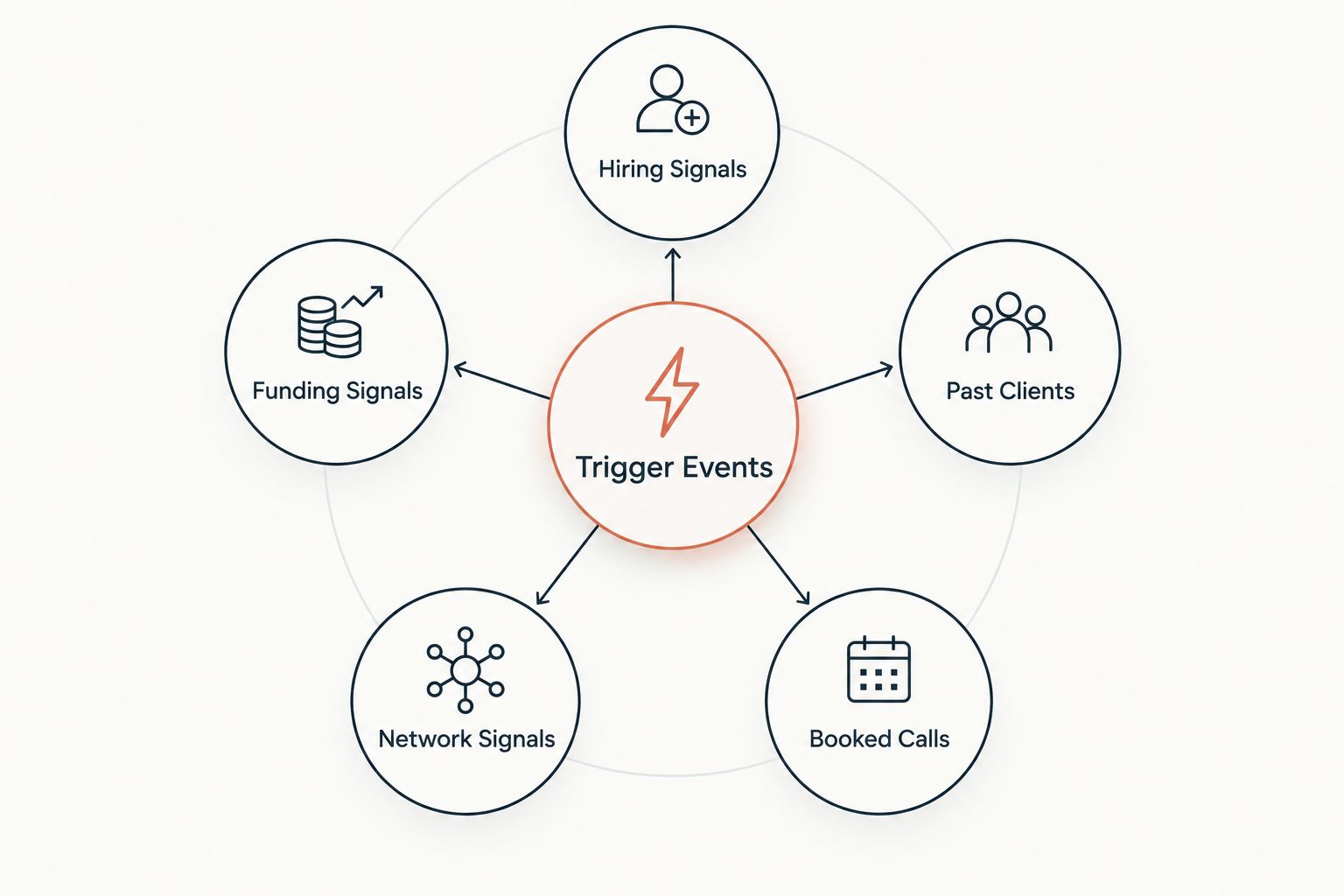
A timely trigger gives outreach a specific reason to start now.
StaffingLeads is the faster path when your staffing business-development team needs to watch hiring, funding, past-client, and network signals at scale. It identifies the relevant decision-maker with a verified email and supports email and LinkedIn sequences. It is not an ATS or CRM, and it has no Bullhorn, Salesforce, or HubSpot integrations.
- Define the account profile before collecting more contacts
- Track one signal manually and document why it matters
- Match each trigger to a relevant outreach angle
- Contact the decision-maker responsible for the hiring problem
- Stop sequences when the signal is stale or the account is not a fit
Measure booked calls and client opportunities
Marketing activity is not the outcome. Track which channel creates qualified conversations, active opportunities, and signed clients. Opens, impressions, and contact counts can diagnose a channel, but they do not prove that the channel creates revenue.
Use a spreadsheet if your current systems do not capture source data. Give every opportunity one primary source and one assisted source. Review the data monthly, then compare channels over a 90-day period before reallocating time.
- Record the original source for every booked call
- Separate qualified client conversations from candidate inquiries
- Track opportunities and signed clients by source
- Calculate acquisition cost with your own spend and labor inputs
- Compare channel performance by vertical and operating model
- Cut recurring activity that creates attention but no sales conversations
Track the right hiring signals
Find decision-makers behind hiring, funding, past-client, and network activity.
Compare staffing agency marketing options
No single channel covers every stage of business development. Referrals carry trust but depend on an existing network. Content creates durable visibility but requires sustained publishing. Signal-based outreach improves timing but still needs a clear ICP, relevant message, and disciplined follow-up.
| Option | Best for | Operating model | Key limitation |
|---|---|---|---|
| Past-client reactivation | Established agencies with dormant relationships | Manual account reviews and personal follow-up | Limited when records are incomplete or relationships are weak |
| Referral loop | Recruiters with successful placements and active networks | Triggered requests after positive client or candidate events | Volume depends on relationship quality |
| Niche content | Agencies committed to a defined vertical or role family | Research, publishing, distribution, and periodic updates | Results compound slowly and weak positioning produces generic traffic |
| Case studies and reviews | Agencies with verifiable client outcomes | Approval, documentation, and sales enablement | Confidentiality can limit what you publish |
| Industry partnerships | Specialists with associations, consultants, or adjacent service providers | Mutual introductions and shared educational content | Partnerships fail when the audiences do not overlap |
| StaffingLeads signal-based outreach | Staffing teams that need current trigger events and decision-maker contacts | Software-supported research plus email and LinkedIn sequences | It does not replace an ATS, CRM, positioning strategy, or relationship building |
StaffingLeads is best for staffing agency owners and BD teams that already know their ICP but need better timing and the right decision-maker, not a general-purpose database or another CRM. Agencies without a defined niche should fix targeting before adding automation.
Common marketing mistakes staffing agencies make
- Automating an unclear ICP. More contacts create more wasted activity when the desk cannot define the industries, company traits, roles, and hiring conditions it serves.
- Publishing candidate content for a client-acquisition goal. Resume tips can attract job seekers while producing no hiring-manager conversations. Separate candidate marketing from business-development content.
- Treating every job posting as equal intent. One routine replacement and a cluster of new roles represent different sales contexts. Review the company, role pattern, decision-maker, and timing before outreach.
- Making unsupported case-study claims. If a result cannot be confirmed, do not publish it. Explain the problem and process instead of adding an estimate.
- Calling software a complete marketing strategy. A platform can find signals and run sequences. It cannot choose your niche, repair a weak offer, obtain client approval for proof, or build referral trust.
FAQ
What are the best staffing agency marketing ideas beyond cold outreach in 2026?
The best options are past-client reactivation, structured referrals, niche content, case studies, industry partnerships, and trigger-based prospecting. Combine relationship channels with hiring signals instead of expecting one tactic to carry the pipeline.
How can a small staffing agency market itself without a large team?
Start with past clients, referrals, and one narrow content cluster. These channels can be managed manually, and each piece of work can support outreach, sales follow-up, and search visibility.
Is content marketing better than cold outreach for staffing agencies?
Content and cold outreach solve different problems. Content builds visibility and proof over time, while outreach starts direct conversations; the strongest 2026 process uses content to make outbound messages more credible.
How does StaffingLeads fit into staffing agency marketing?
It watches hiring, funding, past-client, and network signals, identifies the relevant decision-maker with a verified email, and runs email and LinkedIn sequences. It is best used after the agency defines its ICP and message.
Does a staffing lead generation platform replace an ATS or CRM?
No. A lead generation platform finds and contacts prospective clients, while an ATS manages recruiting workflows and a CRM manages relationship records. The roles are separate.
How much should a staffing agency spend on marketing?
Set the budget from your own client acquisition cost, sales capacity, vertical, and operating model rather than a generic benchmark. Include media spend, software, contractor costs, and internal labor when calculating the figure.
Can staffing agencies use email and LinkedIn for business development in 2026?
Yes, but the process must follow applicable outreach, privacy, platform, and identification requirements. CAN-SPAM establishes federal commercial-email rules in the United States, state requirements change, and agencies should confirm current obligations with their own counsel.
One last thing
The most useful 2026 marketing change is not adding another channel. It is connecting the channels you already have. A past client appears in a new role, a target account starts hiring, and a relevant case study gives the recruiter a credible reason to reach out. That sequence is stronger than sending another generic introduction to a static list.
Related guides
Let your agent start the conversations.
StaffingLeads watches hiring, funding, past-client and network signals, finds the decision-maker behind each one, and sends personalised email and LinkedIn outreach in your voice. You pick up the replies.
Start your 14-day free trial →Keep reading
Free, no signup