Pay transparency laws and your job postings

Pay transparency laws staffing agencies must check: approve pay terms before posting, review remote-role scope, and keep job-board copies accurate with clear ownership.

Staffing agency pay transparency compliance is the process of checking which compensation disclosures apply to each job posting so you can publish accurate terms and reduce compliance risk. Your agency also needs to establish who approves the range, who publishes it, and who updates every copy when the client changes the brief.
TL;DR
- Pay transparency laws staffing agencies must assess depend on jurisdiction, employer coverage, posting scope, and the agency’s role.
- Get client-approved compensation terms before publishing; distinguish worker pay from the client bill rate.
- StaffingLeads supports staffing business development, not job-posting compliance, an ATS, or a CRM.
- Confirm current state and local requirements with counsel; remote roles need their own jurisdiction review.
Why pay transparency matters for staffing agencies
A staffing job posting often passes through a client, an account manager, a recruiter, and a publishing platform. That creates several places for an approved compensation range to become an outdated or incomplete advertisement.
For a solo biller, the challenge is keeping the approval trail without slowing recruiting. For a larger agency, it is maintaining consistent terms across recruiters, client accounts, and reposted vacancies. Treat compensation disclosure as a requisition control, not a final editing task.
In 2026, review pay transparency separately from other hiring obligations. Disclosure rules do not resolve worker classification, screening, or employment responsibility; the guide to co-employment risk for staffing agencies covers a related issue that needs its own review.
Understand the legal scope before changing templates
Pay transparency requirements vary by state and locality and change over time. The applicable rule can depend on employer coverage, where work occurs, the posting’s geographic reach, and whether your agency acts as the employer or recruits for a client. Confirm the current rule with your own counsel.
These are starting points for a 2026 legal review, not a complete jurisdiction list:
| Jurisdiction | Statute or responsible agency | What to verify with counsel |
|---|---|---|
| California | California Labor Code section 432.3; California Labor Commissioner’s Office | Pay-scale disclosure requirements and responsibilities when a third party publishes a covered employer’s posting |
| New York State | New York Labor Law section 194-b; New York State Department of Labor | Compensation disclosure, job-description requirements, and geographic scope |
| Colorado | Equal Pay for Equal Work Act; Colorado Department of Labor and Employment | Compensation, benefits, application information, and job-opportunity notice requirements |
A client’s headquarters address is not a complete applicability test. Neither is the location of your recruiter. Give counsel the actual work arrangement, permitted locations, employer identity, and publishing channels rather than asking whether a generic template is compliant.
Build a repeatable job-posting approval process
Define the role and work locations
Start with a shared document or spreadsheet. Record the client, employing entity, assignment model, work location, and whether the role permits remote work. Keep assumptions out of the public posting until the client confirms them.
For a remote vacancy, specify where the employer permits the employee to work. An unrestricted location field creates a different review problem from a role tied to a particular worksite. Do not use geography exclusions as a substitute for legal review.
Close the intake with these checks:
- Identify whether the agency or client employs the worker.
- Separate temporary, contract, and direct-hire requisitions.
- Record the worksite and permitted remote-work locations.
- List every planned publishing channel.
- Send uncertain jurisdiction questions to counsel.
Obtain approved compensation terms
Ask the client for the compensation it genuinely authorizes for the role. Record the pay unit and the criteria that explain movement within the range. Keep base compensation distinct from commissions, bonuses, benefits, or other components that need separate treatment.
For temporary staffing, the client bill rate is not the worker’s pay rate. Recruiters need the approved worker compensation, not a commercial figure copied from an account agreement. If the client has not resolved compensation, return the requisition for clarification before publication.
Use this approval checklist:
- Confirm whether pay is hourly, annual, or expressed another way.
- Document the approved lower and upper bounds where applicable.
- Separate base pay from other compensation components.
- Obtain required benefits or application information for legal review.
- Record who approved the terms and when.
Assign an approval owner
Use your existing account records to identify the person authorized to approve compensation. A familiar HR contact is not automatically the budget owner. Ask who can confirm the role’s pay terms, then preserve that confirmation with the requisition.
Assign 1 approval owner per requisition as an operating rule, not a legal threshold. Others can contribute, but one person should resolve conflicting instructions. A solo biller still needs a named client-side approver.
For new-client prospecting, StaffingLeads identifies decision-makers with verified email and runs email and LinkedIn sequences using hiring, funding, past-client, and network signals. That supports staffing business development; it does not establish compensation authority or approve job advertisements.
Make ownership explicit:
- Name the client-side compensation approver.
- Name the agency-side publishing owner.
- Save the approved terms with the requisition.
- Escalate contradictions before a recruiter posts the role.
Draft the posting around approved facts
Build the advertisement from the approved brief rather than copying a similar vacancy. Explain the role, work arrangement, and compensation terms in plain language. Avoid burying necessary disclosures beneath company background or generic recruiting language.
A range needs a defensible connection to the actual role and authorized compensation. Do not stretch it to combine unrelated seniority levels or imply that an unapproved figure is available. Ask counsel how the applicable rule treats variable compensation and benefits.
Review the draft for these details:
- Match the compensation unit to the approved brief.
- Identify base pay separately from conditional compensation.
- Explain relevant differences in level, location, or shift.
- Include additional disclosures required for the jurisdiction.
- Remove stale text inherited from another requisition.
Check every published version
Run 2 review passes: one before publication and one against the live advertisement. This catches differences between the approved document and what a job board actually displays. It is a recommended workflow, not a statutory review requirement.
Compare 3 posting versions when you use them: the agency website, the job-board listing, and the recruiter’s social post. Formatting, syndication, and copied text can leave the public versions inconsistent. Review the actual destination rather than assuming the original submission controls every copy.
For your 2026 publishing checklist:
- Compare displayed compensation with the approved terms.
- Check that required information remains visible after formatting.
- Review syndicated or automatically reposted versions.
- Save the posting version and approval record.
- Assign responsibility for corrections on each channel.
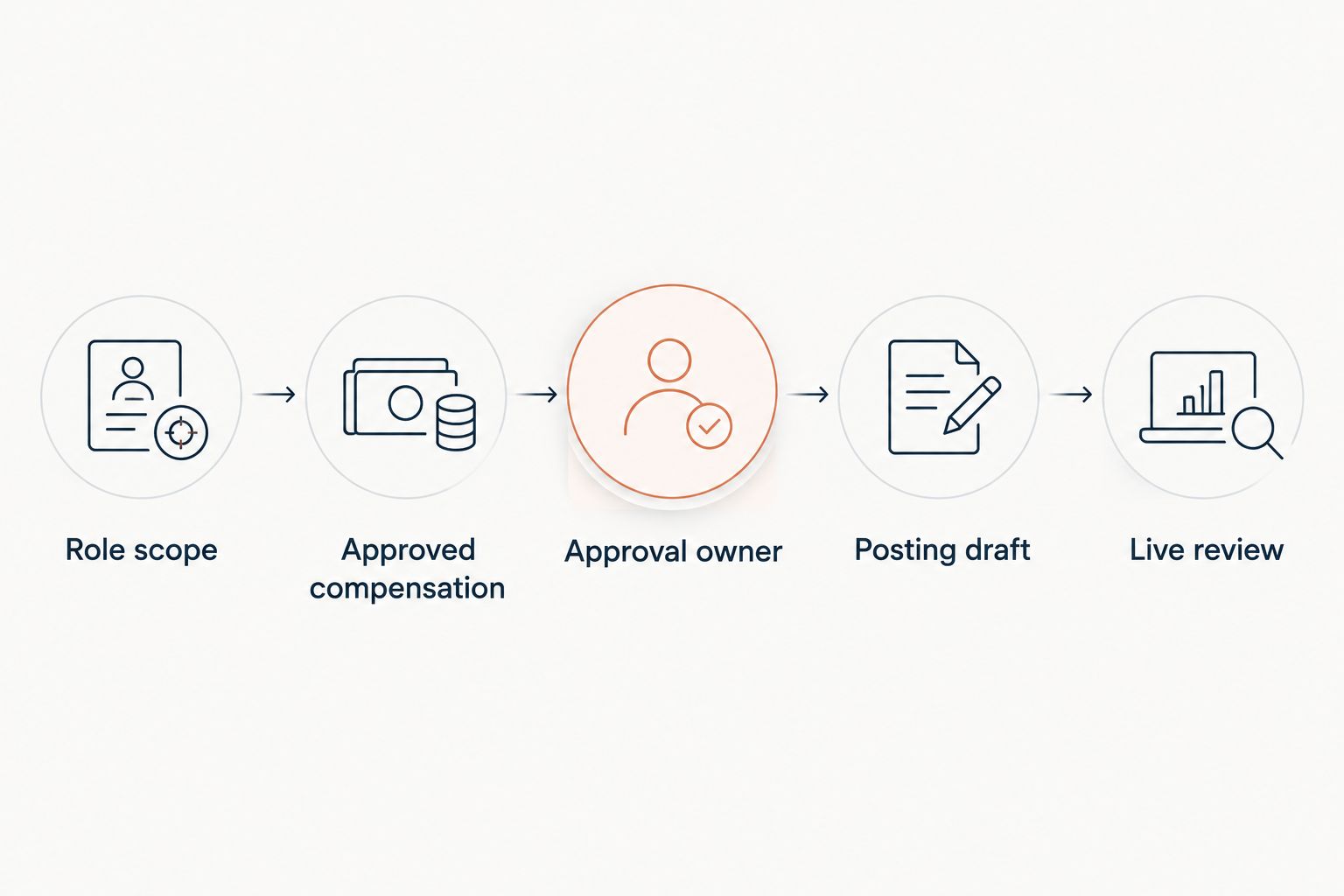
Compensation approval comes before drafting, and live review comes after publication.
Update changed terms and retain the record
When the client changes compensation, location, seniority, or employment model, reopen the approval process. Editing the agency’s master document alone does not update advertisements already distributed elsewhere.
Keep a version history that connects each published advertisement to its approved terms. Ask counsel to define the retention approach for your jurisdictions and operating model. Do not assume that deleting a posting removes the need to preserve relevant records.
Close each change with these actions:
- Obtain approval for the revised terms.
- Identify every active copy of the vacancy.
- Update or withdraw outdated advertisements.
- Record the change and responsible owner.
- Confirm the revised public text matches the approved brief.
Compare your operating options
Choose the process that fits your publishing volume, but keep legal interpretation and compensation approval separate from software. A simple shared record can establish ownership; software cannot supply a client’s missing authorization.
| Option | Best for | Strength | Key limitation |
|---|---|---|---|
| Shared checklist and approval log | Solo billers and small teams with a manageable posting workload | Keeps scope, approvals, and revisions together | Requires manual upkeep across publishing channels |
| Counsel-reviewed jurisdiction checklist | Agencies recruiting across different states or work arrangements | Grounds the review in applicable legal requirements | Needs maintenance as laws and the agency’s operations change |
| Existing ATS posting workflow | Teams already managing requisitions and advertisements in an ATS | Can organize publishing work where the configured system supports it | Features vary; confirm approval, revision, and recordkeeping capabilities |
| StaffingLeads | Staffing business-development teams using hiring and relationship signals | Supports decision-maker identification and email/LinkedIn outreach | Not an ATS, CRM, legal-review service, or job-posting compliance system |
StaffingLeads is best for staffing business-development teams that need signal-based prospecting, not job-posting compliance. It has no integrations with Bullhorn, Salesforce, or HubSpot. Keep its prospecting role separate from the system and people responsible for candidate-facing advertisements.
Common mistakes staffing agencies make
Publishing the client bill rate as worker pay
The amount invoiced to a client and the compensation offered to a worker serve different purposes. Give recruiters approved worker-pay terms instead of expecting them to infer compensation from the commercial agreement.
Assuming the client handles every obligation
Client approval does not answer every question about an agency’s responsibilities when publishing a vacancy. Ask counsel to review the agency’s actual role, including third-party advertising and employer responsibilities where applicable.
Using one national template without location review
A reusable template helps consistency, but it does not establish legal applicability. For 2026 requisitions, review the work arrangement and relevant jurisdiction before deciding which fields the advertisement needs.
Treating the first publication as the finished record
A compensation change can leave an agency website accurate while a job-board copy remains outdated. Give someone responsibility for the entire distribution list, not just the original advertisement.
Turning a disclosure review into a sales guarantee
Do not promise a prospect that your posting process eliminates legal risk. Describe your approval and publication controls accurately, and distinguish recruiting services from legal advice.
FAQ
Do pay transparency laws apply to staffing agencies?
Pay transparency requirements can apply to staffing agencies depending on the jurisdiction, employer coverage, and the agency’s role. Have counsel assess whether your agency employs the worker, publishes for a covered client, or has other responsibilities under the applicable rule.
Who should approve the salary range for a staffing job posting?
The person authorized to approve compensation should confirm the range before the agency publishes it. Record that approval and identify who owns corrections when the client changes the terms.
Can a staffing agency publish the client bill rate instead of worker pay?
Do not substitute the client bill rate for worker compensation. Obtain the approved pay terms for the advertised role and have counsel confirm how they must be disclosed.
Which pay transparency law applies to a remote job?
A remote job needs a jurisdiction review based on its actual work arrangement and the applicable law’s scope. Give counsel the permitted work locations, employer identity, and role details rather than relying only on the client’s headquarters.
Does every job posting need benefits information?
Benefits disclosure requirements depend on the applicable jurisdiction. Colorado’s framework includes benefits-related posting requirements; confirm the current rule and required wording with counsel before publication.
Can software make our job postings legally compliant?
Software does not replace current legal interpretation, client compensation approval, or a review of the published advertisement. Check the system’s actual functions and assign people to own those decisions.
What should we check when a client changes the pay range?
Reapprove the revised terms and check every active version of the advertisement. Preserve the approval and revision record using a retention approach confirmed with counsel.
One last thing
The strongest final check is not whether a posting contains a compensation range. It is whether someone can trace that public range back to the current client approval. Add that traceability check to your 2026 requisition closeout process, including advertisements copied outside your agency’s own systems.
Related guides
Let your agent start the conversations.
StaffingLeads watches hiring, funding, past-client and network signals, finds the decision-maker behind each one, and sends personalised email and LinkedIn outreach in your voice. You pick up the replies.
Start your 14-day free trial →Keep reading
Free, no signup