RPO vs staffing agency: what is the difference?

RPO vs staffing agency: choose RPO for recruiting-process ownership or an agency for defined hiring needs. Compare scope, responsibilities, and fit.

Choose RPO if you need an external team to own an agreed recruiting process; choose a staffing agency if you need candidates or workers for defined openings. The RPO vs staffing agency decision turns on what you delegate: responsibility for recruiting operations or delivery against hiring requirements.
TL;DR
- RPO vs staffing agency is a scope decision: recruiting-process ownership versus delivery against defined openings.
- RPO suits employers delegating ongoing recruiting operations; staffing agencies suit employers buying candidate search or temporary staffing.
- Neither model guarantees faster hiring. Compare responsibilities, hiring-manager access, and agreed measures.
- StaffingLeads supports staffing business development, not candidate recruiting or outsourced recruiting operations.
Why this matters
A provider can find candidates without taking responsibility for your recruiting process. It can also manage recruiting operations without becoming the employer of the people you hire. Confusing those responsibilities creates gaps between what your team expects and what the contract covers.
For a 2026 provider review, define the work before comparing proposals. Use consistent definitions for fill rate, time to fill, and submission ratios, then assign responsibility for each stage. A fast shortlist means little if interview feedback stalls inside your business.
RPO vs staffing agency at a glance
RPO means recruitment process outsourcing. An employer transfers responsibility for all or part of its recruitment process to an external provider. A staffing agency recruits against client requirements through services such as direct-hire search or temporary staffing.
These are service models, not mutually exclusive company types. One provider can offer both.
| Dimension | RPO | Staffing agency |
|---|---|---|
| Best for | Employers delegating an ongoing recruiting function or defined recruiting program | Employers needing candidates or workers for specific requirements |
| Process ownership | Owns agreed recruiting stages and operating responsibilities | Usually delivers against individual searches or staffing orders |
| Standout feature | Embedded recruiting delivery across an agreed scope | Focused candidate search or worker supply |
| Hiring flexibility | Can support an ongoing program or defined hiring project | Can support individual vacancies and temporary assignments |
| Employer relationship | Recruits on behalf of the client; the contract defines responsibilities | Direct-hire and temporary staffing create different employment arrangements |
| Quality measurement | Process outcomes and hiring outcomes both matter | Search, placement, and assignment outcomes matter |
| Pricing model | Can use management, activity-based, per-hire, or blended arrangements | Can use placement-based, retained-search, or assignment-billing arrangements |
| Main limitation | Requires clear scope, access, and internal cooperation | Filling openings does not necessarily fix the client's recruiting process |
RPO fits employers handing over recruiting-process ownership
RPO is the stronger fit when the problem is how recruiting runs, not just who applies. An employer might need external ownership of sourcing, screening, interview coordination, reporting, or an agreed combination of those activities.
The scope matters more than the label. Full-process RPO and a limited sourcing engagement do not transfer the same responsibilities. Ask the provider to identify exactly where its ownership starts and stops.
A staffing agency can manage a search thoroughly. That does not automatically make it responsible for your internal approvals, recruiting systems, reporting standards, or hiring-manager behavior.
For your 2026 scope document, separate:
- Process ownership: Who runs the agreed recruiting stages?
- Candidate delivery: Who finds and presents suitable people?
- Hiring decisions: Who approves interviews and offers?
- Worker employment: Who employs and pays the worker?
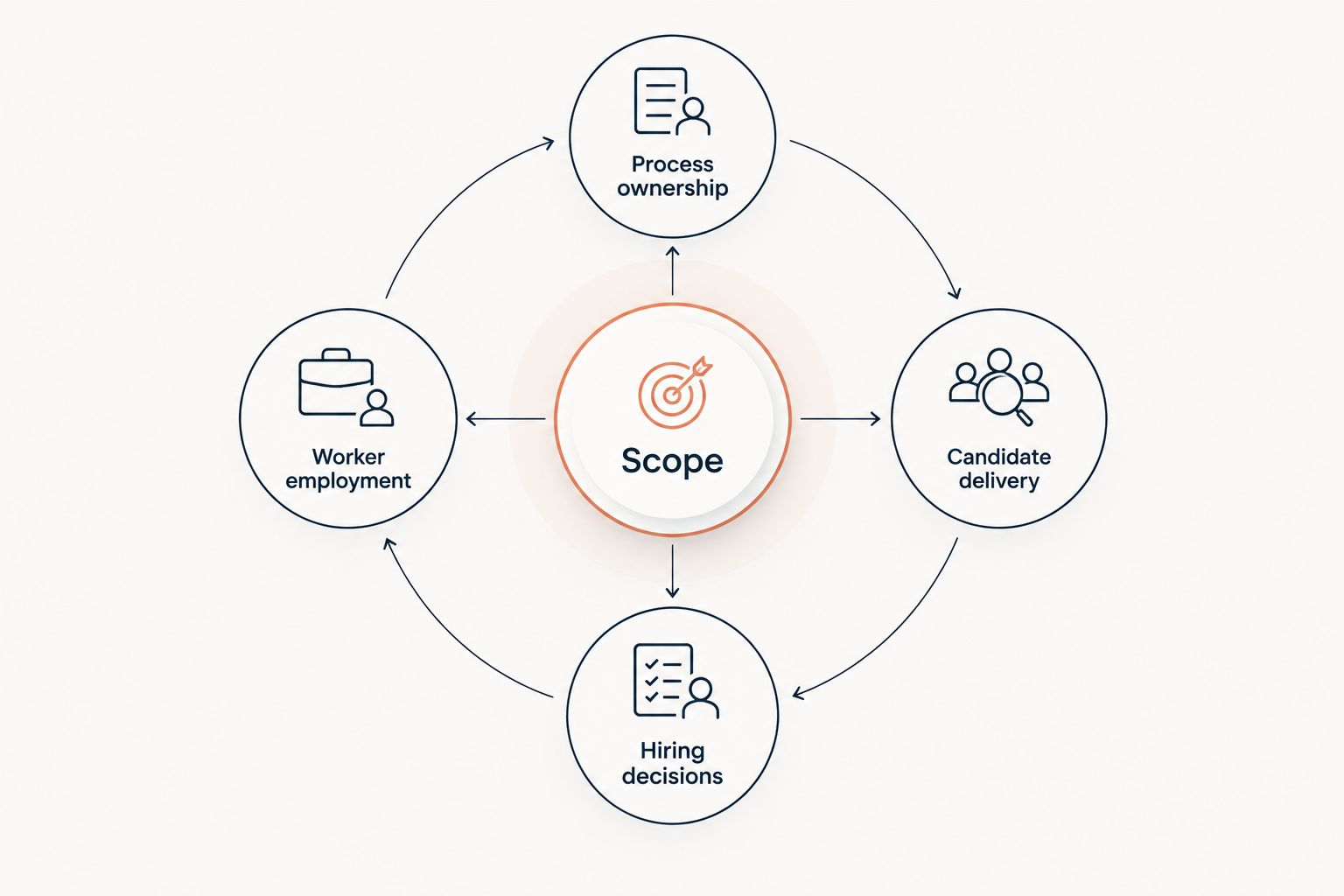
Candidate delivery and worker employment are separate responsibilities.
RPO's limitation is the same feature that makes it useful: deeper responsibility requires clearer operating agreements. If managers will not share requirements or provide feedback, outsourcing does not remove that bottleneck.
Staffing agencies fit defined searches and worker requirements
A staffing agency is the clearer choice when you know the opening and need help filling it. That includes direct-hire searches and temporary staffing requirements, although those services have different contracts and employment arrangements.
You can brief an agency on a role, location, required experience, and hiring process without delegating the entire recruiting function. This suits an employer that wants to retain its internal process while adding outside candidate access or recruiting capacity.
The limitation is scope. An agency engaged to submit candidates is not automatically responsible for redesigning interviews, maintaining your talent-acquisition reporting, or coordinating every other supplier.
Keep the agency model when your internal team already owns recruiting operations and the gap is delivery. Do not replace a working search relationship with RPO merely because you have recurring vacancies; recurring demand alone does not prove you need outsourced process ownership.
RPO fits recruiting programs; agencies fit discrete demand
RPO can support an ongoing recruiting function or a defined project. Project RPO is still process outsourcing when the provider takes responsibility for agreed recruiting activities within that project.
Staffing agencies fit demand expressed as particular searches or assignments. Temporary staffing also addresses a different requirement from permanent recruitment: access to workers for assignments rather than only introductions for direct employment.
For 2026 hiring plans, distinguish more recruiting work from a need for temporary workers. They are not the same problem.
- Choose an RPO discussion when an employer wants someone to operate a defined recruiting program.
- Choose an agency discussion when an employer wants a shortlist for an opening or workers for assignments.
- Define separate scopes when the employer needs both.
Neither model deserves a blanket speed advantage. Role difficulty, candidate availability, interview capacity, and approval delays affect either arrangement. Ask how each provider handles those constraints instead of accepting an unsupported promise about speed.
Staffing agencies are the relevant option for temporary worker supply
RPO is not another name for temporary staffing. An RPO provider recruits on a client's behalf; the RPO label alone does not establish who employs the resulting hires.
In direct-hire agency recruitment, the client hires the selected candidate. In temporary staffing, the agency commonly employs workers assigned to a client, with responsibilities defined by the arrangement and applicable law.
This distinction changes the buying decision. If you need workers supplied for assignments, evaluate the agency's temporary staffing service rather than assuming an RPO proposal includes it.
Employment, payroll, safety, and joint-employment responsibilities require separate review. Requirements vary by state and change; confirm the current arrangement with your own counsel and the responsible labor agencies. Do not treat a service label as a legal allocation of responsibility.
Both models need quality measures tied to their scope
Neither RPO nor a staffing agency wins on quality by definition. Measure the work the provider actually controls, then connect it to hiring outcomes.
An RPO scorecard can include stage progression, candidate experience, process completion, and agreed hiring outcomes. An agency scorecard can include qualified submissions, interviews, accepted offers, completed placements, or assignment performance, depending on the service.
For either model, write down:
- What starts and stops each measurement period.
- Which openings and candidates belong in the calculation.
- How client-side delays are recorded.
- Who investigates rejected submissions or failed handoffs.
For a 2026 comparison, require both proposals to use the same definitions wherever their responsibilities overlap. Otherwise, you are comparing reporting conventions rather than delivery.
Pricing models reward different work, not an automatic winner
RPO arrangements can combine management fees, activity-based charges, per-hire charges, or other agreed components. Agency arrangements can include placement-based fees, retained-search payments, or billing for temporary assignments.
The commercial tradeoff is between committed capacity, defined deliverables, and charges that follow activity. Neither label establishes which proposal is cheaper or more predictable.
Compare proposals against your own hiring plan. Include internal management work, implementation responsibilities, scope changes, and termination terms. Ask what happens when hiring pauses or requirements change. A proposal is not comparable until you understand what work it includes and excludes.
For agency owners, sell the missing responsibility
If you run a staffing business, an employer's interest in RPO does not automatically disqualify the account. Ask which recruiting responsibilities the employer wants to outsource and which suppliers still handle specialist searches or temporary staffing.
StaffingLeads is a staffing business-development tool for agencies targeting accounts through hiring, funding, past-client, and network signals. It identifies decision-makers with verified email and runs email and LinkedIn sequences. It is not an ATS, CRM, staffing agency, or RPO provider.
Use StaffingLeads for the business-development side of the conversation, not candidate delivery. Match your outreach to a specific hiring requirement, then establish whether the buyer wants candidates, workers, or recruiting-process ownership.
A job posting is a reason to investigate. It is not proof that the employer wants an agency or an RPO contract.
Final verdict: choose the responsibility you need covered
Choose RPO if you own an ongoing recruiting program
Winner: RPO for the talent-acquisition leader delegating defined recruiting operations. Choose it when you need an external team accountable for agreed process stages and can provide the access, decisions, and cooperation that scope requires.
Choose a staffing agency if you own specific hiring requirements
Winner: a staffing agency for the hiring manager or internal recruiter needing candidate delivery or temporary staffing. Stay with the agency model when your internal process works and the missing piece is search capacity, specialist candidates, or workers for assignments.
| Dimension | Winner |
|---|---|
| Recruiting-process ownership | RPO |
| Defined searches | Staffing agency |
| Ongoing recruiting programs | RPO |
| Temporary worker supply | Staffing agency |
| Hiring quality | Tie: evaluate delivery against scope |
| Commercial fit | Tie: compare actual contract models |
FAQ
What's the main difference between RPO and a staffing agency?
RPO transfers responsibility for agreed recruiting processes; a staffing agency delivers candidates or workers against client requirements. The contract determines the exact boundaries.
Is RPO better than a staffing agency?
RPO is better for employers outsourcing recruiting operations; a staffing agency is better for defined searches or temporary staffing requirements. Neither model is automatically faster or better at hiring.
Can a staffing agency also offer RPO?
Yes, a staffing agency can offer a separate RPO service. Evaluate the proposed responsibilities rather than assuming every service from that company has the same scope.
Does an RPO provider employ the people it recruits?
An RPO engagement does not by itself make the provider the employer of the resulting hires. Confirm employment and payroll responsibilities in the contract and with your own counsel.
Is RPO only for permanent hiring?
RPO describes outsourced recruiting-process ownership, not a universal employment category. Ask which worker populations and recruiting activities the specific engagement covers.
How do RPO and staffing agency costs compare?
Compare the commercial models and included responsibilities, not the labels. Review committed capacity, activity-based charges, placement arrangements, internal workload, and change terms against your own hiring plan.
Can StaffingLeads replace an RPO provider?
No. StaffingLeads supports staffing business development through signal-based targeting, decision-maker identification, and email and LinkedIn outreach; it does not operate an employer's recruiting function.
One last thing
Before signing a 2026 agreement, ask both providers the same question: What stops being my team's responsibility when this engagement starts? Require a written answer. If both proposals leave you owning the same recruiting work, compare their actual deliverables rather than paying attention to the labels.
Related guides
Let your agent start the conversations.
StaffingLeads watches hiring, funding, past-client and network signals, finds the decision-maker behind each one, and sends personalised email and LinkedIn outreach in your voice. You pick up the replies.
Start your 14-day free trial →Keep reading
Free, no signup