What is a VMS in staffing?

What is a VMS in staffing? It's client-side supplier management software. Learn how it differs from an ATS, CRM, and MSP, and what agencies must check.

A VMS in staffing is a vendor management system: software a hiring company uses to manage staffing suppliers, distribute job requisitions, review candidate submissions, and administer contingent-worker assignments. For your agency, it is the client's hiring-program workspace—not your applicant tracking system, and not a source of guaranteed job orders or placements.
TL;DR
- What is a VMS in staffing? A vendor management system coordinates a client's staffing suppliers and contingent hiring workflow.
- A VMS is software; an MSP is a service provider that can manage the staffing program.
- Use a VMS for client-program participation, an ATS for candidate delivery, and a CRM for relationship management.
What is a VMS in staffing?
A vendor management system gives a hiring organization a central place to coordinate external staffing suppliers. Depending on the program, it can cover requisitions, submissions, interviews, assignment approvals, time entry, and invoicing.
The client controls the program; your agency works within its rules. Access to the software does not automatically make you an approved supplier or authorize you to submit candidates.
A typical staffing workflow looks like this:
- Supplier approval. Your agency completes the client's supplier qualification and contracting process.
- Job release. The client or program manager distributes an approved requisition to eligible suppliers.
- Candidate submission. Your recruiter submits a candidate using the required fields and documents.
- Hiring review. The client reviews submissions, arranges interviews, and approves a selection.
- Assignment management. The program records assignment details and, where configured, handles time approval and invoicing.
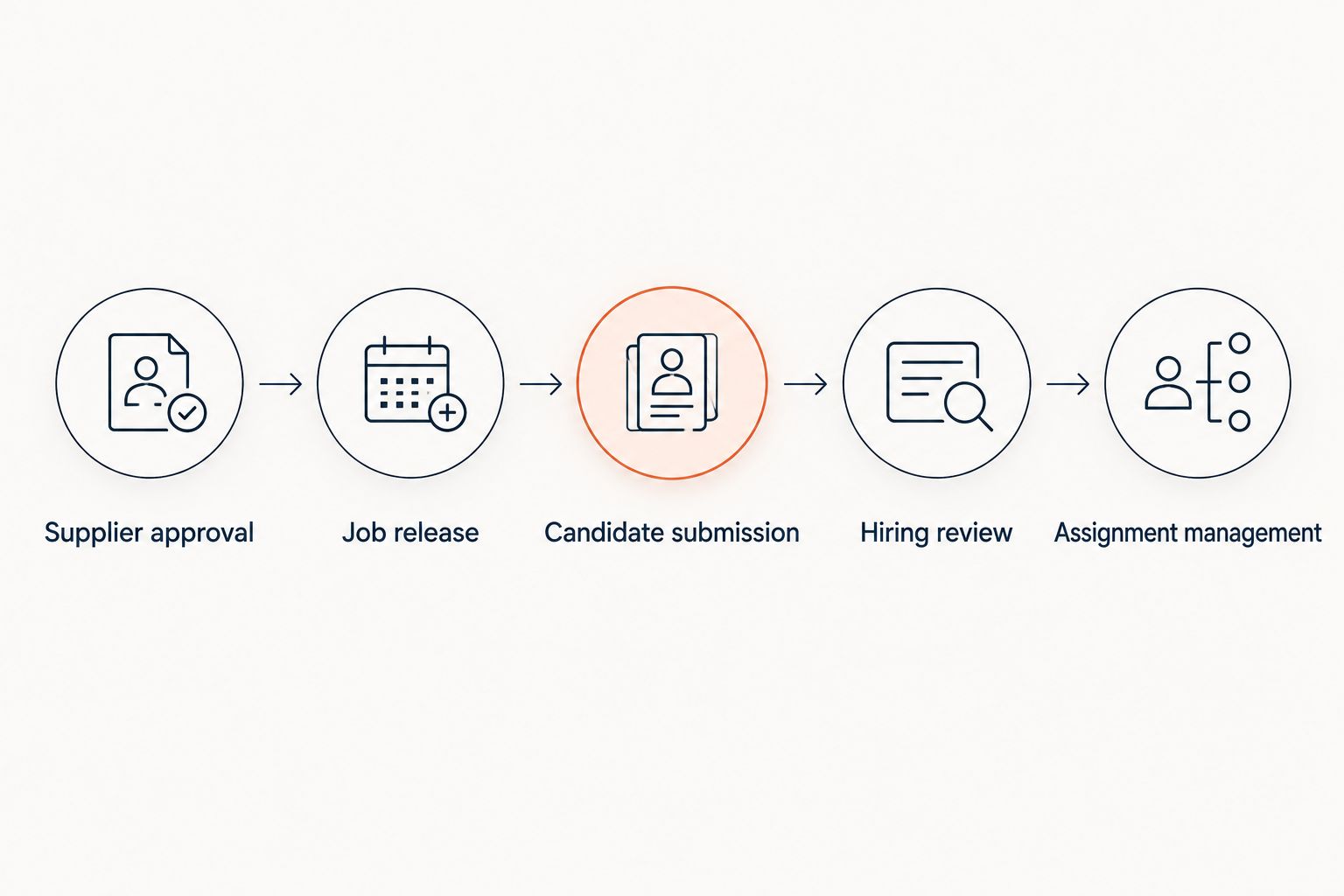
Supplier approval comes before candidate submission; system access alone does not establish supplier status.
Your agency still needs a way to manage recruiting activity outside the client's system. The guide to recruiting software for staffing firms explains the broader software categories.
Why this matters
For a staffing agency evaluating a client program in 2026, the important question is not simply whether the client uses a VMS. It is whether your agency can win and deliver suitable assignments under that program's rules.
Separate access from opportunity. Before assigning recruiting capacity, confirm which requisitions you can receive, who reviews submissions, and how your team gets feedback. A visible job order is not the same as an exclusive assignment or a committed hiring decision.
How is a VMS different from an ATS or CRM?
A VMS manages the client's supplier workflow; an ATS manages your recruiting workflow. A recruitment CRM manages prospect and client relationships. These functions overlap at the edges, but they solve different problems.
| System | Best for | Main strength | Main limitation |
|---|---|---|---|
| VMS | Participating in a client's contingent staffing program | Centralizes supplier submissions and program administration | Does not replace your agency's candidate pipeline or prospecting process |
| ATS | Managing candidate delivery | Organizes applicants, recruiting stages, and placement activity | Does not grant access to a client's supplier program |
| Recruitment CRM | Managing business relationships | Organizes prospects, clients, and follow-up activity | Does not replace the client's requisition and approval rules |
When reviewing your stack in 2026, map the work before choosing software. Ask where recruiters source candidates, where client relationships live, and where the client requires submissions. Do not assume that entering information in one system updates another; confirm each supported connection separately.
Is a VMS the same as an MSP?
A VMS is software; an MSP is a managed service provider. In contingent staffing, an MSP can administer the client's supplier program and use a VMS to run its workflow.
The distinction affects whom you contact. A technical access problem belongs with the designated system support contact. A question about supplier eligibility, requisition distribution, or program performance belongs with whoever owns that part of the program.
Ask the client to identify those owners. The hiring manager, procurement team, and MSP can have different responsibilities; do not infer decision authority from a person's access to the platform.
Why VMS workflows vary
There is no universal supplier experience. In 2026, evaluate the client's configured program rather than assuming every VMS works the same way.
- Program ownership. A client-managed program and an MSP-managed program can route questions and approvals differently.
- Supplier eligibility. Your approval can apply to particular job categories, locations, or business units rather than every requisition.
- Requisition distribution. Confirm which suppliers receive a role and whether release timing differs between supplier groups.
- Submission requirements. Candidate consent, required documents, duplicate-submission rules, and submission limits depend on the program.
- Assignment administration. Establish who approves time, handles assignment changes, and resolves invoice discrepancies.
Get these answers from the supplier agreement, operating guide, and program contact. A software demonstration shows functionality; it does not establish your commercial or operational rights.
Should a small staffing agency accept VMS work?
Accept VMS work when the program fits your niche and delivery capacity—not simply because it offers access to a large client. The benefit is a defined route into an established staffing program. The limitation is that your agency must compete and deliver within rules it does not control.
Before committing recruiters, check:
- Whether released roles match your candidate network.
- Whether you can satisfy the required screening and documentation.
- Whether submission feedback is clear enough to guide recruiting effort.
- Whether assignment administration fits your operating process.
- Whether the agreement supports your agency's cash-flow needs.
For a 2026 program review, use your own records to assess accepted submissions, interviews, starts, and recruiter effort. Compare like-for-like roles rather than treating every requisition as an equal opportunity.
Does a VMS help you find new staffing clients?
A VMS supports supplier participation after the relevant approval process. It is not a substitute for identifying target accounts, reaching decision-makers, and earning a place in the buying process.
StaffingLeads is best for staffing agencies that need signal-led prospecting and outreach, not VMS administration. StaffingLeads watches hiring, funding, past-client, and network signals, identifies decision-makers with verified email, and runs email and LinkedIn sequences. It is not an ATS or CRM, and it does not integrate with Bullhorn, Salesforce, or HubSpot.
Keep prospecting separate from program delivery. When approaching an account in 2026, establish whether it buys staffing directly, uses an MSP, or requires supplier onboarding before discussing candidate submissions.
FAQ
What does VMS stand for in staffing?
VMS stands for vendor management system. Hiring organizations use it to coordinate staffing suppliers, requisitions, submissions, and contingent-worker administration.
Is a VMS the same as an applicant tracking system?
A VMS is not the same as an applicant tracking system. A VMS manages the client's supplier program, while an ATS manages candidate and recruiting activity.
Who uses a VMS in a staffing program?
Client program teams, hiring managers, staffing suppliers, and sometimes an MSP use a VMS. Their permissions and responsibilities depend on the program.
Can a staffing agency submit candidates immediately after getting VMS access?
VMS access does not automatically authorize candidate submissions. Confirm supplier approval, eligible job categories, and submission rules before sending candidate information.
Does every VMS include timesheets and invoicing?
Do not assume every VMS program includes timesheets and invoicing. Confirm the modules and workflow the client actually uses.
Does joining a VMS guarantee staffing placements?
Joining a VMS does not guarantee staffing placements. Your agency still needs eligible requisitions, suitable candidates, and client selection.
One last thing
Before recruiting against a VMS requisition, confirm it is still open to your supplier account. Then check candidate ownership and duplicate-submission rules. Those checks establish whether your recruiter can make a valid submission before spending time on delivery.
Related guides
Let your agent start the conversations.
StaffingLeads watches hiring, funding, past-client and network signals, finds the decision-maker behind each one, and sends personalised email and LinkedIn outreach in your voice. You pick up the replies.
Start your 14-day free trial →Keep reading
Free, no signup