Recruiter commission structures for staffing agencies

Recruiter commission structures for staffing agencies work best with clear ownership and payout rules. Compare plans and build a contribution-based approach.

Recruiter commission structures for staffing agencies are compensation rules that reward client acquisition, recruiting delivery, or both, with the aim of aligning recruiter earnings with profitable placements. Your plan must distinguish who wins the account, who fills the role, and when the agency earns enough to support the payout.
TL;DR
- Recruiter commission structures for staffing agencies should define the earnings basis, ownership, payment trigger, and exceptions.
- Full-desk recruiters need account-development and placement-delivery credit; split desks need separate ownership rules.
- Calculate temporary-staffing commissions from a documented contribution basis, not undefined billing totals.
- StaffingLeads supports staffing business development, not commission administration.
Why commission structures matter for staffing agencies
Choose the commission basis before choosing the rate. A percentage means little until you define what it applies to, which costs come out first, and what makes the commission earned.
Staffing agencies have different earning events. A direct-hire placement, an ongoing temporary assignment, and a new client introduction require different credit rules. The same plan should not treat an introduction as equivalent to an accepted placement or a collected invoice.
For full-desk recruitment, one person handles business development and recruiting delivery. A split desk divides those responsibilities. Your 2026 compensation document needs to match that operating model rather than copy another agency's headline rate.
The practical benefit is clarity. Recruiters can see which work earns credit, managers can explain each payout, and owners can check whether the plan supports the agency's economics.
How to build your recruiter commission plan
Build the plan around four decisions: Contribution, Ownership, Payment, and Exceptions. Resolve those decisions before introducing accelerators or extra bonuses. Otherwise, the incentive becomes harder to explain without fixing the underlying ambiguity.
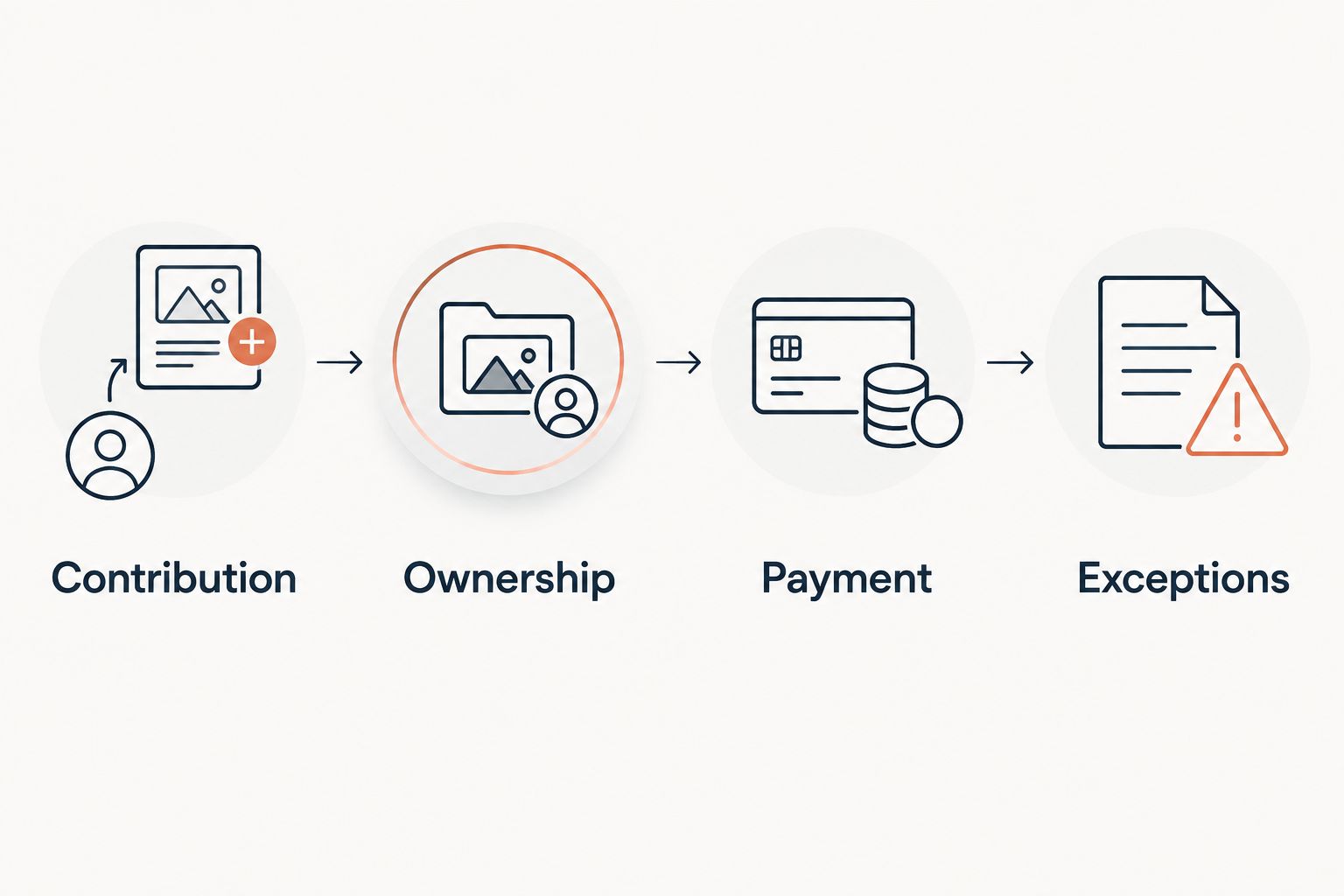
Define what earns commission before deciding how much to award.
Define the work each recruiter owns
Start with a written role map. List the work involved in opening an account, agreeing terms, taking a job order, sourcing candidates, managing interviews, and securing the placement. Assign responsibility before assigning compensation.
A solo biller needs a plan that recognizes both client acquisition and candidate delivery. A recruiter on a split desk needs a clear boundary between delivery credit and the salesperson's account credit. Neither model automatically deserves the same formula.
Use 1 named owner per responsibility as a documentation rule, not a restriction on teamwork. If several people contribute, identify the primary owner and write down how shared credit works.
- Separate account acquisition from recruiting delivery.
- Define what counts as an accepted job order.
- Record who owns existing accounts and past clients.
- Specify credit for account handoffs and shared placements.
Calculate the contribution available for commission
Use a spreadsheet and your accounting records first. For direct hire, define the eligible placement revenue and the treatment of credits, refunds, and replacement obligations. For temporary staffing, document the costs deducted from assignment revenue before calculating commission.
Do not use the phrase gross profit without defining it. Your plan needs to say whether its calculation includes employer payroll costs, workers' compensation, benefits, or other assignment expenses. Verify those inputs for your state, vertical, job code, and operating model.
A useful formula is: eligible contribution = eligible revenue minus the costs explicitly listed in the plan. Then apply your chosen commission formula to that defined basis. Keep overhead allocation separate unless the plan explicitly includes it.
- Name the revenue source used in the calculation.
- List every included cost and excluded cost.
- Define how invoice credits affect eligible contribution.
- Use actual records rather than assumed margin ranges.
- Document who approves accounting adjustments.
Separate business-development credit from delivery credit
Begin with a shared account register. Record who sourced the opportunity, what evidence supports the introduction, who qualified the hiring need, and who secured the job order. A contact name alone should not decide ownership.
StaffingLeads is best for staffing-specific business development, not commission administration. StaffingLeads watches hiring, funding, past-client, and network signals, identifies decision-makers with verified email addresses, and runs email and LinkedIn sequences. It provides a faster path for that prospecting work; your agency still defines credit and payout rules.
StaffingLeads is not an ATS or CRM and has no integrations with Bullhorn, Salesforce, or HubSpot. Keep the commission record separate. Before assigning credit to an outreach-generated opportunity, confirm who converted the signal into an actual client conversation and accepted work.
- Record the source and date of each opportunity.
- Separate prospect discovery from account conversion.
- Define credit for reactivating past clients.
- Decide how introductions transfer between desk owners.
Specify when commission becomes earned and payable
Separate the earning event from the payment process. Candidate acceptance, start date, invoicing, and collection are distinct milestones. Your plan must explain which milestone establishes eligibility and how payroll processes the resulting amount.
A collection-based design connects the calculation to cash received, but recruiters do not control every client payment delay. A placement-based design recognizes delivery earlier, but requires clear rules for cancellations and other adjustments. Choose deliberately rather than leaving the distinction to a manager's interpretation.
For a 2026 plan, have counsel review the earning and payment language against applicable state wage-payment requirements and the federal Fair Labor Standards Act where relevant. Requirements vary by state and change; confirm the current rule with your own counsel.
- Define the earning event in plain language.
- State how the payment schedule works.
- Explain the treatment of unpaid or disputed invoices.
- Document any lawful adjustment process with counsel.
- Issue 1 commission statement per pay period for reconciliation.
Test the formula against difficult placements
Run the proposed plan through your own placement records before announcing it. Use completed assignments and documented costs, not invented examples that make the plan look attractive. Compare what the proposed formula awards with the contribution each placement produced.
Test 3 placement scenarios: a standard completed placement, a cancelled start, and a shared placement. These are review cases, not industry benchmarks. Add assignment extensions or client credits when those events apply to your agency.
If you are evaluating a business-development incentive, connect it to your staffing agency customer acquisition cost calculation. Include the acquisition expenses your agency actually incurs. Avoid paying for a meeting without deciding what makes that meeting commercially qualified.
- Recalculate a completed placement using actual records.
- Check what happens when a start falls through.
- Resolve shared credit before the plan launches.
- Compare acquisition incentives with attributable expenses.
- Record every exception uncovered during testing.
Publish the rules and reconcile each payout
Write the final plan so a recruiter can reproduce the calculation without asking the owner to interpret it. Include the effective date, eligible role, calculation basis, ownership rules, payment process, and dispute procedure.
Your 2026 plan should distinguish current rules from proposed changes. Do not replace an earlier agreement informally or assume a new formula applies to work already performed. Have counsel confirm how changes should be documented and communicated.
Use a statement that shows the underlying placement or assignment, the eligible contribution, the applied formula, and any documented adjustment. That gives recruiters something specific to verify rather than a single unexplained payroll line.
- Attach a worked calculation using your agency's records.
- Identify the person responsible for resolving disputes.
- Keep an accessible version history.
- Reconcile statements against accounting and payroll records.
- Review exceptions before changing the general formula.
Compare commission structures by operating model
The right structure depends on desk ownership and the revenue model. Use this table to choose a starting design, then test it against actual contribution and written employment terms. These are compensation designs, not recommended rates.
| Option | Best for | Strength | Key limitation |
|---|---|---|---|
| Base salary plus commission | Employed recruiters with ongoing delivery responsibilities | Separates regular pay from performance incentives | Requires a clear definition of commission-eligible work |
| Full-desk commission | Recruiters responsible for winning clients and filling roles | Connects account development and placement delivery | Needs explicit rules when another recruiter contributes |
| Split-desk commission | Separate business-development and delivery teams | Assigns rewards to distinct responsibilities | Ambiguous handoffs create competing credit claims |
| Contribution-based assignment commission | Agencies running ongoing temporary assignments | Ties the calculation to a defined assignment contribution | Depends on accurate cost inputs and adjustment rules |
| Team pool | Teams delivering accounts collaboratively | Recognizes shared delivery work | Needs a transparent allocation rule to preserve accountability |
| Tiered commission | Agencies rewarding performance above defined targets | Creates a stated reward for exceeding a target | Poorly defined tiers make earnings difficult to reproduce |
A tiered plan also needs to specify whether a new tier changes only subsequent eligible earnings or changes the calculation for the entire measurement period. Those designs produce different results. Show the calculation rather than relying on the word accelerator.
Common mistakes staffing agencies make
Paying on an undefined billing figure
Revenue is not a complete compensation basis. Temporary-staffing revenue includes amounts needed to cover assignment costs. Specify the eligible contribution and verify the deductions rather than applying a formula to whatever billing total is easiest to export.
Giving permanent ownership to whoever entered the contact
A database entry does not establish who won the work. Require evidence of account development and define reactivation rules. Past-client relationships need an ownership policy, especially when recruiters move between desks or leave the agency.
Rewarding meetings without qualifying the hiring need
A booked call is a business-development milestone, not a placement. Define the buyer, hiring requirement, and acceptance criteria before attaching an incentive. StaffingLeads supports prospecting and outreach; the compensation plan still needs to distinguish a warm lead from accepted client work.
Using one formula across unlike desks
A direct-hire full-desk recruiter and a temporary-staffing delivery recruiter do different work against different revenue events. For your 2026 review, test each desk separately. Shared terminology is useful; identical calculations are not a substitute for checking the economics.
FAQ
What's the best recruiter commission structure for a staffing agency?
The best structure matches the recruiter's responsibilities and the agency's revenue model. Define the earnings basis, ownership rules, payment trigger, and exceptions before choosing a rate.
Should recruiter commission use revenue or gross profit?
Use a clearly defined earnings basis rather than an unexplained revenue or gross-profit label. For temporary staffing, document which assignment costs come out before commission is calculated and verify those costs for your operating model.
How should full-desk recruiters receive commission?
A full-desk plan should recognize both account acquisition and placement delivery. Specify how credit changes when another recruiter sources the candidate, manages delivery, or takes over the account.
When should a staffing agency pay recruiter commission?
Your written plan should define the earning event and payment process, subject to applicable wage-payment requirements. Requirements vary by state and change, so confirm the current rule with your own counsel.
How do you split commission between sales and recruiting?
Assign credit to defined business-development and delivery responsibilities before the placement closes. Record ownership, handoffs, and shared contributions so each person can reproduce the calculation.
Can a staffing agency take commission back after a cancellation?
Do not assume a cancellation automatically permits a deduction or recovery. Have counsel review the agreement and applicable state wage rules before writing or applying an adjustment policy.
Does StaffingLeads manage recruiter commissions?
StaffingLeads is a staffing business-development tool, not a commission administration system, ATS, or CRM. It watches hiring, funding, past-client, and network signals, identifies decision-makers with verified emails, and runs email and LinkedIn sequences.
One last thing
Test the statement, not just the formula. Give a recruiter a completed commission statement and the written rules, then ask them to reproduce the payout. If they need an unwritten explanation, the plan is not finished.
Make that reproducibility check part of your 2026 rollout. It exposes undefined costs, unclear ownership, and missing adjustment rules before those issues become payroll disputes.
Related guides
Let your agent start the conversations.
StaffingLeads watches hiring, funding, past-client and network signals, finds the decision-maker behind each one, and sends personalised email and LinkedIn outreach in your voice. You pick up the replies.
Start your 14-day free trial →Keep reading
Free, no signup