When to hire your first recruiter — resourcer or BD first?

Decide when to hire your first recruiter: resourcer for delivery, BD for client demand. Check workload, cash collections, and handoffs before adding headcount.

Hire your first recruiter when a repeatable workload exceeds your capacity, you can hand over a defined part of the desk, and cash collections can support the commitment. Hire a resourcer first when signed client work is waiting on candidate delivery; hire a business-development specialist first when delivery has capacity but qualified client conversations are missing. If neither constraint is clear, keep the desk founder-led until you know which work the hire will own.
TL;DR
- When to hire your first recruiter depends on the bottleneck: candidate delivery, client acquisition, or both.
- Resourcer first: best for agencies with qualified client assignments and a repeatable candidate-search process.
- BD first: best for agencies with delivery capacity and a defined client-acquisition process.
- StaffingLeads supports staffing business development and automated outreach; it does not replace candidate delivery or sales judgment.
When should you hire your first recruiter: resourcer or BD first?
Your first hire should take ownership of the work that stops your agency from progressing qualified opportunities. A crowded calendar is not enough. Separate candidate delivery from client acquisition before choosing the role; a full-desk recruitment model combines those responsibilities, but your first employee does not have to inherit both.
| First-hire option | Best for | Main strength | Main limitation | Hire when |
|---|---|---|---|---|
| Resourcer | Owners with qualified assignments but limited sourcing capacity | Takes candidate research, sourcing, and agreed screening work off the owner | Does not solve a shortage of client demand | Candidate delivery is the constraint |
| BD specialist | Agencies with delivery capacity but too few qualified client conversations | Gives prospecting and follow-up a clear owner | Needs an ICP, a credible offer, and a sales handoff | Client acquisition is the constraint |
| Full-desk recruiter | Agencies with a repeatable desk and broad responsibilities to transfer | Can own client and candidate activity together | Requires a broader skill set and more complex onboarding | Both sides of the desk are defined and transferable |
| Defer the hire | Owners still testing their niche or operating process | Preserves cash while the owner clarifies the model | Leaves capacity concentrated with the founder | The job cannot yet be described clearly |
Choose the role from the workload, not from the title. A resourcer cannot fix weak client qualification. A BD hire cannot fix a delivery process that loses candidates after the shortlist.
Why this matters
Your first employee changes your job. You still need to win business and make placements, but you also need to assign work, review quality, and resolve exceptions. Delegation requires management capacity as well as payroll capacity.
For your 2026 hiring plan, write down what you will stop doing and what you will keep. If the answer is simply that the new recruiter will help with everything, the role is not ready. Give the hire a defined output and give yourself a defined management responsibility.
Hire a resourcer first when candidate delivery is the constraint
A resourcer is the better first hire when you have qualified assignments but cannot give candidate search enough attention. Keep client qualification, account management, and closing with the owner while transferring a specific sourcing workflow.
Check the assignments before hiring. Confirm that the client has explained the role, that you understand the candidate requirements, and that there is a workable interview process. An unqualified job order is not reliable evidence of delivery demand.
A practical resourcer handoff includes:
- Search brief: Required experience, location constraints, role requirements, and exclusions.
- Candidate sourcing: Where to search and what makes a profile relevant.
- Screening scope: Which questions the resourcer owns and which require your judgment.
- Submission standard: What information must accompany a candidate recommendation.
- Escalation rules: When to bring a mismatch, client objection, or candidate concern back to you.
The strength of this hire is a focused handoff. The limitation is that you retain the commercial side of the desk. If prospecting disappears while you manage sourcing, the agency still depends on you to replenish client work.
Review your 2026 assignment history by client and role type. Separate recurring, qualified work from isolated requests. Hire against work you can explain and transfer, not a list of vacancies you hope to fill.
Hire BD first when client acquisition is the constraint
A BD specialist is the better first hire when your agency can deliver candidates but lacks consistent, qualified client conversations. Define the target account and the next step before handing over outreach.
Your BD hire needs more than a contact list. Document the ICP, the hiring problems you address, the decision-maker you want to reach, and the evidence that makes an account relevant. Specify what counts as a qualified meeting rather than accepting every booked call as progress.
Keep the initial handoff narrow:
- Account selection: Which employers fit your niche and which to exclude.
- Decision-maker research: Who owns the hiring problem or agency relationship.
- Outreach: What the message says and which evidence supports it.
- Qualification: What must be established before a meeting reaches the owner.
- Sales handoff: What context the owner needs to continue the conversation.
The strength is dedicated attention to new-client development. The limitation is dependence on a clear offer and credible delivery. A BD hire should not be asked to discover your niche, build your sales process, and sell an undefined service at the same time.
In your 2026 BD plan, assign ownership after the meeting. Decide who runs discovery, agrees next steps, and follows up. A booked call is a handoff, not a completed sale.
Hire a full-desk recruiter only when the desk is transferable
A full-desk recruiter fits when client acquisition and candidate delivery are both established enough to hand over. This role is not a shortcut around choosing priorities. It combines responsibilities that still need clear expectations.
Document the account boundaries, candidate ownership, escalation rules, and decision rights. Explain which activities the recruiter owns independently and which need approval. Without those boundaries, you have hired another person to share your uncertainty.
The advantage is broad ownership. The drawback is a more demanding handoff: you must assess and support both commercial and delivery skills. Stay with a narrower hire when your immediate constraint sits clearly on one side of the desk.
How do you confirm that you are ready to hire?
Use this sequence before publishing the vacancy. Each step should produce something you can show a candidate or use during onboarding.
- Find the bottleneck. Record where qualified work waits: sourcing, screening, prospecting, qualification, or follow-up. Include your own interruptions and rework.
- Define the output. Write what the employee will deliver and what acceptable quality looks like. Keep activity measures separate from business outcomes.
- Document the handoff. Prepare the brief, access requirements, working process, and escalation rules. Walk through a real assignment or prospect with the candidate.
- Check the cash. Map employment commitments against expected collections, existing obligations, and a slower-collection scenario.
- Set the review. Agree how you will inspect work, give feedback, and decide whether the role is relieving the original constraint.
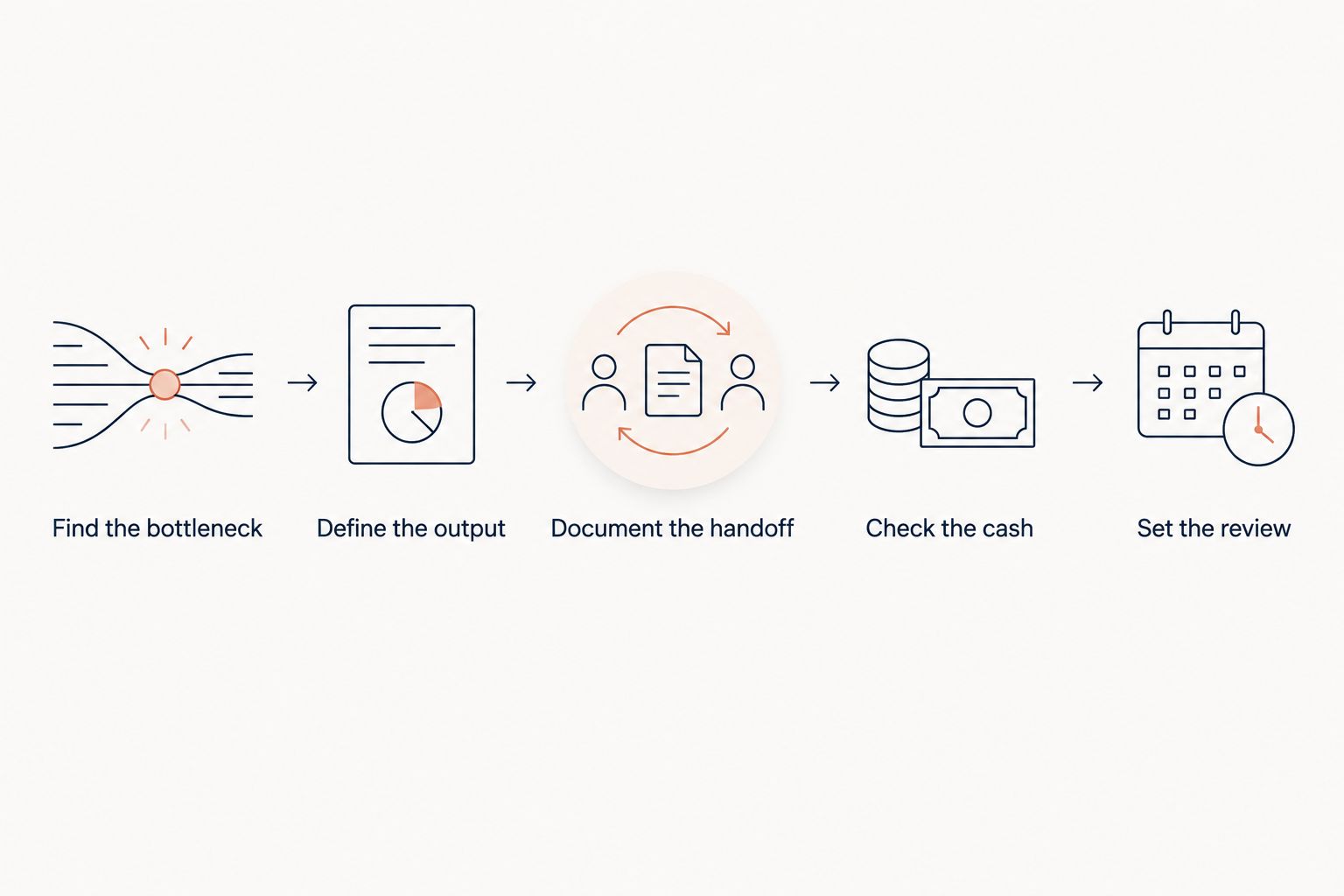
Define the work and cash commitment before opening the vacancy.
Build the cash check from your own operating model. Include salary, applicable employer obligations, tools, recruitment expenses, and the management work you must absorb. Use confirmed terms and your actual collection history rather than treating an expected placement as cash already received.
For temporary staffing, review the payroll commitments tied to active assignments separately from your internal hire. For permanent recruitment, map when placement revenue is expected to be collected. Your 2026 hiring decision needs a cash plan, not just a revenue target.
Why the right first hire varies
The same title can solve different problems at different agencies. Base the decision on these factors:
- Demand quality: Qualified assignments justify delivery capacity; untested employer interest does not.
- Delivery capacity: Available recruiter capacity changes whether new client demand is the immediate priority.
- Process clarity: A documented workflow gives a new employee something specific to own.
- Owner involvement: Work that still requires your approval remains part of your workload.
- Operating model: Temporary and permanent staffing require different cash-planning assumptions.
- Collection timing: Expected revenue and available cash are not interchangeable.
Can outreach software replace your first BD hire?
Software can take on defined prospecting and outreach tasks, but it does not take ownership of discovery, commercial judgment, or client relationships. Decide which tasks need execution and which need a person accountable for the outcome.
StaffingLeads watches hiring, funding, past-client, and network signals, identifies decision-makers with verified email, and runs email and LinkedIn sequences. StaffingLeads is best for staffing owners who need signal-led prospecting and automated outreach, not candidate delivery.
The limitation matters: StaffingLeads is a staffing business-development tool, not an ATS or CRM. It has no integrations with Bullhorn, Salesforce, or HubSpot. Keep candidate operations, sales ownership, and recordkeeping responsibilities explicit when deciding between software and headcount.
Should you hire a resourcer if you have no signed client work?
Do not hire a resourcer solely to compensate for missing client demand. First establish what work the person will own, who needs that work, and how the commitment fits your cash plan. Candidate sourcing without a defined commercial purpose does not resolve the sales constraint.
Should you keep selling after hiring a BD specialist?
Keep the owner responsible for the parts of the sale that have not been transferred. A BD specialist can own account research, outreach, and qualification while you retain discovery and closing. Expand ownership only after the handoff works in practice.
FAQ
When should I hire my first recruiter?
Hire your first recruiter when qualified work exceeds your capacity, the responsibilities are transferable, and cash collections support the commitment. Identify whether candidate delivery or client acquisition is the constraint before choosing the role.
Is a resourcer or BD specialist better as my first hire?
A resourcer is better when qualified assignments are waiting on candidate delivery; a BD specialist is better when delivery has capacity but client acquisition is the constraint. Neither role fixes an undefined operating process.
Should my first recruiter run a full desk?
Choose a full-desk recruiter only when both client acquisition and candidate delivery are defined enough to transfer. A narrower role is the clearer choice when the immediate constraint sits on one side of the desk.
How do I work out whether I can afford a recruiter?
Compare the hire's actual employment commitments with expected cash collections and existing obligations. Include tools, recruitment expenses, and management capacity, then test a slower-collection scenario.
Can StaffingLeads replace a candidate resourcer?
StaffingLeads does not replace a candidate resourcer. It supports staffing business development through hiring, funding, past-client, and network signals, decision-maker identification, and email and LinkedIn outreach.
What should I measure after making the first hire?
Measure whether the hire relieves the original bottleneck without creating unacceptable rework. Review output quality, handoff completeness, and the owner's remaining involvement rather than relying only on activity totals.
One last thing
Before approving your 2026 first hire, write a stop-doing list for yourself. Name the responsibilities that will leave your desk and the decisions that will remain. If every task still needs your intervention, simplify the handoff before adding headcount.
Related guides
Let your agent start the conversations.
StaffingLeads watches hiring, funding, past-client and network signals, finds the decision-maker behind each one, and sends personalised email and LinkedIn outreach in your voice. You pick up the replies.
Start your 14-day free trial →Keep reading
Free, no signup