How to Evaluate a Staffing Business for Sale

Evaluating a staffing business for sale in 2026? Check client concentration, revenue mix, compliance history, and recruiter retention before you buy.

A staffing business for sale is not the same asset as a staffing agency's website or its office lease — the real thing you're buying is a client list, a recruiter bench, and a compliance record, and each of those can be strong or rotten independent of the other two. This guide ranks the staffing niches you'll see listed for sale in 2026 by who they fit best, and gives you the checklist to run before you sign anything.
TL;DR
- A light industrial or general staffing book is the best staffing business for sale for a first-time buyer who wants fast cash flow.
- An IT/tech staffing book carries the highest margins but the most client concentration risk in 2026.
- Healthcare and travel nurse agencies hold up best in a downturn if VMS accounts are active, not dormant.
- Client concentration above roughly a third of revenue in one account is the single biggest deal-killer in staffing acquisitions.
- Recruiter retention post-sale matters more than the P&L — the relationships are the asset, not the desks.
Why this matters
Staffing is a service business with almost no hard assets. When you buy one, you're buying trust — a hiring manager's habit of calling this recruiter first, a biller's relationship with three accounts on a full-desk recruitment model, a payroll funding line that keeps contractors paid on time. None of that shows up cleanly on a balance sheet, and sellers have every incentive to present it in the best light.
Buyers who skip structured evaluation tend to overpay for a client list that evaporates within 12 months of the transition. The niches below carry different risk profiles, and the right pick depends on your operating experience, your appetite for compliance overhead, and how much of the existing team you expect to keep.
Best overall for a first-time buyer: a light industrial or general staffing book with diversified temp billings. Best for margin: an IT/tech staffing book with strong perm placement fee history. Best for downturn resistance: a healthcare or travel nurse agency with active VMS accounts. Best for a solo operator: a small executive search or RPO practice with a loyal, if concentrated, client base.
What makes a staffing business worth buying
- Client concentration — no single account should carry more than roughly a third of trailing revenue
- Revenue mix — the ratio of recurring temp/contract billings to one-time perm placement fees
- Recruiter and relationship transferability — whether billers, and the clients they own, stay through the transition
- Compliance and licensing history — state staffing licenses, workers' comp experience modifier, and any wage-and-hour findings
- Payroll funding structure — in-house payroll versus a factoring or funding partner, and what happens to that line at close
- Tech and pipeline health — how much of the ATS/CRM data is live job orders versus dormant accounts
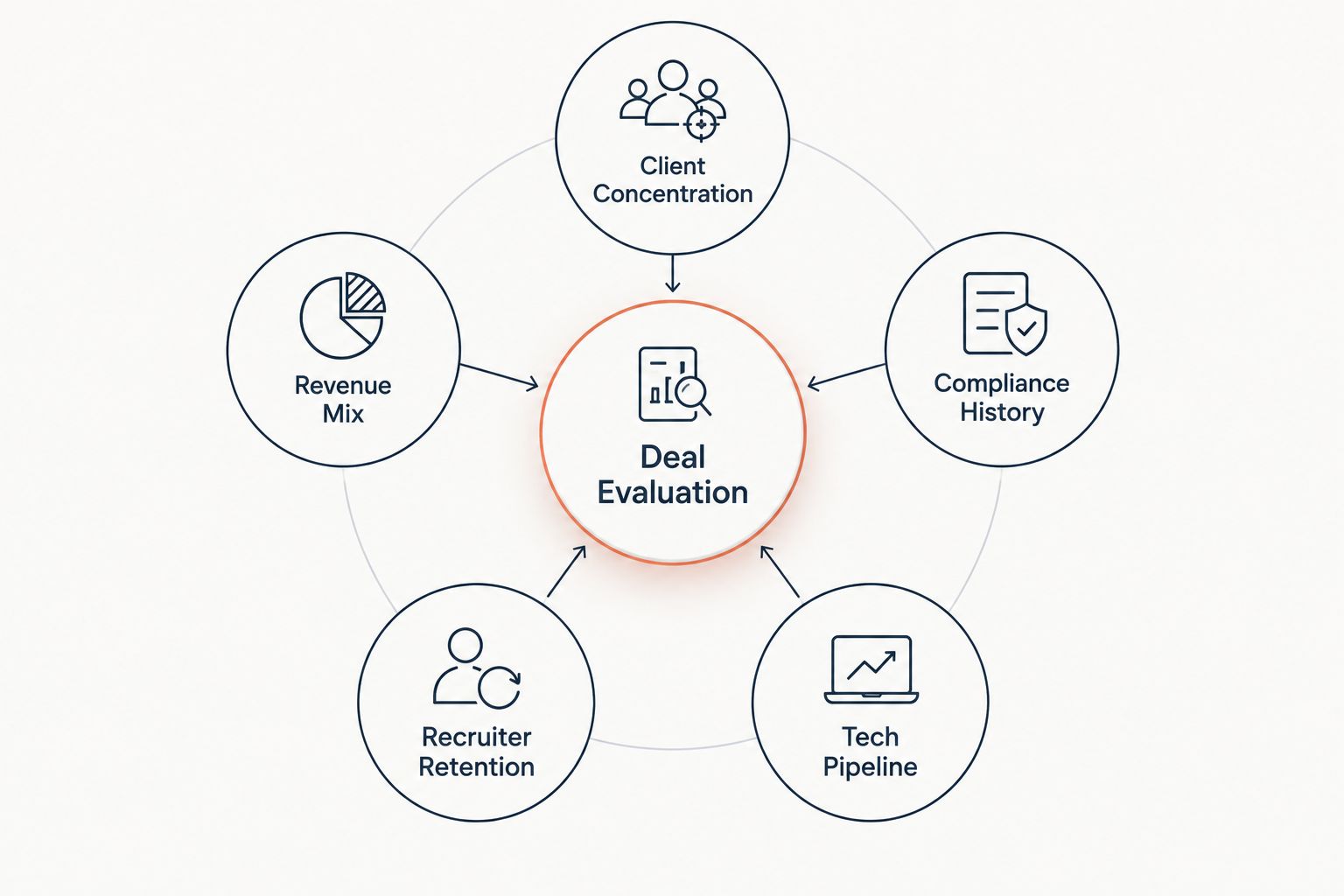
Client concentration and recruiter retention decide whether the deal holds up past year one.
Staffing business for sale, at a glance
| Business type | Best for | Standout feature | Key limitation |
|---|---|---|---|
| Light industrial / general staffing | First-time buyer wanting fast cash flow | High order volume, short fill cycle | Thin margins, high contractor turnover |
| IT / tech staffing book | Buyer wanting the highest margins | Strong perm placement fee mix | Revenue concentrated in a handful of accounts |
| Healthcare / travel nurse agency | Buyer wanting recession resistance | Steady demand, active VMS relationships | Heavy credentialing and compliance load |
| Administrative & clerical shop | Buyer wanting low operating complexity | Simple compliance, low licensing burden | Lower fee per placement, price competition |
| Executive search / RPO firm | Solo buyer wanting relationship-driven work | High fee per search, low overhead | Lumpy revenue, hard to scale without a name |
1. Light industrial / general staffing: best staffing business for sale for a first-time buyer
This is the volume play — warehouse, logistics, and manufacturing placements billed weekly through a temp desk. What you're buying is a client roster of plant managers and ops directors, plus whatever payroll funding arrangement keeps contractors paid between invoices.
Light industrial pros:
- Fast, predictable cash flow from weekly billing cycles
- Lower barrier for a first-time owner without deep niche expertise
- Easier to replace a departing recruiter than in a relationship-heavy vertical
Light industrial cons:
- Margins run thin and clients switch vendors on price
- Contractor turnover means the pipeline needs constant refilling
- Workers' comp experience modifier can be a hidden liability if the seller's safety record is weak
Verdict: Buy if you want operational cash flow fast and you're comfortable running a high-volume desk from day one.
2. IT / tech staffing book: best staffing business for sale for margin
Higher fees, fewer placements. A tech staffing book usually mixes contract-to-hire IT roles with direct-hire perm fees, and the client list skews toward a smaller number of larger accounts.
IT staffing pros:
- Perm placement fees carry meaningfully higher margin than temp billing alone
- Skilled candidate pipelines are harder for a buyer to replicate from scratch
- Tech hiring cycles have historically moved faster than industrial hiring, which shortens the sales cycle for new logos
IT staffing cons:
- Client concentration is usually the worst of any staffing niche — losing one account can gut revenue
- Tech hiring slows hard in a downturn, and the seller's trailing numbers may not reflect the current cycle
- Recruiter departures hit harder here because relationships are often personal, not institutional
Verdict: Hold for diligence — confirm the top three clients in writing before you commit, not just from the seller's summary.
3. Healthcare / travel nurse agency: best staffing business for sale for downturn resistance
Healthcare staffing runs on vendor management system (VMS) contracts with hospital systems, which makes the revenue more institutional and less dependent on any single hiring manager's goodwill. A travel nurse agency built on real VMS relationships is a fundamentally different asset than one running on a handful of direct facility contacts.
Healthcare staffing pros:
- Demand holds up better than industrial or tech staffing in a slowdown
- VMS contracts are institutional, not tied to one hiring manager's tenure
- Credentialing infrastructure, once built, is a real barrier to entry for competitors
Healthcare staffing cons:
- Compliance and credentialing overhead is the heaviest of any staffing niche
- State licensing requirements vary and change — confirm current rules with counsel before close, not after
- VMS relationships can be gatekept by the seller personally rather than owned by the agency
Verdict: Buy if the VMS accounts are active and the credentialing files are clean; Skip if the seller can't produce current fill-rate history by account.
4. Administrative & clerical staffing shop: best staffing business for sale for low complexity
The simplest desk to run. Admin and clerical staffing carries lighter compliance burden than healthcare or industrial, and the skill match between candidate and role is straightforward.
Admin staffing pros:
- Lowest licensing and compliance overhead of the niches on this list
- Candidate sourcing is faster because the skill requirements are less specialized
- Easier to train a new owner into the desk without deep vertical expertise
Admin staffing cons:
- Fee per placement is the lowest of any niche here, so volume has to be high to make the economics work
- Price competition from generalist agencies and job boards is constant
- Client loyalty tends to be weaker without a specialized value proposition
Verdict: Wait unless the price reflects the lower margin ceiling — this is a volume business, and the purchase price should discount for that.
5. Executive search / RPO firm: best staffing business for sale for a solo buyer
Low volume, high fee per search, and revenue built almost entirely on relationships rather than a job board pipeline. This is the smallest operational footprint on the list, which is exactly why it fits a solo buyer who wants to run lean.
Executive search pros:
- High fee per placement means fewer transactions are needed to hit revenue targets
- Overhead is minimal — no large contractor payroll to fund
- Well suited to an owner-operator who wants to stay client-facing rather than manage a desk of recruiters
Executive search cons:
- Revenue is lumpy and hard to forecast month to month
- The brand and the founder's personal network are often inseparable, which makes transferability the hardest question to answer
- Scaling beyond the founder requires building a name that clients trust independent of one person
Verdict: Buy only if the seller stays on in an advisory or transition role for a defined period — otherwise the client relationships may not survive the sale.
How this list was ranked
Each niche was scored against the six criteria above: client concentration, revenue mix, recruiter transferability, compliance history, payroll funding structure, and tech pipeline health. The ranking reflects which buyer profile each niche fits best, not which one is objectively "better" — a light industrial book that's wrong for a margin-focused buyer can still be the right acquisition for someone who wants fast cash flow.
Which staffing business should you buy?
If you're evaluating your first acquisition and want predictable cash flow without deep vertical expertise, a light industrial or general staffing book is the safest starting point in 2026. If you have recruiting experience in tech and can stomach concentration risk, an IT staffing book offers the best margin ceiling. If you want a business that holds up in a downturn, prioritize healthcare staffing with verified, active VMS accounts over one running on a thin client list.
Whatever niche you land on, the inherited client list is a starting point, not a finish line. Buyers who rely solely on the seller's existing accounts tend to watch revenue decay as those relationships age out — the fix is building a pipeline of new decision-makers from day one, independent of what came with the sale. StaffingLeads tracks hiring, funding, and past-client signals so a new owner can identify decision-makers to contact before competitors do, rather than waiting for the inherited book to run dry. Confirming your true cost to land each new logo — see how to calculate CAC for a staffing agency — tells you fast whether the acquired book alone can carry the business or whether you need new client development built into the plan from month one.
Grow Past the Inherited Client List
Find new hiring managers and funded companies before competitors do.
FAQ
What's the best staffing business for sale in 2026?
For a first-time buyer, a light industrial or general staffing book offers the fastest, most predictable cash flow. For margin, an IT/tech book scores higher; for downturn resistance, healthcare staffing with active VMS accounts is the stronger pick.
How much does a staffing agency sell for?
Staffing businesses are typically priced off a multiple of trailing revenue or EBITDA, and the multiple varies widely by niche, client concentration, and margin structure. Get a current valuation from an accountant or M&A advisor familiar with staffing rather than relying on a rule of thumb.
Is buying an existing staffing agency better than starting one?
Buying gets you an existing client list, payroll funding relationship, and recruiter bench on day one, while starting from scratch means building all three yourself. The trade-off is price and the risk that the inherited client list doesn't transfer as cleanly as the seller claims.
What should I check before buying a staffing agency?
Verify client concentration, the mix of temp versus perm revenue, workers' comp experience modifier, current state licensing status, and whether key recruiters plan to stay through the transition. Ask for AR aging by client, not just a summary client list.
How do you value a staffing business for sale?
Valuation methods usually apply a multiple to trailing revenue or EBITDA, adjusted for client concentration and margin quality. The right multiple depends on state, vertical, and operating model, so confirm the approach with an accountant who works in staffing M&A.
What's the biggest risk when buying a staffing agency?
Client concentration is the most common deal-killer — if one account carries a third or more of revenue and that relationship is tied to a departing owner or recruiter, the acquired revenue can evaporate within months.
Do staffing agency clients transfer with the sale?
Not automatically. Clients often stay loyal to a specific recruiter or owner rather than the agency name, so transferability depends on whether that person stays on through and after the transition.
How long does it take to grow a purchased staffing book of business?
There's no fixed timeline — it depends on how much of the inherited client base holds and how fast the new owner builds outbound pipeline to replace accounts that don't transfer. Building new-client development into the first-year plan, rather than assuming the acquired book is permanent, reduces that risk.
One last thing
Ask for 24 months of accounts receivable aging broken out by client, not just a client list with logos on it. A client list tells you who the seller says pays; AR aging tells you who actually pays on time and how much of that revenue is concentrated in accounts that could walk the day the ownership changes.
Related guides
Let your agent start the conversations.
StaffingLeads watches hiring, funding, past-client and network signals, finds the decision-maker behind each one, and sends personalised email and LinkedIn outreach in your voice. You pick up the replies.
Start your 14-day free trial →Keep reading
Free, no signup