What is an MSP in staffing?

What is an MSP in staffing? Learn who controls supplier access, how MSPs differ from VMS platforms, and what to check before joining a staffing program.

An MSP in staffing is a managed service provider: a company that manages a client’s contingent workforce program, including staffing suppliers, job requisitions, reporting, and program rules. For your agency, the MSP can control access to assignments and the submission process—but joining its supplier list does not guarantee placements.
TL;DR
- What is an MSP in staffing? A managed service provider that coordinates a client’s contingent workforce program.
- An MSP manages the program; a VMS is software used to administer it.
- Staffing agencies should verify supplier access, submission rules, payment terms, and hiring-manager contact before committing resources.
Why this matters
A hiring manager with an open role is not always authorized to add your agency as a supplier. When an MSP controls the program, a good sales conversation can still end at a procurement gate.
For your 2026 prospecting plan, qualify the buying process alongside the hiring need. Learn the distinction between the provider and its technology in this guide to what a VMS is in staffing.
What is an MSP in staffing?
An MSP manages how a client sources and administers contingent labor through staffing suppliers. The client defines the program’s scope; the MSP coordinates the agreed processes rather than necessarily recruiting every worker itself.
Responsibilities can include distributing requisitions, onboarding suppliers, tracking supplier performance, coordinating time and invoice workflows, and reporting program activity. The contract determines the MSP’s authority—not the acronym.
| Participant | Main responsibility | Best for | Limitation to understand |
|---|---|---|---|
| MSP | Manages the contingent workforce program and supplier process | Buyers seeking centralized program administration | Adds program rules and approval steps for suppliers |
| VMS | Provides software for requisitions, submissions, time, and reporting | Buyers needing a shared workflow and record | Software does not replace program ownership |
| Staffing agency | Sources candidates and supplies talent under its agreement | Buyers needing recruiting and workforce delivery | Must work within the client’s supplier requirements |
| Hiring manager | Defines the team’s staffing need and assesses candidates | Establishing role requirements and team fit | Does not necessarily control supplier approval |
An MSP and a staffing agency can belong to the same corporate group, but their responsibilities remain distinct. Ask which entity manages the program and which supplies workers.
How does an MSP staffing program work?
Use this sequence to qualify an MSP-controlled account in 2026. Individual programs assign responsibilities differently, so confirm the actual workflow before submitting candidates.
- Confirm program ownership. Ask who manages contingent hiring and whether your target department participates.
- Check supplier access. Establish whether the program accepts new agencies, who approves them, and which specialties it needs.
- Review requisition rules. Confirm how jobs reach suppliers, what a valid submission requires, and how feedback returns.
- Agree delivery terms. Review candidate ownership, onboarding responsibilities, payment terms, and escalation routes.
- Track supplier performance. Use the program’s definitions for submissions, interviews, starts, and assignment completion.
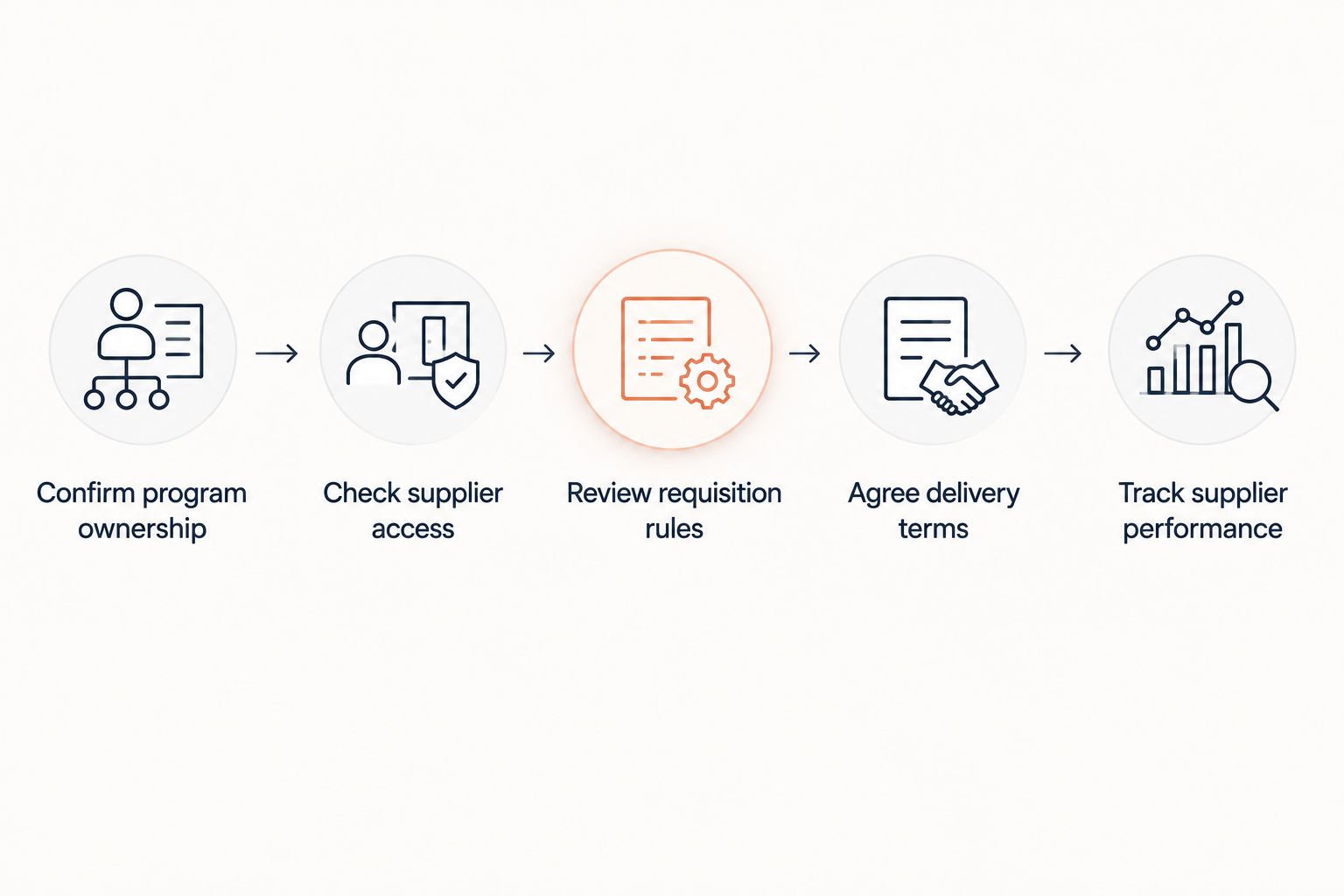
Confirm supplier access before committing recruiting effort.
A supplier agreement is not the same as an active requisition. Before assigning recruiting capacity, confirm that your agency can receive relevant roles and understand how those roles are distributed.
Why MSP staffing programs vary
The MSP label does not tell you how an account will operate. Review these factors in your 2026 account qualification:
- Program scope: Which locations, departments, worker categories, and assignment types fall under the program?
- Supplier model: Does the program use independent suppliers, affiliated staffing businesses, or both?
- Requisition access: Do approved suppliers receive the same opportunities, or does distribution follow tiers or specialties?
- Manager access: Can recruiters clarify requirements directly, or must communication go through the program team?
- Performance rules: How does the client define submission quality, responsiveness, and successful delivery?
- Commercial responsibilities: Who approves time, resolves disputes, and handles payment under your agreement?
Ask for documented answers. A familiar client name does not make an unfamiliar supplier process workable for your desk.
Should your staffing agency join an MSP program?
An MSP program fits an agency when its specialty matches the requisitions and its delivery process fits the program’s rules. It is a poor fit when supplier approval creates work without a credible route to relevant assignments.
When participation makes sense
Prioritize a program when you can explain the delivery advantage your agency brings: a defined talent specialty, relevant candidate relationships, or experience with the assignment requirements. Confirm that the program actually needs that capability.
The benefit is access to an established client process. The trade-off is accepting its submission, communication, and reporting requirements.
When direct-client development fits better
Direct-client development fits agencies that want to build their own buyer relationships and negotiate the engagement process. It still requires supplier approval and procurement checks; direct contact does not remove those obligations.
Staffingleads is best for staffing agencies that need signal-led business development, not contingent workforce administration. It tracks hiring, funding, past-client, and network signals, identifies decision-makers with verified email, and runs email and LinkedIn sequences; it is not an MSP, ATS, or CRM and has no integrations with Bullhorn, Salesforce, or HubSpot.
What should you ask before accepting requisitions?
Build a 2026 qualification checklist around decisions that change your delivery workload:
- Who can authorize your agency to submit candidates?
- Which requisitions will your agency receive?
- What establishes candidate ownership and resolves duplicate submissions?
- Who provides interview feedback and clarifies requirements?
- What must happen before a worker starts?
- How are time disputes and payment questions escalated?
Record the answer and the responsible contact. Do not treat an unanswered operating question as an agreed term.
FAQ
What does MSP stand for in staffing?
MSP stands for managed service provider in staffing. The provider manages agreed parts of a client’s contingent workforce program, including supplier coordination and program processes.
Is an MSP the same as a staffing agency?
An MSP is not the same role as a staffing agency. The MSP manages the program, while a staffing agency sources candidates and supplies talent; related businesses can perform both roles under separate responsibilities.
What is the difference between an MSP and a VMS?
An MSP is a service provider; a VMS is a vendor management system. The MSP manages program operations, while the VMS supports workflows and records.
Can a small staffing agency work with an MSP?
A small staffing agency can participate if it meets the program’s supplier requirements and the program accepts it. Confirm specialty demand and requisition access before spending time on onboarding.
Does joining an MSP guarantee job orders?
Joining an MSP supplier program does not guarantee job orders or placements. Ask how requisitions are distributed and whether your specialty has an active need.
Can recruiters contact hiring managers inside an MSP account?
Hiring-manager contact depends on the program’s communication rules. Confirm permitted contact before approaching managers about program-controlled requisitions.
What should an agency check in an MSP agreement in 2026?
An agency reviewing an MSP agreement in 2026 should check supplier access, candidate ownership, payment terms, onboarding duties, and escalation procedures. Have counsel review the agreement before accepting obligations.
One last thing
An open job tells you the client needs talent. It does not tell you the client can buy from your agency. Ask who controls supplier approval before asking for the requisition.
Related guides
Let your agent start the conversations.
StaffingLeads watches hiring, funding, past-client and network signals, finds the decision-maker behind each one, and sends personalised email and LinkedIn outreach in your voice. You pick up the replies.
Start your 14-day free trial →Keep reading
Free, no signup