What is direct sourcing?

What is direct sourcing? An employer-led talent-pool strategy. Learn how it works, where staffing agencies fit, and what to ask before pitching a buyer.

Direct sourcing is a hiring model in which an employer builds and engages its own talent pool, often under its own brand, rather than relying only on staffing suppliers to introduce candidates. In contingent staffing, a specialist partner can curate that pool while another provider handles employment administration. Direct sourcing changes where candidates come from; it does not automatically remove staffing agencies, payroll providers, or compliance responsibilities.
TL;DR
- What is direct sourcing? An employer-led talent-pool strategy, not simply another name for direct hire.
- Direct sourcing and staffing suppliers can work together; the difference is who builds and engages the candidate pool.
- StaffingLeads supports staffing business development, not candidate sourcing or talent-pool management.
What is direct sourcing?
Direct sourcing means developing an employer-connected candidate pool that can supply future hiring needs. That pool can include former applicants, former workers, referrals, and people who have expressed interest in working for the organization.
The employer does not have to run every activity internally. A partner can attract, screen, and engage candidates on its behalf. The defining feature is the employer-centered talent relationship, not the absence of outside support.
For your 2026 account planning, separate candidate attraction from program administration:
| Approach | Best for | Main strength | Main limitation |
|---|---|---|---|
| Direct sourcing | Employers building a reusable candidate pool | Creates an employer-connected source of candidates | Requires ongoing engagement and relevant hiring demand |
| Supplier-led staffing | Employers needing external recruiting capacity or specialist reach | Adds a supplier's recruiting relationships and delivery capability | Candidate access depends on supplier performance and relationships |
| Blended sourcing | Employers combining an internal pool with external coverage | Preserves supplier support where the pool has gaps | Requires clear routing and ownership rules |
A vendor management system is a separate concept. It supports staffing-program workflows rather than defining the source of candidates; see what a VMS is in staffing.
Why this matters for staffing agencies
A buyer saying it has direct sourcing is not the same as a buyer saying it has no need for agencies. Ask which roles the program covers, who curates the pool, and where external suppliers still participate.
Your opportunity depends on the gap. An employer with an established pool needs a different conversation from an employer struggling to engage candidates. In 2026 prospecting, qualify the delivery problem before pitching more resumes.
How does direct sourcing work?
A direct-sourcing workflow connects candidate interest to an actual requirement. Use this sequence to understand what a buyer has built and where your agency fits.
- Define demand. Establish the role families, locations, skills, and engagement types the pool should serve. A general database is not a substitute for a defined hiring need.
- Build the pool. Attract relevant candidates through the employer's channels, referrals, past applicants, and previous workers, with appropriate permission to retain and contact them.
- Engage candidates. Keep information current and understand candidates' interests. A stored record does not establish current interest in an assignment.
- Match requirements. Assess candidates against a live role, confirm interest, and route suitable people into the selection process.
- Assign responsibilities. Establish who handles engagement administration, onboarding, and the worker relationship before an assignment starts.
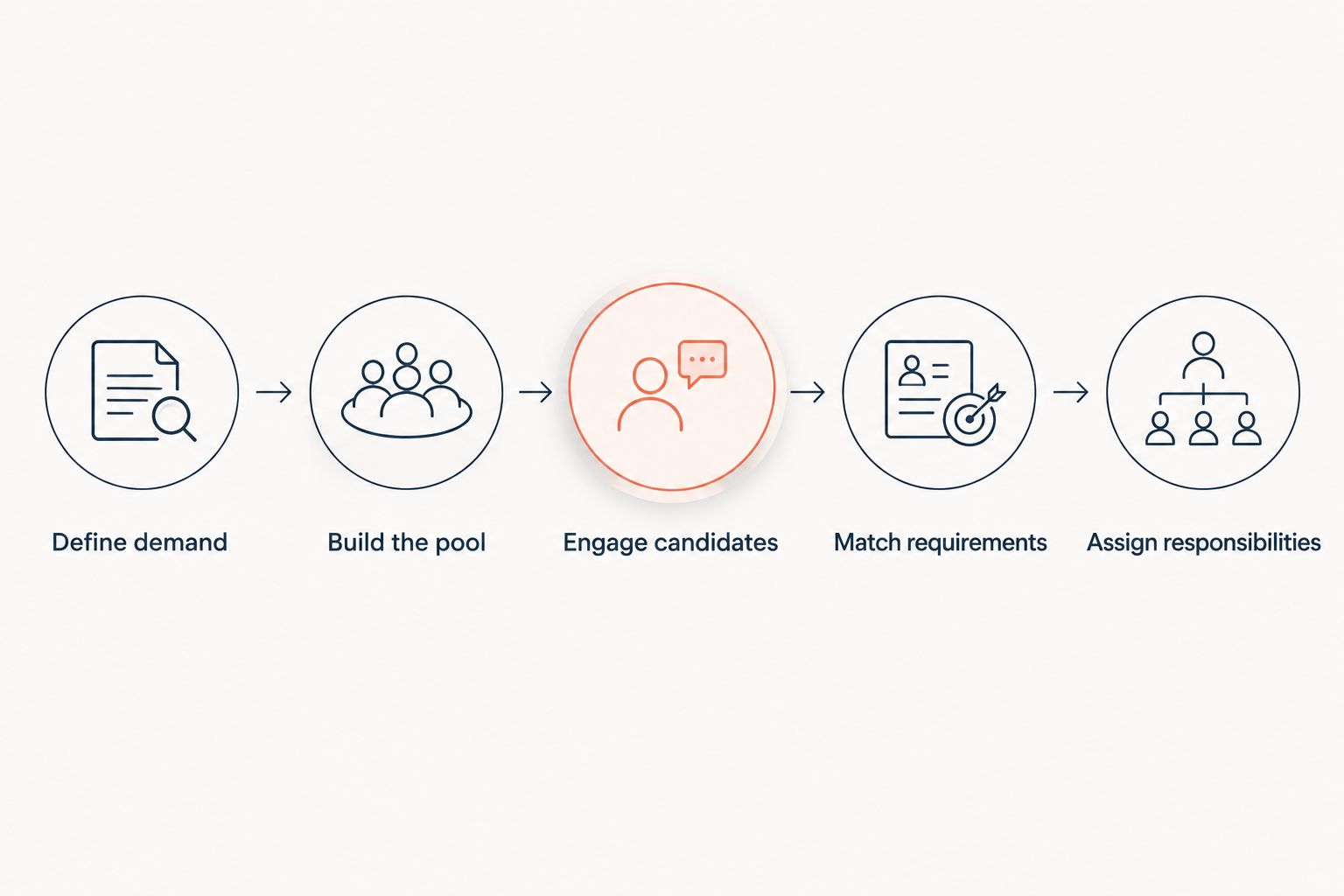
Candidate sourcing and assignment administration need explicit owners.
For a 2026 program review, ask the buyer to describe that handoff using a real requisition. Identify who sources, who selects, and who administers the engagement. Unclear ownership is a process issue, not something a larger candidate list fixes.
Employer-run direct sourcing
Best for employers with internal recruiting capacity and a clear engagement process. The employer manages candidate attraction and ongoing communication itself.
The strength is direct control over the candidate relationship. The limitation is operational responsibility: someone must maintain records, assess suitability, and keep candidates engaged between relevant opportunities. Your agency's offer should address an identified gap rather than duplicate that work.
Partner-managed direct sourcing
Best for employers that want an employer-branded pool with outside delivery support. A specialist partner can manage attraction, curation, or engagement within the agreed program.
The strength is access to external recruiting capacity without abandoning the employer-centered pool. The limitation is the need for clear responsibilities and information-sharing arrangements. Confirm the scope before assuming the partner also provides employment administration.
An MSP is another distinct role in the staffing supply chain. Read what an MSP is in staffing before treating program management and candidate sourcing as interchangeable services.
Why direct-sourcing results vary
Evaluate the operating model, not the label. These factors determine whether the pool fits the requirement:
- Demand fit: The pool must contain candidates relevant to the roles the employer actually needs.
- Candidate engagement: Historical interest does not establish present interest or suitability.
- Internal ownership: Someone must own communication, record maintenance, and requisition routing.
- Partner scope: Attraction, screening, administration, and program management are distinct responsibilities.
- Supplier coverage: External recruiters need clear instructions on where they can contribute.
For your 2026 account review, request evidence against each factor. Ask about relevant candidates, unresolved requisitions, and responsibility handoffs—not just total database size.
Is direct sourcing the same as direct hire?
Direct sourcing describes how an employer develops and reaches candidates. Direct hire describes an employment outcome: the candidate joins the employer directly. An employer can use direct sourcing for permanent hiring or contingent-workforce needs.
Does direct sourcing replace staffing agencies?
Direct sourcing does not inherently replace staffing agencies. Agencies can support pool curation, specialist searches, or requirements outside the pool's coverage. Stay in the conversation when you can name the specific delivery gap your agency addresses.
How should recruiters approach direct-sourcing accounts?
Lead with a coverage question, not a claim that the buyer needs more candidates. Ask which roles remain difficult to fill and who owns the supplier relationship.
StaffingLeads is best for staffing agencies that need signal-led business development, not candidate sourcing. StaffingLeads tracks hiring, funding, past-client, and network signals, identifies decision-makers with verified email, and runs email and LinkedIn sequences. It does not manage a direct-sourcing talent pool and is not an ATS or CRM.
FAQ
What is direct sourcing in recruitment?
Direct sourcing is an employer-centered approach to building and engaging a candidate pool for hiring needs. The employer can run it internally or use a partner to support delivery.
Is direct sourcing only for temporary workers?
No. Direct sourcing can describe employer-led candidate sourcing for permanent hiring, while contingent-workforce programs use the term for employer-connected talent pools serving assignments.
Can a staffing agency manage a direct-sourcing pool?
Yes, a staffing agency can provide pool-management services when that work falls within its agreement. Confirm whether the scope includes attraction, screening, engagement, or administration.
Is a candidate database the same as direct sourcing?
No. A database stores candidate information; direct sourcing also requires relevant demand, candidate engagement, and a process for matching people to requirements.
Does direct sourcing mean the employer handles payroll?
No. Direct sourcing identifies the candidate-sourcing model, not the payroll arrangement. Confirm separately who employs or engages the worker and handles administration.
Does StaffingLeads source candidates for employers?
No. StaffingLeads supports staffing business development by identifying prospective client decision-makers and running outreach. It is not a candidate-sourcing platform, ATS, or CRM.
One last thing
For 2026 account qualification, ask: Which requirements still go outside your direct-sourcing pool, and why? The answer gives your agency a specific delivery problem to discuss. A broad pitch about candidate access does not.
Related guides
Let your agent start the conversations.
StaffingLeads watches hiring, funding, past-client and network signals, finds the decision-maker behind each one, and sends personalised email and LinkedIn outreach in your voice. You pick up the replies.
Start your 14-day free trial →Keep reading
Free, no signup